Showing posts with label Hillsborough History. Show all posts

30 May 2021

Hillsborough Celebrates its Bicentennial, May 1971

Hillsborough, New Jersey received its royal charter on May 31, 1771. Two hundred years later, the township residents came together came together to celebrate their bicentennial.


The week-long celebration began on May 22, 1971 with the "Miss Hillsborough" Pageant and Beard Judging events at the high school.

Hillsborough Bicentennial coverage in
The Courier News


On Sunday evening May 23, residents were invited to an old fashioned church service at the historic Neshanic Dutch Reformed Church.


The activities continued on Tuesday with a Family Square Dance and Song Jamboree at the high school cafeteria. On Thursday and Friday evenings a history pageant and Girl Scout song and dance show were featured at the high school auditorium.


Hillsborough Bicentennial Coverage in
The Home News

And finally, on Saturday May 29th, the event everyone was waiting for - the parade! Touted as the biggest event ever held in Hillsborough up to that time (it wasn't, the John Basilone post-parade rally in September 1943 at Duke Farms drew 20,000) the parade went right down Route 206 from Triangle Road to Amwell Road. 


Hillsborough Bicentennial Coverage in
The Messenger Gazette

One hundred units marched, including The American Legion Color Guard, the U.S. Air Force Band, the U.S. Army Marching Unit, and the Polish Falcon Cadets, among many others. The parade featured colorful and creative floats of all kinds - The Hillsborough CYO's float featured a huge cake with 200 candles, the Somerville Borough Council had a replica of the court house, and the Hillsborugh Dukes had a float with a 12-foot-high football player named "Charlie". Besides the Polish Falcon Cadets and Air Force Band, musical entertainment was also provided by the marching bands of Montgomery, Piscataway, and of course Hillsborough.


Hillsborough Bicentennial Coverage in
The South Somerset News


The Parade was followed by a picnic at the high school (all you can eat for $2.25) and fireworks after dark. Commemorative items for sale included a decorative plate featuring historic scenes, a mug with the Bicentennial Emblem, and the Bicentennial Journal containing a concise history of Hillsborough.


23 April 2021

The Somerville Quartermaster Sub-Depot (1942 - 1947)

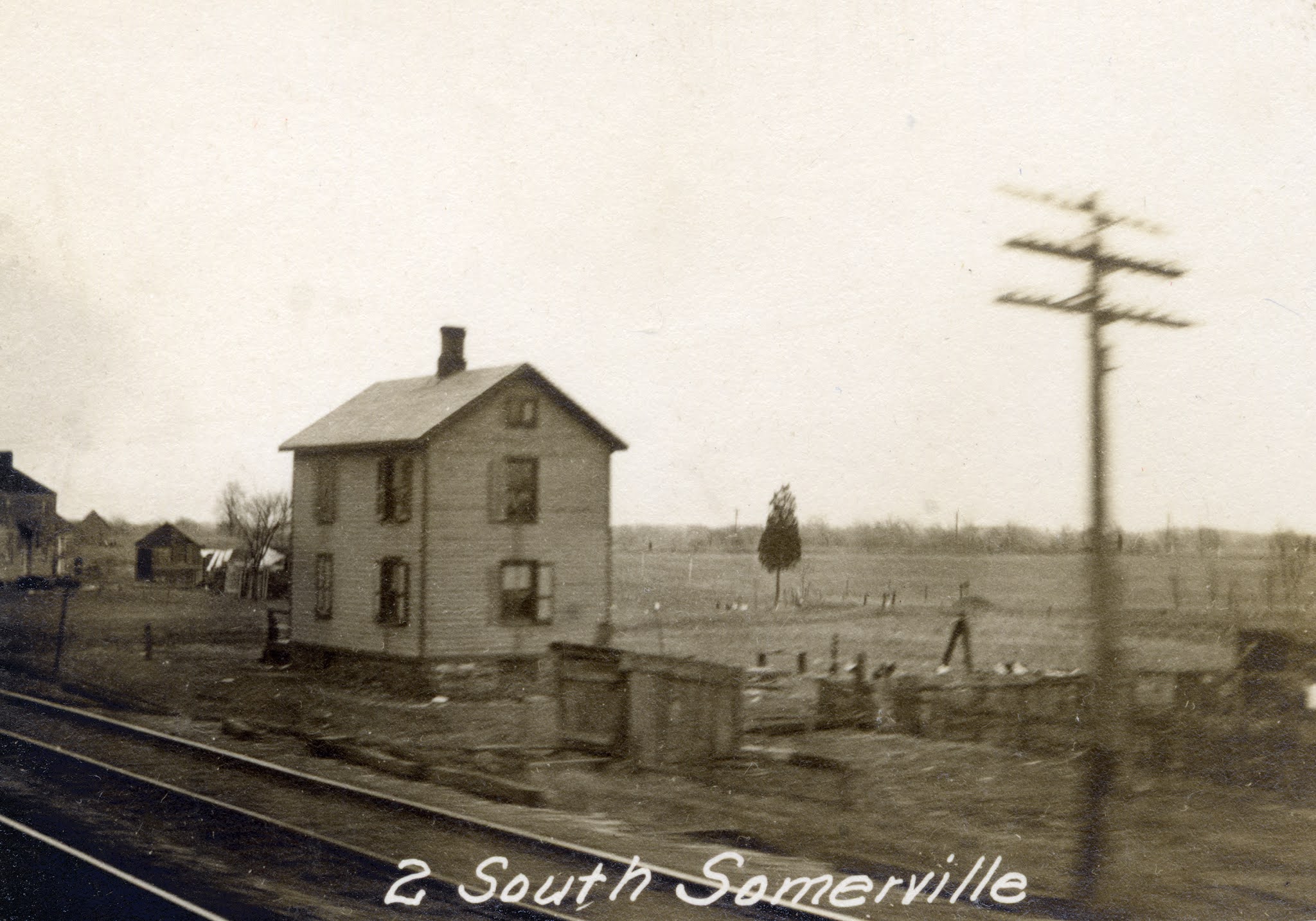
A few weeks after the Belle Mead Army Service Forces Depot opened in August 1942, the Army officially announced that a second depot in Hillsborough was "rapidly nearing completion". This facility was located in the South Somerville section of the township and was officially known as the Somerville Quartermaster Sub Depot. 


1 October 1942 Home News

The depot was not an adjunct of the Belle Mead depot but rather was connected with the Jersey City Quartermaster Depot. The depot was located west of Route 206 just south of the Doris Duke estate.


Unlike the Belle Mead Depot which dealt with heavy machinery, petroleum, cables, trucks, etc., the Somerville Depot was the transit point for other types of items needed by Army posts stateside or destined for the war in Europe. In 1943 alone, $500 million of food, canned fruit, stationery, furniture, chemicals, laundry supplies, and other miscellaneous items arrived by railcar and were sorted, stored, and eventually sent to the New Jersey ports.


Aerial view of the Somerville Quartermaster Sub-Depot circa 1953

Colonel George F. Spann - the commanding officer of the Jersey City Quartermaster Depot in 1943 - described what made the sub depot a success: "Systematic warehousing and shipping here at Somerville is possible only through the cooperation of the civilian men and women workers and the small group of officers at the station."


8 April 1943 Courier News

As the war in Europe and the Pacific raged on, able-bodied men were continually being called up for service putting a tremendous strain on the depot's workforce. Bankers, merchants, lawyers, and others not directly employed in the war effort all put in a few hours of work each evening after their day jobs. Somerville High School students - including many boys from Hillsborough - worked on weekends and school holidays with teachers as their foremen. 


30 October 1944 Courier News

The depot made the national news in October 1944 when it was discovered that area locals had been scavenging the refuse pits at the depot and had reclaimed hundreds if not thousands of tins of canned food that the army had disposed of because it was "unfit for human consumption". The scavengers proclaimed the cans of meat and vegetable hash, grapefruit juice, tomatoes, cherries, pumpkin, corned beef, and Vienna sausage to be just fine. One woman who lived near the depot said that she had four children to feed, and had been visiting the pits for four months!

In 1947, with the war over, the 325-acre depot was conveyed to the Veterans Administration. Since then, the property has been divided many times and used for many purposes: the US Postal Service, Somerset County, an industrial park, and even Hillsborough Township Parks and Recreation have each inhabited a portion of the depot.

05 April 2021

Easton and Amboy - Lehigh Valley Railroad

Our story begins in 1851 when railroad entrepreneur Asa Packer became the majority stockholder in the stalled Delaware, Lehigh, Schuylkill, and Susquehanna Railroad (DLS&S) and changed the name to Lehigh Valley Railroad. The DLS&S had been chartered in 1847 to move coal from Pennsylvania's Wyoming Valley to Easton but had done little in four years besides some route surveying and grading. Packer brought financing and a bolder plan - to reach the lucrative metropolitan market of New York.

1908 LVRR Timetable
(Collection of Gillette on Hillsborough)


In the 1860s the LVRR used the Central Railroad of New Jersey's mainline through Hunterdon and Somerset Counties to reach the New Jersey ports. In 1871 the LVRR leased the Morris Canal in the hopes that a railroad line could be built along its right-of-way but the project proved unworkable. In 1872 the company purchased the charter of the unbuilt Perth Amboy and Bound Brook Railroad and added to that a charter for a new railroad from Easton to Bound Brook. They then combined the two roads into one company called the Easton and Amboy Railroad.


1908 LVRR System Map

It took three years to build the railroad - most of that time spent on a troublesome one-mile tunnel through the Musonetcong Mountain near Pattenburg. The construction itself was a boon to businesses along the line, including in Hillsborough where Andrew Lane's general store at the end of Mill Lane in Neshanic Mills took a contract with the railroad to supply the workmen with food, clothing, and other necessities.

Clockwise from top left,
Flemington Junction, Flemington Station,
Tracks into Three Bridges, Three Bridges Depot


After the Pattenburg tunnel, there were a half dozen stations to Flemington Junction. There a transfer could be made to go south into town. Part of Walter E. Foran Boulevard is built on the right-of-way of this short branch. After crossing the South Branch of the Raritan River, the train would pull into Three Bridges.

Scenes around Neshanic Station, top to bottom:
The creamery, approaching the station from the east, and the station.


From there it was just a short hop to Neshanic Station. For decades coal remained the LVRR's chief moneymaker, but they also served other businesses along the line such as the Neshanic Station Creamery and stockyards. Later, as we will see, passenger traffic became an important source of revenue. The station building was razed by the railroad in 1944 - long after passenger service was suspended at the station.

The old (top) and new (bottom) LVRR bridges
over the South Branch at Neshanic Station.
(Photographs courtesy of Carlene Kuhl)

The original bridge over the South Branch of the Raritan River was completed in time for the Easton and Amboy Railroad to commence service on June 28, 1875. The first station in Neshanic was actually on the Hillsborough side of the river on the hill behind Andrew Lane's Mill Lane store. 


LVRR Flagtown Station
(Collection of Gillette on Hillsborough)

The Lehigh Valley Railroad used a number of different designs for their stations, The one in Flagtown included an apartment on the second floor for the station agent. Today the old LVRR through Hunterdon and Somerset County is single-tracked - but when it opened in the 1870s it was double-tracked. In 1912 the railroad added a third and fourth track to most of the route and in Flagtown, with sidings, there were actually six sets of tracks!

Scene along the LVRR in Hillsborough circa 1900
(Collection of Gillette on Hillsborough)

The railroad had a way of influencing the names of localities - and sometimes even Post Offices - along their path. In 1942, the LVRR changed the name of their freight station at Flagtown to Read Valley and lobbied the US Post Office to change the name of the Post Office - and thereby the village - to Read Valley. The Flagtown Board of Trade, led by George Farley, vigorously opposed the change.


The Royce Valley - South Somerville Station
(Collection of Gillette on Hillsborough)

Hillsborough residents usually referred to the section of the township along what is now Route 206 as South Somerville. When the railroad built their station there in the 1870s they consequently called it South Somerville. Later in the last century, they renamed it Royce Valley, as seen in the photo above.

Scene along the LVRR tracks near present-day Manville
(Collection of Gillette on Hillsborough)

Railroads of a century ago needed constant maintenance and regularly employed work crews who lived in designated "camps" along the line. One such camp in Hillsborough was near Camplain Road (originally Camp Lane - a name that derived from its purpose). Residents tolerated the camps pretty well until 1944 when overcrowding, unsanitary conditions, and general rowdiness - including criminal behavior - were brought to the attention of the township committee who began a legal battle to have the camp either cleaned up or moved.


The old (top) and new (bottom)
Hillsboro - Manville Stations
(Borrowed from ManvilleHistory.com)

Before there was a Manville, New Jersey, the station stop in that part of Hillsborough was called "Hillsboro". In 1912 - after the Johns-Manville company relocated their plant to the township, Hillsboro Station became the destination for hundreds of families from the Pennsylvania "coal country" recruited to work and live in the new town of Manville.

The LVRR Bound Brook Station

Although hauling coal from Pennsylvania to the coal docks in Perth Amboy was a lucrative business, what was really needed was a terminal closer to New York. In 1887 the LVRR began construction of a terminal in Jersey City on land acquired in the Morris Canal deal and on a classification yard at Oak Island. To reach the terminal, they built the Roselle and South Plainfield Railroad which could connect with the Central Railroad of New Jersey tracks at Roselle.

The LVRR New Market Station

Eventually, the LVRR completed its own route from Roselle to Jersey City by constructing five separate railroads. The complete line from Easton to the Jersey City waterfront was finally completed in 1895.

The John Wilkes at South Plainfield


With the line finished, the LVRR was ready to compete in the high-speed passenger business. On May 18, 1896, the Black Diamond Express passenger train left Jersey City at 12:14 pm and arrived in Buffalo, New York at 10 pm reaching speeds as high as 70mph. 


Although neither the Black Diamond Express nor the John Wilkes stopped at any of the local stations, they must have been a sight for residents! 

Few railroads survived the bankruptcies, failures, and mergers of the 1960s and 1970s. Today, Norfolk Southern operates the freight line from Easton to Manville while Conrail Shared Assets controls the Manville to Newark route.

31 March 2021

The Enduring Mystery of Millstone's Secession

The Hillsborough Township Committee meeting minutes for June 7th and 8th, 1894, barely hint at it. Local newspapers published that spring are silent. The well-researched 1976 history "Portrait of a Village" gives the topic half a paragraph then throws in the towel - for good reason. There just doesn't seem to be any good information out there - either now or then.


The reasons for Millstone, New Jersey's secession from Hillsborough Township and incorporation as an independent boro on May 18, 1894, remain a mystery. 


It is often said that Hillsborough is a township of small villages. That was never a good description - Hillsborough was a township of farms, with a few small villages at major crossroads, and is now a township of residential developments with a few shopping centers along the highway. But in acknowledgement of that first description, it is important to say that among Hillsborough's villages Millstone stands apart.


Situated on the major north-south road between Bound Brook and Princeton at the intersection of the road that leads to New Brunswick, it is no wonder that Millstone was settled early and was the seat of Somerset County government during the Revolution. 


After the Delaware and Raritan Canal opened in the 1830s, East Millstone - across the river in Franklin Township - gained in prominence while its sister village declined. 


So what happened in 1894? After years of looking into this the only clue that I have turned up - and it's merely circumstantial evidence - is that exactly two months after Millstone Boro's incorporation, the brand new Central New Jersey Traction Company announced plans to extend a trolley line south from Finderne through the sleepy boro and on to Trenton. This project - and by the way it was never built - must have been in the works for months in 1893 and 1894, with inquiries about land purchases and surveyors out on Millstone River Road.


I wrote about the trolley line here. But this certainly isn't the end of the line for this mystery. 

17 March 2021

The Delaware and Bound Brook Railroad

The Delaware and Bound Brook Railroad - later a division of the Philadelphia and Reading and known in Central New Jersey today as the West Trenton Line - is one of the most important railroads in New Jersey history. It is also important to Hillsborough history - not only because 7 of its 27 miles of track were laid in Hillsborough but because of the connection to Hillsborough of two men intimately associated with the story.


Henry Martyn Hamilton and Peter Dumont Vroom


Governor Peter Dumont Vroom was born in the village of South Branch in 1791. He attended grade school at the "Old Red Schoolhouse" (it was brand new then!) on River Road near Beekman Lane, and "high school" at the Somerville Academy. After graduating from Columbia and reading law in Somerville, he practiced in Sussex and Hunterdon Counties before moving back to Somerville in 1826 and being elected to the state legislature and then as governor in 1829.

1870s Delaware and Bound Brook Railroad ticket,
(collection of Gillette on Hillsborough)

One of Vroom's most important acts as governor was nurturing the nascent railroad and canal industries in New Jersey. He promoted granting charters to the Camden and Amboy Railroad and the Delaware and Raritan Canal, which gave those companies exclusive rights to build interstate (i.e., New York to Philadelphia) transportation lines across the state - and then he endorsed the merger of the two companies as The United Companies, thus creating a virtual railroad monopoly enshrined in state law.


1884 railroad map showing the stations of the
Delaware and Bound Brook Railroad.
Missing from the map is Weston Station
 which was just north of Hamilton.

Henry Martyn Hamilton was born in Ohio in 1831. He attended college first in Ohio, but a case of typhoid fever prevented him from graduating. After recovering, he continued at Hamilton College in New York State, where he also received his law degree. The enterprising young man then returned to the Midwest and became one of the four founders of the town of Grinnell, Iowa. It was in this enterprise that he first became involved in the railroad business, trying to lure railroads to build lines through Grinnell and other Midwest cities. He soon came to the New York area, earning a living as a financier and settling in Bloomfield.

Belle Mead Station circa 1905
(collection of Gillette on Hillsborough)

By the mid-1860s Hamilton started to think that he could build a railroad from Philadelphia to New York and, against the advice of experts, began brainstorming ways to break the United Companies monopoly. He knew that some provisions of the charter would expire in 1869, so he began purchasing "paper" railroads - lines that had been incorporated but never built - in Pennsylvania and New Jersey.


The Delaware and Bound Brook Yardleyville Centennial Bridge
1876

The United Companies lobby was enormous, as would be expected. After all, they controlled all of the traffic - passengers and freight - in the lucrative New York to Philadelphia corridor. The machinations and litigation which followed Hamilton's venture could easily fill a book. In 1867, against great odds, he got the New Jersey legislature to pass an act incorporating the Hamilton Land Improvement Company. The act allowed the company to build a railroad from the Delaware River north of Trenton to a point near the village of Millstone in Hillsborough Township. It also allowed the company to build another 6 miles of railroad anywhere in the state.


The 1929 West Trenton Station,
photographed circa 1961


That six miles would prove to be the key, and three years later, when the United Companies realized what was happening, all hell broke loose. They desperately lobbied legislators to repeal the 1867 legislation, while at the same time courting the Pennsylvania Railroad as a partner. Meanwhile, Hamilton renamed his company The National Railway and in early 1871 attempted to get a federal law passed through Congress that would officially allow a rival railroad through New Jersey. 


Pennington Station

On June 30, 1871, the Pennsylvania Railroad signed a 999-year lease with the United Companies allowing them to run trains over their tracks, but basically nothing else. This lease cost them - in the first year alone - $1,948,500 paid in dividends to United Companies stockholders! You can imagine how motivated they were now to keep any rival railroad from building.


Hopewell Station


Over the next few years, each side pulled out of every trick they could think of. Hamilton's National Railway introduced several bills in the New Jersey Legislature with hidden "Trojan Horse" provisions allowing them to proceed - all defeated. The Pennsylvania Railroad - which now controlled the "monopoly" - began building its own railroad from "north of Trenton to Millstone," which resulted in the famous Frog War covered here.


Stoutsburg, Skillman, and Harlingen Stations -
top to bottom

In the midst of all of this, Hamilton took a meeting with a "former State Governor" and a representative of the United Companies. An offer of half a million dollars upfront and a $5,000 no-show job was made to entice Hamilton to walk away, but, as he told confidantes, "I can afford to be defeated, but I can't afford to sell out my friends."

Remarkably - notwithstanding the Frog War three years later -  the rivals set aside their differences in 1873 and compromised to support a general railroad law allowing for competition.


Royal Blue Line postcard
(collection of Gillette on Hillsborough)

Hamilton began building immediately in an effort to have the railroad open in time for the Philadelphia Centennial Exposition in 1876. The line had been surveyed through Mercer and Somerset Counties to "a point near the village of Millstone". That spot was in the vicinity of today's Hamilton and North Willow Roads - which is where Hamilton moved with his family and built a station. 


Ad for the Royal Blue Line -
an upscale passenger service between New York and Washington

You may have guessed the essential "six miles anywhere in the state" was exactly what was needed to finish the route to Bound Brook. The original concept was for the National Railway to cross over the Central Railroad of New Jersey line and continue northeast and east to Jersey City, but in the end, the National Railway simply acquired trackage rights of the Central past Bound Brook.


Hamilton Station on North Willow Road
in Hillsborough

The Delaware and Bound Brook Railroad was incorporated on May 12, 1874. Hamilton gave the Pennsylvania portion of the project to the North Pennsylvania Railroad. 

Hillsborough's Weston Station circa 1905 

The New Jersey portion of the line crossed the Delaware at the Yardleyville Centennial Bridge (replaced in 1912) and had station stops at Ewing, Pennington, Moore's, Hopewell, and Stoutsburg in Mercer County. The twin stations at Pennington and Hopewell are still standing.


The Reading "Crusader" - a streamlined speedster -
near Weston Station

In Somerset County, the stations were at Skillman, Harlingen, Belle Mead (originally called Van Aken), Hamilton, Weston, and Bound Brook. The new stations built at Belle Mead in 1919 and Bound Brook in 1913 are the only ones that survive. 

The 1875 Philadelphia and Reading railroad bridge
crossing the Raritan River
(collection of Gillette on Hillsborough)

The Delaware and Bound Brook Railroad opened on May 1, 1876 - about three years after the death of Governor Vroom. In 1879 it was leased to the Philadelphia and Reading Railroad. Hamilton attempted to build a namesake city at the location of Hamilton Station in Hillsborough. He laid out streets and tried to get investment, to no avail. 


The 1913 Philadelphia and Reading Bound Brook Station

He lived out his later years rather quietly at home with his wife, Cornelia, and unmarried daughter, Mary. Hamilton died in 1907, Cornelia in 1920, and Mary in 1941. Hamilton Station was abandoned by the Philadelphia and Reading in 1956.

The Hamilton house on Willow Road


After the railroad bankruptcies and mergers of the 1960s, New Jersey Transit operated passenger trains on the line until service was ended in 1982. Today, CSX operates the 27-mile freight line as part of its Trenton Subdivision.

20 February 2021

John F. Kennedy International Village, 1965

John F. Kennedy spent about four months in New Jersey in the fall of 1935 as a freshman at Princeton. Although an illness forced the future president to leave Princeton in December, can we imagine that on at least one weekend that fall he and his buddies took a drive out to the country? Maybe even to the Sourland Mountain?


JFK as a Princeton Freshman, 1935

Thirty years later - about a year after Kennedy's assassination - the International Student Research and Development Council Inc. (ISRDC) began making plans to bring the spirit of JFK to Hillsborough. John F. Kennedy International Village would have been a massive cultural exchange center for young people from around the world covering a minimum of 45 acres on Montgomery-Zion Road. 


What the JFK Village would have looked like

The Hillsborough Township Committee was first made aware of the plan in January 1965 when 15 homeowners showed up at a committee meeting. They had become aware of the ISRDC when they were approached with offers to buy their property. The village was designed by Tectonic Associates. As reported in The Courier News, the property would include:

"an administration and information center, a chapel for all faiths, a theater and museum, three classroom buildings, a food service building, a gymnasium, an athletic field, a guest house, eight male housing units, five female housing units, five parking lots, a heliport, practice fields and a summer campground."


The initial 45-acres was gifted to the ISRDC for Christmas of 1963 by C. Benjamin Curley. Curley and his wife Alma had owned a summer home in the Sourlands since the 1930s and had even run a summer camp for black children called  Rainbow's End. You can read more about the Curley's and the camp here. Over the years the Curleys added to their property and were actively involved in attempting to acquire adjacent properties for the proposed center even after their donation.

C. Benjamin Curley as a student at Howard University in 1910


The finished $3.5 million project - essentially a conference center for young people - was expected to encompass 100 acres and also include a swimming pool, tennis courts, basketball courts, a cultural exchange center, and "50 units of small buildings that will bespeak the lands they represent in every aspect and detail." This final revelation caused planning board member James Older to wonder aloud who would issue the building permits for "thatch huts and Arab tents"?


13 October 1965 Courier News

Local residents initially had more questions than complaints - would there be enough water for the center? how would sewage be handled? would the roads need to be improved? how would this affect zoning on the mountain? These were the questions being considered by the township officials even as the Curleys' summer home was being renovated as the JFK Village information office and 5 acres in the immediate vicinity were being cleared for use as a summer camp.


Robert and Ted Kennedy in 1965


What eventually turned public opinion against the ISRDC was the fact that the Kennedy family had no knowledge at all about the village. Senator Robert F. Kennedy replied to an inquiry about the project from the Hillsborough Township attorney in October 1965:

"I don't personally have, and as far as I know, no other member of my family has any knowledge of this organization. Our approval or sanction was neither given nor ever requested."
In January of 1966, the ISRDC officially dropped the project.