Showing posts with label Sourlands. Show all posts

20 February 2021

John F. Kennedy International Village, 1965

John F. Kennedy spent about four months in New Jersey in the fall of 1935 as a freshman at Princeton. Although an illness forced the future president to leave Princeton in December, can we imagine that on at least one weekend that fall he and his buddies took a drive out to the country? Maybe even to the Sourland Mountain?


JFK as a Princeton Freshman, 1935

Thirty years later - about a year after Kennedy's assassination - the International Student Research and Development Council Inc. (ISRDC) began making plans to bring the spirit of JFK to Hillsborough. John F. Kennedy International Village would have been a massive cultural exchange center for young people from around the world covering a minimum of 45 acres on Montgomery-Zion Road. 


What the JFK Village would have looked like

The Hillsborough Township Committee was first made aware of the plan in January 1965 when 15 homeowners showed up at a committee meeting. They had become aware of the ISRDC when they were approached with offers to buy their property. The village was designed by Tectonic Associates. As reported in The Courier News, the property would include:

"an administration and information center, a chapel for all faiths, a theater and museum, three classroom buildings, a food service building, a gymnasium, an athletic field, a guest house, eight male housing units, five female housing units, five parking lots, a heliport, practice fields and a summer campground."


The initial 45-acres was gifted to the ISRDC for Christmas of 1963 by C. Benjamin Curley. Curley and his wife Alma had owned a summer home in the Sourlands since the 1930s and had even run a summer camp for black children called  Rainbow's End. You can read more about the Curley's and the camp here. Over the years the Curleys added to their property and were actively involved in attempting to acquire adjacent properties for the proposed center even after their donation.

C. Benjamin Curley as a student at Howard University in 1910


The finished $3.5 million project - essentially a conference center for young people - was expected to encompass 100 acres and also include a swimming pool, tennis courts, basketball courts, a cultural exchange center, and "50 units of small buildings that will bespeak the lands they represent in every aspect and detail." This final revelation caused planning board member James Older to wonder aloud who would issue the building permits for "thatch huts and Arab tents"?


13 October 1965 Courier News

Local residents initially had more questions than complaints - would there be enough water for the center? how would sewage be handled? would the roads need to be improved? how would this affect zoning on the mountain? These were the questions being considered by the township officials even as the Curleys' summer home was being renovated as the JFK Village information office and 5 acres in the immediate vicinity were being cleared for use as a summer camp.


Robert and Ted Kennedy in 1965


What eventually turned public opinion against the ISRDC was the fact that the Kennedy family had no knowledge at all about the village. Senator Robert F. Kennedy replied to an inquiry about the project from the Hillsborough Township attorney in October 1965:

"I don't personally have, and as far as I know, no other member of my family has any knowledge of this organization. Our approval or sanction was neither given nor ever requested."
In January of 1966, the ISRDC officially dropped the project.

04 February 2016

Silvia Dubois

When contemplating the life of Silvia Dubois - one of the most remarkable women in the history of Hillsborough Township - one needs to first dispose of the idea that she ever lived to be 125, or 120, or even 116 as claimed by her biographer Dr. C.W. Larison in 1883. The reality is that upon her death in 1888 she was perhaps 100, which is remarkable without exaggeration - and fitting for a former slave who lived such a remarkable life of freedom.

Dr. Larison published his interviews with Silvia Dubois as her "biografy" in 1883.


That we know anything at all about the life of Silvia Dubois is due to the work of Larison. He was a physician, an educator, a scientist, a local historian, and, notably, a spelling reformer. The biography he produced from the interviews he conducted with Silvia in 1883 was written in a phonetic spelling of his own creation - perhaps somewhat useful in capturing Silvia's colorful language, but maddening for the modern reader, and unwittingly destined to keep the narrative from becoming widely accessible until transcriptions were made in standard English, about 100 years after publication.

An etching made from a photograph of Silvia Dubois taken in Flemington in 1883
which became the frontispiece for her biography. P.S. She wasn't born in 1768.

Although Larison is an interesting subject - and we can learn much about him from the biography and his other works - the real interest is Silvia Dubois. She was born about 1788 in the tavern owned by Richard Compton just north of Rock Mills in Hillsborough Township, NJ. Silvia's mother, Dorcas, was a slave belonging to Compton, whose name she took and used throughout her life. Silvia's father was Cuffee Bard, a fifer during the Revolution participating in the battles at Trenton and Princeton.

Dr. C.W. Larison (1837-1910) of Ringoes, NJ


Silvia remarked that her mother was "ambitious to be free". To that end, she borrowed a considerable sum of money from prominent Hillsborough farmer Dominicus Dubois - indenturing herself and her children to him while using the cash to buy her freedom from Compton. When she found herself unable to repay Dubois, she and Silvia became his slaves. Still striving for freedom, Dorcas endeavored upon a similar transaction with one William Bard - this time sadly leaving Silvia, who was still only a toddler, behind.

Silvia Dubois would have been familiar with this stone house
constructed by Abraham Dubois in 1757 near today's Eisler Lane.


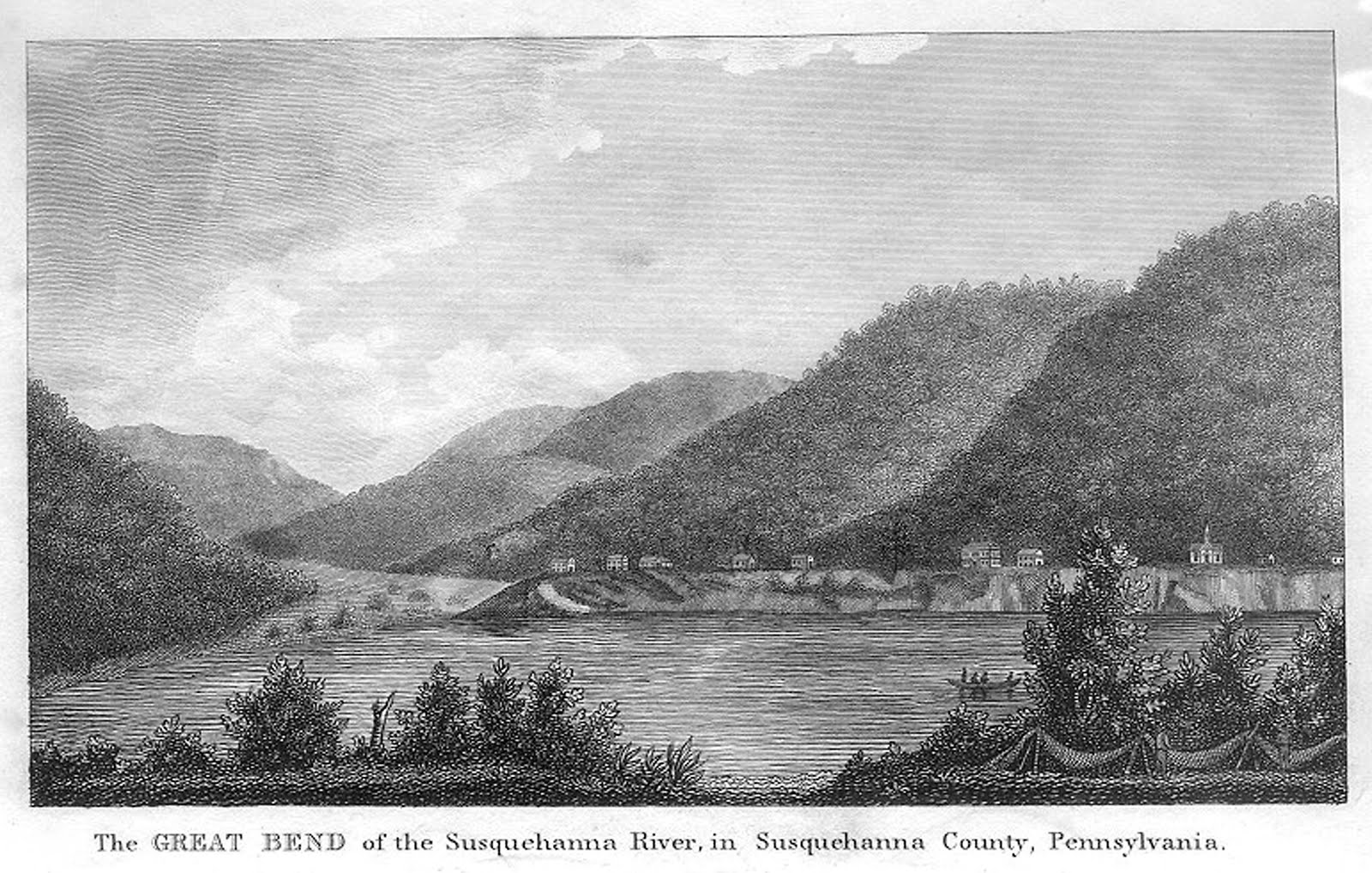
Dominicus Dubois - called Minical in Silvia's remembrances - was the youngest of three brothers who were the grandchildren of an original settler of Hillsborough, Abraham Dubois. The eldest, also named Abraham, moved to Philadelphia and became a jeweler. The second, Nicholas, remained in Hillsborough eventually inheriting his grandfather's home and estate south of Amwell Rd. near the present-day Eisler Lane. Dominicus struck out on his own, opening a tavern in the frontier wilderness of Great Bend, Pennsylvania, and hoping to make his fortune in the fledgling turnpike business.


Great Bend, PA on the Susquehanna River circa 1811

Silvia was only fourteen when she made the 152-mile trek with the Dubois family to Great Bend. She walked the entire way. Already big and strong for her age, she became bigger and stronger in Great Bend, eventually reaching five feet ten inches tall and weighing 200 pounds. Silvia was employed by Dubois in ferrying passengers across the Susquehanna  - in competition with a ferry service owned by a Captain Hatch. The way she was able to steal customers from Hatch, and her speed in rowing single passengers across in a skiff, endeared her to Dubois.

Although she got along well with Dubois during this period - stating that when she pleased him, he pleased her - relations with his wife were more than brutal. She was repeatedly beaten by her mistress, once being hit about the head so furiously with a fire shovel that Silvia was left with a three-inch depression in her skull. When she was about twenty years old, while Dubois was away serving on a grand jury in Wilkes Barre, Silvia unleashed her fury, delivering a mighty blow to Mrs. Dubois that drove her back against a door and left her unconscious on the floor.

Silvia immediately ran away across state lines to New York, but soon returned to retrieve her 18-month-old son Moses, who she had left behind. By this time, Dubois had decided to give Silvia her freedom, telling her that he would write her a pass so long as she took her child back to New Jersey and didn't return.


The cabin home of Silvia Dubois and her daughter Elizabeth Alexander
 at Cedar Summit near Rock Mills

The 152-mile journey back to Flagtown, carrying her child the entire way on foot, through wilds where there were few roads or paths to follow and where wild animals howled each night was bad enough, but one day as she came closer to civilization she heard a man call out to her, "Whose n****r are you?" A piece of paper in the pocket of a freed slave often wasn't enough in a frightening situation such as this. So Silvia set her child on the ground, adopted her best pugilistic stance, and answered, "I'm no man's n****r - I belong to God - I belong to no man."

Hoping to find her mother in Flagtown, she was disappointed to learn that Dorcas was now living in New Brunswick with yet another master, Miles Smith. Silvia lived with her mother in New Brunswick for three years finding menial or household work. In 1811 she went to Princeton and became a house servant for the Tulane family for many years.


Silvia Dubois, right, and her next-to-youngest daughter Elizabeth, circa 1883

About 1830, Silvia accepted an invitation to come back to the Sourland Mountain and help run the notorious tavern at Rock Mills owned by her maternal grandfather - a freed slave named Harry Compton who went by the name of Harry Put after his first owner General Rufus Putnam. Put's Tavern was the kind of place where people went to get a little wild. A completely unlicensed establishment, the entertainment featured boxing, gambling, cockfights - and plenty of booze. As Harry became ill, Silvia took over more and more of the responsibilities of the tavern, inheriting it upon his death. Around 1840 the tavern was burned to the ground by, in Silvia's words, "those damned Democrats" and she lost everything. She rebuilt a wigwam style hut on the land and for a couple of decades made a living raising hogs.

Sometime in the 1870s, her home was again burned down and she went to live with her daughter Elizabeth, also known as Big Lib or Lizi, the only one of her six children still living, just across the county line at Cedar Summit in East Amwell Township. Already 85 years old by this time, Silvia and Lizi lived in a log cabin with no windows, little furnishing, and an ancient wood cookstove in the corner of the room. In her later years, she would come down from the mountain just twice per year, usually visiting the village of Harlingen, to entreat on the generosity of her neighbors.

Still drinking and smoking her clay pipe well into her 90s, Silvia deigned to allow herself to be exhibited as a curiosity at the state fair at the Waverly fairgrounds in Elizabeth in 1887. Despite newspaper claims that she had perished in the great blizzard of 1888, she, in fact, survived until the spring of that year, newspapers trumpeting that at 125 years she was certainly the oldest person to have ever lived! In fact, she was 100 years old - full of freedom to the end.

09 September 2015

"Mountain Air, Mother's Care"

New Yorkers have been sending their tykes out to "the country" for decades, centuries even. Entire institutions, such as the Fresh Air Fund - which began in 1877 - have grown up around the concept that kids need to spend their summer vacation away from city life in the Adirondacks, on Long Island, or even right here in the Sourland Mountains of Somerset County, N.J.

5 August 1923 Brooklyn Daily Eagle

One such camp was opened in 1917 by Mrs. Carrie Closson and her veterinarian husband on East Mountain Road in Hillsborough. With good intentions, she placed tiny three-line ads, such as the one above, in New York newspapers, hoping to attract clients with the tagline: mountain air, mother's care. But when Henrietta Honius from the New Jersey Bureau of Child Hygiene made an inspection of the property in the summer of 1919, she found the children were barely receiving one of the two touted benefits.

9 September 1919 Trenton Evening Times


In a word, conditions at the camp were appalling. Seventeen children were living and sleeping in just a few rooms of the ten-room house - as many as eight to a room - in homemade berths or straw mattresses on the floor, with little ventilation. No indoor sanitary facilities were provided, and the house was found to be "generally unclean". Mrs. Honius reported to her boss, Dr. Julius Levy, that "Mrs. Closson is an unintelligent person, whose motive for conducting the place is entirely mercenary". The Clossons were receiving $4.50 per week per child in 1919.

The inspection came after parents complained that their children were returning to the city malnourished and with bedsores. Indeed Mrs. Honius further reported that "Mrs. Closson knows nothing about the proper diet for children and.... she should not be permitted to conduct such an establishment."

From the August 1929 Brooklyn Daily Eagle Camp directory.
The Closson Kiddie Kamp is also listed under Boys' Camps.


Ironically, it may have been this inspection that saved the camp. Upon review of the report, Dr. Levy recommended to the state that private kiddie camps should be licensed and inspected on a regular basis. One-year licenses would not be renewed if conditions were unsatisfactory.

4 May 1931 Courier News

Mrs. Closson must have taken heed. She cleaned up her act, hired an assistant, and profitably operated the Kiddie Kamp into the following decade and beyond. Hundreds of city kids enjoyed the Sourland Mountain air - and Mother Closson's care - until she succumbed to a severe case of influenza in February 1931.


06 May 2015

The Sourland Mountain Murder of Peter Nixon

According to Google Maps, it would take about four hours to walk from New Hope, Pa. to the heart of the Sourland Mountain in Hunterdon County - probably longer if you attempted the trek after dark. Neither the distance nor the rough terrain was enough to deter Benjamin Peterson, who set out from his New Hope home on the evening of May 29, 1878, armed with a musket loaded with broken nails, and a determination to kill Peter Nixon - and his own wife.


New York Evening Telegram, September 5, 1878

About seven months earlier, Peterson's nineteen-year-old daughter Lucinda went to live with Nixon as his housekeeper.  Sometime later that winter, Peterson's wife decided to make a visit to the mountain to visit her daughter - she didn't return.

As winter turned to spring, Peterson was bothered by stories of his wife's past infidelities and was justifiably suspicious of this new arrangement. Thoughts of revenge began to fill his mind. With his nerve bolstered and senses deadened by booze, the cuckolded husband wrote his intentions in a letter, slid it into a pocket, and began his journey.

He arrived at the cabin around 2 am. To Nixon's cries of "who's there?" Peterson answered, "a friend, come down and open the door and you will see".

When Nixon opened the door, Peterson pressed the gun's muzzle at Nixon's temple and pulled the trigger. According to The New York Times, the ammunition "went through the left side of Nixon's forehead and came out at the top of the head, carrying pieces of the skull and brain with it."

Wakened by the gunshot, Lucinda escaped by way of a bedroom window, while the terrified Mrs. Peterson hid under the bid. When her husband discovered her hiding place, she jumped out and attempted to run past him. Peterson, having reloaded, fired, grazing her cheek. Thinking that he had delivered a mortal wound, he pulled out a knife, declaring, "wife, let us die together", before slashing at his windpipe in an unsuccessful suicide attempt.

31 May 1878 Cincinnati Enquirer

Before Peterson's first court appearance in October, newspapers from Philadelphia to New York jumped on the sensational story, being sure to point out that both Nixon and Peterson were "negroes" or "colored", and that the Sourland Mountain region was awash in lawlessness. Here is how The New York Times began an October 14, 1878 story about the upcoming trial:

The Sowerland Mountain, a range of hills eight miles from here [Flemington], has long been a terror to the surrounding country on account of the dangerous character of the inhabitants.

Despite having found Peterson's letters detailing his murderous intentions, and the long walk from New Hope to Nixon's door, the jury concluded that there was still the possibility that this had been a crime of passion, and not a premeditated murder - narrowly sparing Peterson from the death penalty. Instead, he was convicted of manslaughter and sentenced to ten years hard labor in the state prison.

11 February 2015

Murder on the Mountain, 1925

More than a thousand mourners, and the otherwise curious, gathered April 26, 1925, at St. Bernard's Cemetery in Bridgewater for the burial of eleven-year-old stabbing victim Josephine Krysowaty. Most had just attended the funeral service at a packed St. Joseph's Church in Raritan and were waiting patiently under cool, cloudy afternoon skies.

27 April 1925 New York Daily News


Before long, the crowd parted as a dark sedan made its way to the gravesite.  Emerging from the car was the matron of the Somerset County Jail, the sheriff, and their inconsolable prisoner, Mrs. Ann Krysowaty.
###

The Krysowatys - mother, Ann, father, Theodore, their two teenage sons, William and Joseph, and little Josephine - operated a sawmill and general farm on their 60-acre property on the Sourland Mountain in Hillsborough Township.  On March 10, for reasons that are still unclear ninety years later, Mrs. Krysowaty abruptly abandoned her family - leaving the many household chores at their Zion Road home, as well as the care and feeding of the sawmill hands and farm laborers, to her young daughter.


The village of Neshanic looking north towards the Sourland Mountains,
circa 1900.

Thirty-year-old John Dorchuk was a Russian immigrant from New York who by 1925 had been working as a laborer on the Krysowaty farm for about two years.  Although he walked with a pronounced limp and was described as "demented", for most of that time he was a reliable hand. Then something changed.  By March he had begun to behave oddly, culminating in his refusal to work during inclement weather - something that could not be tolerated.  After a couple of weeks of this, Mr. Krysowaty had seen enough and ordered Dorchuk off the property.

25 June 1925 New York Daily News


At first, it was assumed that Dorchuk had either gone back to New York or had taken up residence with another family on the mountain.  But when the Krysowatys began to notice that fruit trees had been mutilated and farm equipment was vandalized, they knew the resentful Russian was still in the area, possibly seeking his revenge.

Josephine Krysowaty


By the fourth week of her mother's absence, Josephine had settled into a routine.  Up early to prepare breakfast for the family and hands, various chores around the house, then to school down in Neshanic.  After school, there were more chores, then dinner for all, and finally homework and bed. 

Newspaper headlines from April 1925
 

After school on April 9th, with her dad and most of the men out at the sawmill, her older brother William at work building a bridge down by the road, and fourteen-year-old brother Joseph busy driving a flock of ducks and geese back to their pens, Josephine went out to the barn to gather eggs. She was accosted by Dorchuk, who brandished a knife and dragged her by her hair into the woods. 


A view of the rugged Sourland Mountains circa 1905

Some newspapers later speculated that Dorchuk was enraged because the child refused his advances. In any case, defensive wounds on her arms were evidence that she put up quite a fight.  Slashes to her eyelids and about her body showed the extent to which she was tortured by the murderous fiend - but it was a stab in her side penetrating Josephine's lung that would prove to be the mortal wound.

This photo of Josephine Krysowaty in her hospital bed in Somerville
appears to show a smiling little girl. But when this photo appeared in the
New York Daily News on April 13, 1925, doctors doubted she would survive.


Joseph, returning from his chores, was the first to miss his sister.  He began a search and was alerted by her groans.  He ran to get his older brother, who gathered her up and sped to the hospital in Somerville.  On the way, a barely conscious Josephine named Dorchuk as her attacker.

12 April 1925 New York Daily News


Posses made up of Hillsborough locals and Somerset County police were already out scouring the mountain before nightfall.  They were joined after dark by 45 state troopers, who used flares to light up the rugged hillsides.  By the next day, New Jersey's top police dogs, Rollo and Bender, were on the trail, but heavy rain hampered their search by nightfall.  Three days after the attack, with hundreds of volunteers fanned out across the whole of the eastern end of the mountain, police, admitting that Dorchuk had likely escaped the area, expanded the search to New York City.

!3 April 1925 New York Daily News


Amazingly, reports began to come in from Hillsborough residents claiming that in the weeks leading up to the attack they had seen Dorchuk in New York - with Mrs. Krysowaty!  Even the Krysowatys older married daughter, Mary Wifzezuk, had to admit that her mother was the one who had initially hired Durchuk, was partial to him and took his side in any dispute.

27 April 1925 New York Daily News


Detectives finally caught up with Mrs. Krysowaty in New York on April 22nd, the day before Josephine succumbed to her wounds.  She was arrested as a material witness in the hope that she would lead them to Dorchuk. This, however, proved to be a dead end.


26 June 1925 New York Daily News


It was a circular sent out by Somerset County detective George Totten with a description of the assailant and the offer of a $500 reward that led to Dorchuk's capture. Totten knew Dorchuk's type and was confident that the killer would return to his old haunts and habits in the city. New York detectives Cronin and Cowley of the Fifth Street Station kept careful watch of the employment agencies on the lower east side for six weeks, looking for someone who matched Durchuk's description.


Newspaper headlines April - June 1925

Josephine Krysowaty's hospital bed interview with detectives was admitted into evidence at the two-day trial in December. Inexplicably, the jurors requested that mercy be shown to Dorchuk, and at that time the judge was compelled to comply with the request, sentencing the killer to life in prison instead of the electric chair.

It wasn't until Dorchuk first came up for parole in 1950 that newspapers used the word "rape" in their reporting of the case. He was released from prison in 1955 after having served thirty years but was returned the next year after having been arrested on an assault charge.

The Krysowaty home burned down in a fire in 1928.

22 February 2011

The Ballad of Hans van Pelt, Part 3

The conclusion of the Ballad of Hans van Pelt.  If any kind reader knows anything about the origins of this tale, or about its author Joseph Hunt Miller, please leave a comment.

But before a man moved, a fresh breeze in the air
Uncovered the legs that were galloping there,
When the gleaming sharp point of each curving cow horn
Seemed the point of a lance by an enemy borne.

Then arose a wild cry that rang far through the town,
That the Tories in hot wrath were fast riding down.
Such a racket, and tumult, and terrible roar
Never Middlebush heard neither since or before.

When his tired horse at last to the spur gave no heed,
And in vain strove the rider to quicken his speed,
As the day hid its face under night's sable gown,
On a slow-walk he rode into Millstone's fair town,
Where Ten Eycks, and Ten Broecks, and ten dozen or more
Of Van Dams and Van Liews, of Van Duzens, Van Dor-
Ens, Van Veghtens, Van Camps, Van Arsdales, Van Dycks,
Van Cleefs, and Van Syckles, Van Homes and Van Slykes,
Who, that evening as wont having finished their chores,
Were all gathered in groups, just in front of their doors;
The men smoking and joking; the good women knitting-
An employment they follow, whether standing or sitting.
Salutations they gave Hans, believing the stranger
One riding the land with war's tidings of danger.
Came his words to their ears, like chill winds to the flowers,
When an iceberg has stranded on tropical shores-
"The British have come!" - then, on turning his head
And beholding the moon, which now arid and red,
Hung low in the east, and shone through the dim haze-
"New Brunswick is sacked! See, the town's in a blaze,
And on their swift horses they hitherward come,
The soldiers of Howe to pillage your town."

Then the hardy Ten Broecks were all in a quiver,
Through the bold Ten Eycks swept an aching cold shiver,
And the tremor contagious spread to each man
Till aching and shaking stood every Van.

Trusty scouts were sent forward who rode all the night
Nor returned to the town till the dawn's early light,
Though far they had ridden, some to New Brunswick below,
They found in the land not a sign of the foe.
Then the Vans took to swearing and swore all the day,
If ever again Hans should ride down that way,
Though he came like a priest, in a cassock and gown,
Only his ghost should ride forth from the town.

At midnight Hans reached the high hill of Neshanic,
Where he sprang from his horse and ran in his panic
To a cave on its brow, where long hidden he lay.
What came of him then, I really can't say,
For like the old dame, who lived under the hill,
For all that I know he is living there still.


Joseph Hunt Miller

21 February 2011

The Ballad of Hans van Pelt, Part 2

Part two of Joseph Hunt Miller's ballad of Hans van Pelt.


With knees pressing the saddle, erect in his seat
Hans rode into town through long Albany Street
Where he gazed with fresh joy at the tall stately stores
All with large, painted signs overhanging their doors,
So distinctly each lettered on wood, or on tin;
Without asking he knew who were merchants within.

In the heart of the city appeared to his ken
The endless long line of fair women and men,
And though bells were not ringing he had not a doubt
That service, was over, and church was just out,
And surmised, as he gazed on the gaily dressed crowd,
That New Brunswick's fine town-folks were all over-proud
In not giving to strangers that shake of the hand
That plain folks would give in Neshanic's green land.

At a window where brokers pile high their bright gold
He was gazing, and dreaming of riches untold,
When he heard a voice cry, "The British have come!"
Then approaching him near the clear tap of the drum.
Soon quivered the air to the bugle's loud blast,
And in martial array came a squad marching fast-
Not the soldiers of Howe and in red coats of flame,
But wild urchins, who mimicked war's blustering game.
On perceiving them Hans was stricken with fear
That each boy in the ranks seemed a tall grenadier;
Each gay feather a plume arid each broomstick a gun,
With a bayonet flashing the light of the sun.

Then the whip and the spur with wild vigor applying,
Up long Albany Street he rode galloping, flying
Far away from the foeman who had taken the town.
With a hand on the pommel to hold his weight down,
He rode galloping, flying past meadow and wood,
With the wild fear of danger ever chilling his blood,
And as thus he rode on, like an aspen he shook
When he turned in his saddle behind him to look,
For a cloud of red dust that arose in his rear
Seemed a British dragoon at a charge with a spear.

As in his mad flight he was riding adown
The broad highway that leads to old Middlebush town,
Some stray cows that were grazing along the roadside
The wild horse and his rider in wonderment eyed;
And when started the leader, alarmed at the sight,
With long tails high in air, the whole herd took to flight,

And then swiftly together pell-mell they came down
Horse, rider, and cows on old Middlebush town;
While the citizens hearing the noise and the clatter
From their houses all ran to see what was the matter;
And preceding the cloud wreath they knew that there must
Be strong winds in its folds to uphold the red dust.

'Twas a whirling tornado, destructive in wrath,
Such as sweeps the green fields, as it speeds on its path,
Bare as lands in the east that the locusts encamp on,
Or the fields through which ran the red foxes of Sampson.

Continue to Part 3 here

20 February 2011

The Ballad of Hans van Pelt, Part 1

Joseph Hunt Miller is the author of this long ballad recounting the Revolutionary era story of Hillsborough's "boy who cried wolf" - Hans van Pelt,  The Sourlands rock formation Fort Hans, near the Montgomery - Hillsborough border, is named after the eager, but misguided Neshanic farmer.  Thanks to Marion Fenwick-Freeman for providing me with a photocopy of the tale - which I will post in three parts.  Enjoy!


Hans Van Pelt


Hans Van Pelt was an honest low-Dutchman;
Not low in his stature, but low by the Van
That you find in his name and which proves his descent
From the burghers of old, who, with peaceful intent,
From the Indians bought all the valleys along
The Raritan, and the Musconetcong;
A long belt of land that runs from the West,
From where Delaware joins with the laughing Pequest,
To East where Passaic, or Hackensack flows,
And Communipaw rests in its quiet repose.

In the day of our fathers, New Brunswick was known
Through all this broad belt as the chief market town,
And thither our farmers oft wended their way
With their barley and oats, and their long wains of hay;
And such stories they told by their bright Winter fires
That each lad in the land longed to see its tall spires.

So one day, as noon's shadows to rosy tints melt,
That bold son of Neshanic, young, burly, Van Pelt,
On horse ventured forth for this city so gay.
Joy gleamed from his eyes as he rode on his way;
But a sad thought at times drove its light from his face-
The thought that Lord Howe might soon capture the place;
For of all things under the sun, or the moon,
The most fearful to him was a British Dragoon.

When many a farm house and hamlet were passed;
When the shadows of day had so shortened their cast,
That the reaching foreleg of the horse in its tread
Stood over the shade of the animal's head,
From the brow of a high hill he saw at his feet
New Brunswick, above which the hazy smoke curled
From full many a forge; while beyond, with sails furled,
Rode long schooners and brigs, from the marts of the world.

There afar flowed the Raritan winding its way
Through long meadows and marshes to Amboy Bay;
And there down in the waters reflected were seen
The wild blossoms in bloom on its borders of green,
For so lovely the wild flowers were blushing in bliss
Where daily the ocean runs up for a kiss;
Where, with shoulder to shoulder, the river and sea
Push their way through the reeds, and across the green lea,
Till the wavelets, all standing tip-toe on the shores,
With their cool lips just touch the warm lips of the flowers;
Where the river and sea, in a bright silver tide,
From the blossoms that deck the smooth meadow-lands glide,
And soft sighs, and low sobs all the little waves heave,

While each tardily moves, as if loathing to leave,
Till, increasing in speed, they, in quick-pulsing swells,
Go far down to the bay, passing hills and fair dells.
For a romp on the beach with the wild sea's gay shells.
Continue to Part 2 here

15 July 2009

Drunken Brawl at Town Hall


Have you taken a walk through the municipal building on a Monday evening when court is in session? Much of the time you won't even know that anything is going on. It can be downright peaceful - serene, even.


21 December 1901 New York Tribune


Not so in Hillsborough's sometimes colorful past. Take the 1901 case of Brophy vs. Vandermark. Mr. Vandermark, who lived up on the Sourland Mountain, had a long overdue grocery bill at the store kept by Mr. Brophy. Unable to extract payment, Brophy sought to impose a levy on Vandermark's household goods - an action that Vandermark attempted to evade by claiming that everything in his home was actually owned by his wife.

12 June 1901 Hopewell Herald


Brophy engaged 33-year-old Nelson Dungan, a former Somerset County prosecutor from Rocky Hill, to represent him in a lawsuit against Vandermark. Subpoenas were sent out by both sides to thirteen "mountaineers" prepared to give testimony as to who held legal title to Vandermark's worldly goods.

On the day of the trial, Friday, December 20, 1901, Justice George Corle - himself a grocer - rode up from Neshanic Station to oversee the proceedings, and Constable Dennis Wyckoff made the long carriage ride from Bridgewater to keep the peace in the courtroom. It's a good thing he brought two associates with him.

Justice George S. Corle's own store in Neshanic Station


Hillsborough Town Hall  - likely at this time the Neshanic Hotel - was packed with hundreds of residents who apparently came out to see a good show. They got their money's worth. All thirteen of the witnesses came off the mountain dead drunk, and - according to a story which appeared the next day in the New York Daily Tribune - "proceeded to run the trial as they saw fit."

The first witness, Tom Johnson, was so drunk that he couldn't stay on his feet during the oath. When Constable Wyckoff attempted to help him up, Johnson started a fight - forcing the sixty-six-year-old Wyckoff to defend himself by striking Johnson a heavy blow to the head with the court Bible!

Nelson Y. Dungan for the defense


When Johnson was dragged from the room, a general melee ensued. Justice Corle, assisted by the three constables, was somehow able to regain control of the courtroom and determined to continue the trial, saying, "These mountaineers are as sober as they are ever likely to be".

Confused, incoherent testimony ensued, but it took the jury just ten minutes to return a verdict in favor of Mr. Brophy. The only possessions determined to be truly owned by Mrs. Vandermark were a bedroom set - and a lemon tree!

14 May 2008

Hillsborough's Cold War Casualty

With Memorial Day approaching, I wanted to reprint this story about a World War II hero that was killed right here in Hillsborough during the Cold War. The following appeared in The New York Times July 18, 1959.


MARINE ACE KILLED
IN JERSEY JET CRASH

HILLSBORO TOWNSHIP, N.J., July 17 - A Marine Corps pilot who shot down eleven enemy aircraft in World War II was killed today on a routine flight when his Navy jet crashed and burned in a cornfield near here, at the base of Sourland Mountain.

Just before the crash, farmers saw the SJ3 jet circling in what appeared to be a struggle to gain altitude. The pilot, Lieut. Col. Kenneth D. Frazier was flying out of the Naval Air Station at Willow Grove, Pa.

Three officers from Willow Grove found Colonel Frazier's wallet in the wreckage. They were unable to determine the cause of the crash.

The pilot had flown about thirty-five miles from his base, which is north of Philadelphia. He was to log flying time and return to the base.

Colonel Frazier lived at 5 Home Road in Hatboro, Pa. His wife and four daughters are vacationing in California.

The 39-year-old pilot joined the Marine Corps in 1941. He saw action over Guadalcanal, Bougainville, and Guam in the Pacific during World War II. He held the Navy Cross, two Distinguished Flying Crosses, eleven Air Medals, and a Presidential Unit Citation.

Colonel Frazier was a graduate of Temple University. He had 3,600 flying hours, 825 of them in jet aircraft.

02 April 2008

Logtown Lightning

Yesterday's warm weather and thunderstorms almost made me think that it was already summer! Before heading out to that favorite camp site, read this short story from the June 11, 1900 edition of The New York Times.


LIGHTNING STRIKES CAMPERS.

BOUND BROOK, N.J., June 10. - During the electric storm on Friday night three boys, Trombley, Franklin, and Welsh, said to be New Yorkers, who were camping at Logtown, in the Sourland Mountains, some miles from this point, were stunned by lightning striking near their camp. They are said to have suffered no ill effects.

At Wood[s] Tavern lightning struck a tree near which Dr. Partridge was seated in a carriage. The doctor felt the effects but slightly. The horse, however, was so badly hurt that it had to be killed. The Lamington Church steeple was struck for the fifth time in as many years.

02 January 2008

Old Men on the Mountain

Sourland Mountain Hermit Dies

Special to THE NEW YORK TIMES

SOMERVILLE, N.J., Jan. 1. - Louis Casaccia, 72 years old, who for the last twenty-five years has been living the life of a hermit in a small shack on Sourland Mountain, about six miles from the Lindbergh estate, was found dead from exposure today. William Ely, 71, his only known acquaintance, found Casaccia after having missed seeing him for several weeks. [The New York Times, 2 January 1934]

19 December 2007

Who Needs Enemies?

Today's Weird, Wild, and Wicked story is a quick one. So quick that I'm going to let the long forgotten anonymous New York Times staff writer tell it in his own words, which appeared in the November 12, 1896 edition of the paper.


Accidentally Shot by a Friend.

FLEMINGTON, N.J., Nov. 11. - George D, Maybuff of Little Ferry, N.J., a business man of New-York, was accidentally shot by Herman Fagan, a close friend of his, while gunning on Sourland Mountain yesterday. One grain of shot entered into his neck and two passed through his left wrist and two teeth were knocked out. The wounds bled freely, but are not dangerous. [Sure, nothing dangerous about being shot in the face, causing one to "bleed freely". He probably didn't need those teeth anyway!]

12 December 2007

"Old Bill"

"Please - let my son go with me! I'm all he has - he needs me - don't separate us!" The cries of a mother soon to be parted from her infant child? No. These were the pleas of "Old Bill" Conover asking a judge in Somerville to let him take his fourteen-year-old son to the state prison with him!

20 July 1900 Brooklyn Citizen


It is said that Mr. Conover came from a respectable family - but alcohol was his downfall. Sometime around 1890, with two young daughters, a four-year-old son, a wife, and a liquor habit to support, he took up thievery. Horses mostly, as they were easy to steal and easy to dispose of.

It was in 1890 that his wife left him, taking his two daughters, leaving him with his little son Elyah. The two grew attached to one another - it was the two of them against the world. Elyah was described as "half-witted", but whether this was truly the case is unclear - although we can be pretty certain that he did not attend school.

20 July 1900 Brooklyn Citizen


Bill and Elyah lived for many years in a cave in the Sourland Mountains. The cave was furnished like a typical home, with a bed and other odd pieces of furniture, kitchenware, and oil lamps. Most of these were acquired by begging - and stealing. The cave home was Bill's base for his raids on neighboring farms across the countryside of Somerset and Hunterdon Counties.

20 July 1900 New Brunswick Daily Times


One night in the summer of 1900, "Old Bill" went down to Hillsborough Township for a raid on the farm of Richard Carter near Frankfort. He got away with a horse and a carriage - but he was spotted.

Old Courthouse, Somerville, circa 1905


He was arrested on July 20. Elyah begged to be allowed to go with his father to the County Jail. The scene was so pitiable that it was allowed. When Bill was sentenced a week later to three years in the state prison, Elyah was ready once again to accompany his father. Instead, he was sent to an institution - and neither was ever heard from again.

14 November 2007

The Outrage at Sourland Mountain

The New York Times called it "The Outrage at Sourland Mountain". Newspapers nationwide picked up the story - writing at first with condemnation and indeed outrage towards the perpetrators, and later with astonishment that such an act could be committed - and even tolerated - in the modern age. It was January 1877.

24 January 1877, Troy, New Yor, Daily Times


Amos and Ida Sheppard lived in a small neat two-story house on Hollow Road on the Sourland Mountain - just across the border from Hillsborough in Montgomery Township. At that time, living on the mountain was a bit like living in the Wild West - hard-drinking, hard-living, hard-loving. Ida specialized in loving. It was rumored that she got a little too intimate with the husbands of her neighbors, causing her to earn a bad reputation.


A portion of the 1873 map of Hillsborough.
Blue stars indicate the homes of some of the principal figures,
and the location of the store

Fanny Conover of Montgomery-Zion Road took particular exception to Ida Sheppard's behavior. When Ida ran away for a dalliance with her son-in-law Jake Hegeman (who happened to be Ida's cousin) she said it made her "feel bad". Hegeman had money but left none for his own wife and three children which he left in the care of his mother-in-law.

28 January 1877 New York Daily Herald


Mrs. Conover spoke freely about her indignation with some of her female neighbors - all of whom agreed with her. She told her friends that she would pay handsomely if someone would tar and feather Mrs. Sheppard, or do something else to punish her. This news made its way to Jacob Sheppard, Ida's brother-in-law, who lived on Zion Road. He made a visit to Mrs. Conover the next day to find out if she was serious. She said she was - but later claimed that this was the last she heard about it until the deed was done.

The store at Rock Mills as it looked in the 1930s.


On January 10th William Docherty, 18 years old, was on his way to a fundraising party at the parsonage in Rock Mills when he stopped into the store run by James Tuttle Peak. There he found his brother Howard (16) and Richard Van Liew (27). They told a story about Fanny Conover offering half a gallon of rum to anyone who would tar and feather Mrs. Sheppard. When Jacob Sheppard showed up at the store, he agreed to go out to Mrs. Conover's house to check again that she was ready to pay for their services with rum. She was.

24 January 1877 New York Daily Herald


At this news, William Docherty went down the road to Jacob Sheppard's to fetch a couple of jugs of cider - enough to fortify the gang. When he returned to Tuttle Peak's barn, he found that they had been joined by Isaac Peak, John Corbett, Charles Hoff, and Alfred Cray - all young men in their teens and early twenties. Tuttle Peak helped them to black their faces with burnt cork, and heated the tar over his fire, before going upstairs and coming down with a load of feathers.

The men went to the Shepherd house about midnight. They called out for Amos Sheppard but he refused to come to the door. As they crashed through, The Sheppards jumped through a front window wearing only their nightclothes. Amos ran through the freezing snow and out onto Hollow Road. Ida wasn't so fortunate. She slipped on the ice and fell. Isaac Peak grabbed her. Charles Hoff ran after Mr. Sheppard, while William Docherty and Alfred Cray ran back to Peak's store.

The home of Elizabeth Van Liew, 
photographed in 2009

Amos Sheppard ran north to the crossroads and found refuge in the house of Elizabeth Van Liew - a relative of the assailant Richard Van Liew. Freezing and frightened, he took refuge in the Van Liews' setee, and was, in the words of Mrs. Van Liew, "too scared to breathe".

Isaac Peak, Howard Docherty, Richard Van Liew, and John Corbett - fortified by the cider and their own adrenaline - gathered up Ida Sheppard, tore the clothes from her body, and tarred and feathered her right there on the stoop of the Sheppards' back porch.  It was later alleged that there was a further assault on her person. Some accounts say that the quartet left her for dead in the snow and continued their drunken reverie through the night, others that they returned her to her bed. In any case, Ida was found later by her husband - unconscious, but alive.

23 January 1877 New York Herald


The seven, proud of their deed, boasted all the next day. They met up at Peak's store and indeed received their reward from Fanny Conover. Of course, Ida, being alive, was able to identify five of her attackers: Richard Van Liew, William Docherty, John Corbett, Alfred Cray, and Charles Hoff. Isaac Peak and Richard Van Liew immediately left the county, but the others were quickly rounded up and fingered Jacob Sheppard, Fanny Conover, and James Tuttle Peak as their accomplices.

The one-day trial took place in Somerville on April 26, 1877. Van Liew, the oldest and perceived as the ringleader, received an 18-month prison sentence, Cray got 15 months, Hoff, one year, and Corbett and William Docherty, each 9 months. Howard Docherty, as a minor, received three months in the county jail.

In the aftermath of the "outrage", all the community feeling was on the side of Ida Sheppard - who after being treated by Dr. Ludlow went to live three miles away with her mother - and against the "desperadoes" and their meager sentences. The Sheppards' marriage had not been a happy one, and it is unlikely that the couple ever reunited.

23 October 2007

FIRE!

As I watched the news reports today of the terrible California wildfires, I recalled reading about one of Hillsborough's worst forest fires. This is an excerpt from a New York Times report of many seasonal fires from April 1923.

Indications last night were that unless the wind shifted or heavy rain fell the disastrous forest fire which started Saturday on the west side of the Sourland Mountain....would ruin the wooded mountain side.

There are few houses on the side of Sourland Mountain at Somerville, near where the forest fire has been raging, but if not held in control the destruction of several small houses in the village of Posttown [later called Plainville, the site of the Carrier Clinic], at the foot of the mountains, including the farm of Judge Nelson Y. Dungan of the Circuit Court, Newark, was thought inevitable.

There was also danger that the flames would work there way around the mountain to the east side, in the direction of Flagtown, a small settlement with a number of houses and stores. Throughout Saturday night and all day yesterday 250 volunteers fought the flames, using tractors and teams in plowing furrows and making clearings. But in many instances the flames leaped across these spaces and with a fresh start, swept on. "Back-firing" also was resorted to, but in most cases this, too, proved ineffectual. The barn of R.C. Harr, a real estate man, was destroyed. Passengers on the Philadelphia & Reading Railroad [CSX], whose tracks are two miles from the mountain, viewed the fire from the windows of passing trains.

[The New York Times 23 April 1923]