Showing posts with label Somerset County. Show all posts

27 September 2019

William Bradley's Ardmaer Farms

In February of 1903, as tobacco tycoon James B. Duke was gearing up for the construction projects that would transform his Hillsborough, NJ estate into the wonderland known as Duke's Park, older brother Benjamin thought he might like to have his own estate on the Raritan River. He purchased two farms on the other side of the river in Bridgewater Township west of the town of Raritan totaling several hundred acres. Over the next few years, he added to his holdings by purchasing an additional eight farms further west.

13 February 1903 Home News

While the Duke brothers were accumulating real estate in New Jersey, fifty-two-year-old contractor William Bradley was digging things up in New York - literally. For years the Bradley Contracting Company held the lucrative city snow removal contract. Favored by Tammany Hall, Bradley employed an army of up to 5,000 men armed with shovels during the winter months. Undoubtedly many of those same men helped Bradley fulfill the tunnel digging contracts he was awarded during the initial construction and expansion of the subway lines in Manhattan and Brooklyn. 


26 February 1903 New York Times

Like many middle-aged millionaires of the early twentieth century (and even today) Bradley spent freely on his hobbies - the biggest being racehorses. In 1907 he also purchased a large tract - 360 acres - west of Raritan and set out to build a world-class breeding operation for trotters and pacers. When Benjamin Duke finally decided not to build on his acreage Bradley was able to acquire that also. By 1910, with the purchase of the large Long and Garretson tracts, Bradley had an estate - Ardmaer Farms - as large as J.B. Duke's Duke Farms! 


Relative Sizes of Duke and Bradley Estates.

He spent considerable sums bringing the finest studs and broodmares to the farm in those early years. Much like his neighbor across the river, Bradley was continually building - enormous barns, stables, roads, and a one-mile track. The mysterious death of two of his best horses early on did not deter Bradley - he just bought more. He even purchased an enormous Tally Ho Coach and Four to drive guests from the Raritan Station out to his farm and had one of the first privately-owned automobile fire engines in the vicinity.

A Tally Ho Coach and Four circa 1908

In 1915 European nations ravaged by war sent to the United States for horses. Hundreds of thousands of horses from America's heartland were shipped across the Atlantic to France and Italy. With its fine and commodious facilities, Ardmaer Farms became a way station for thousands of horses bound for the battlefield. They arrived by train 300, 500, even 800 at a time. Once at the farm horses were inspected for fitness and given the nourishment needed for the arduous ocean crossing.


30 March 1911 Home News

When Bradley died in 1924 it was reported that the self-made millionaire who started with a pair of horses and a wagon as a teenager in the 1870s had - through some bad business dealings and failure to collect the money owed on some large contracts  - allowed his net worth to fall to less than $500.


26 February 1930 Home News

After the sale of Ardmaer farms to settle the estate - an auction that brought in $125,000 - the Bradley property continued to operate as a farm for the rest of the decade. In 1930 new owners sold all of the livestock and equipment and within a year streets were laid out for the residential development known as Bradley Gardens.

02 July 2018

World War I Ends in Raritan, 1921

Most wars have two endings - the end of hostilities, and the signing of a treaty. Such is the case with the Great War of 1914-1918 which formally ended on July 2, 1921, in Raritan, New Jersey.


3 July 1921 New Brunswick Sunday Times
President Warren G. Harding and New Jersey Senator Joseph Frelinghuysen were golf buddies from the time when they served in the Senate together - often spending hours together on the links in Maryland. After Harding became President in 1921, it was only natural for him to spend some vacation time with Frelinghuysen at his Raritan Estate. After all, it was adjacent to the Raritan Valley Country Club.


The Frelinghuysen Mansion circa 1891 -
P.C. Richard & Son is on the site today

With the July 4th holiday falling on a Monday in 1921, the President came north to enjoy a long weekend of golf in the country. On July 2nd he received word that a messenger was on his way carrying the Knox-Porter Resolution - the document that officially ended America's role in World War I.


10 July 1921 Home News

Harding signed the resolution with little fanfare in the Frelinghuysen mansion, surrounded by family, friends, aides, and a few politicians. Afterward, reporters were eager to ask the President about the big prize-fight the previous evening with Jack Dempsey retaining his world championship. Harding seemed oblivious to the bout the whole country was talking about, asking, "Was it a good fight?"


19 July 1921 Home News
Harding golfed every day that weekend, including on July 4th. Before heading to the first tee on that day, he christened a nine-foot rowboat built by Frelinghuysen's son Joseph, Jr. It was noted that this was the first "ship" launched by the President.


8 July 1921 Morning News
After eighteen holes, the President and the Senator returned to Frelinghuysen's home, where they spent the afternoon greeting hundreds, maybe thousands, of area residents on the lawn of the estate.


8 July 1921 Home News
Frelinghuysen served in the Senate until March 1923. He contemplated running again in 1938, but decided against it and instead retired to Arizona where he died in 1948.


27 August 1957 Courier News
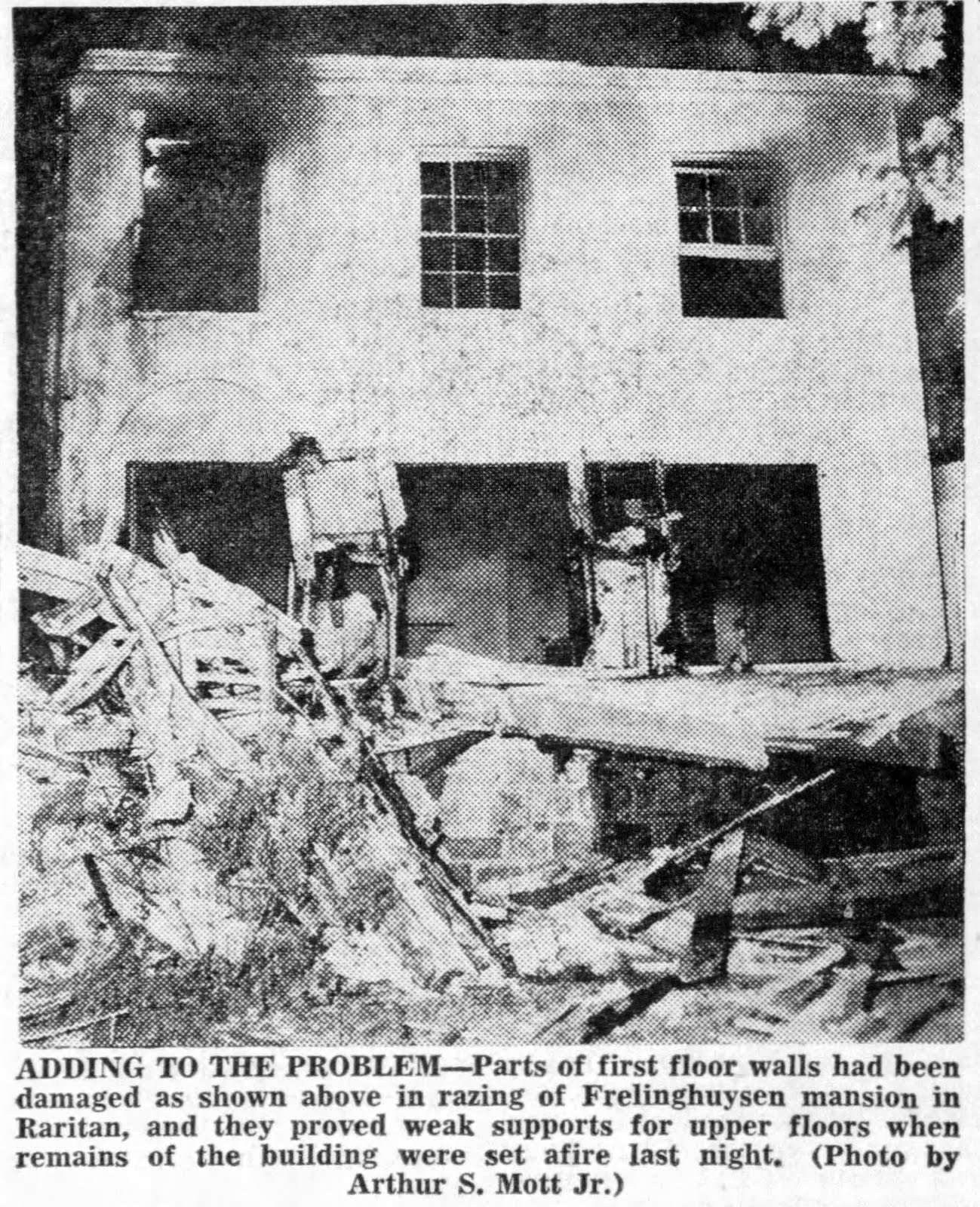
The mansion was used for a time by the State Police before being acquired by real estate developer Philip J. Levin in 1952. He planned a shopping center on the site, and eventually got around to razing the house in 1957.

The original concept for Raritan shopping center


Less than three weeks into the demolition, the house - which was built in 1874 and also visited by presidents Taft, Coolidge, and Hoover, was struck by an arsonist.

12 September 1957 Courier News
Today there is a marker near a spot that would have been the entrance to the estate. Electronics retailer P.C. Richard & Son sits at the approximate site of the mansion.


March 2014

05 November 2015

J.B. Duke Works the Polls, 1908

Imagine going to your local polling place Tuesday and being greeted by Steve Forbes, or Steve Kalafer, or one of the several hedge fund millionaires and billionaires whose homes dot the Somerset Hills. Could you have been cajoled or intimidated into supporting their chosen candidate?

James B. Duke
On November 3, 1908, James B. Duke, Hillsborough resident and millionaire president of the American Tobacco Company set out to do just that - win votes for Colonel Nelson Y. Dungan in his bid to unseat state senator Joseph S. Frelinghuysen of Raritan.

Colonel Nelson Y. Dungan

Duke, irritated that the Republican (Republican!) Frelinghuysen had called out the wealthiest Somerset County residents for not paying their fair share in taxes, enlisted the help of Alexander W. Mack, manager of the Raritan Woolen Mills, in organizing the opposition to the first term legislator. Both men directed their hundreds of employees to "vote against Frelinghuysen".
Trenton Evening Times headline, November 5, 1908


Duke personally visited several polling places in and around Raritan hoping that either the force of his personality, or his unflinching stare would win the day.

Senator Joseph S. Frelinghuysen
It wasn't enough. Frelinghuysen was swept up in a wave of Republican support, winning by 150 in Raritan and 725 across the district. He eventually became New Jersey's first directly elected US Senator in 1916 after the ratification of the 17th amendment, serving one term before returning to the insurance business and retiring to Arizona.

13 August 2010

Happy 50th "Island" Park!

Somerset County residents and VIPs who came out on a rainy Saturday morning fifty years ago today for the grand opening of Somerset's first county park may have done a double-take when they looked at their programs.  What had been often referred to as "Raritan River Park", and most recently as "Island Park" had a new name.
As recently as August 11, the Thursday weeklies were touting the upcoming dedication of "Island Park".
The News-Record even provided a map, showing the location of Island Park on Old York Rd.

But careful readers may have noticed a second news story in the same newspaper - on the same page!


The Park Commission had just selected - indeed had received permission - to use the name "Duke Island Park".  Permission was granted by Doris Duke, who had already been instrumental in getting the park up and running even before the groundbreaking back in February.

The heiress, who resided just across the river on her Hillsborough estate, had provided $30,500 to repair the Headgates Dam, and had donated 55 acres of land - plus trees, shrubbery, and maintenance equipment.
 
 
It's obvious that Doris Duke felt an attachment to the park that bore her name. Less than four years after the park was dedicated, she magnanimously gave the county a staggering $493,000 for repairs and improvements - no strings attached.

26 February 2009

It's a Mardi Gras Miracle!

Just call it "Lean Tuesday". With their announcement on February 24 that property taxes will go down, the Somerset County Freeholders have finally taken the fat out of Mardi Gras!

County Freeholders Robert Zaborowski and Peter Palmer are attempting to fulfill a campaign promise for 5-percent cuts across county departments, and this has largely been accomplished - resulting in an overall budget decrease of 2.63 percent.

So how did they do it? It took reducing appropriations for over 600 line-items, and significantly, not filling 30 vacant positions - a move that saved $1.4 million all by itself.

But essentially it took a conservative approach to fiscal planning - not expanding too rapidly when the money was rolling in so there would be no desperate contraction during a crisis. According to the Freeholders, the budget is designed to ride out a three-year economic downturn.

Budgets aside, what taxpayers in Somerset County care about is the overall tax levy. This too would decrease - by about a million dollars - resulting in a reduced tax rate, and, lower taxes!

Somerset County homeowners could see their wallets expand by about $20 next year.

I wonder how many beaded necklaces you can buy for twenty bucks!

06 August 2008

Sleep Well, Hillsborough

When people describe Hillsborough as a bedroom community, they're not kidding. According to the statistics provided in Somerset County's Hazard Mitigation Plan, Hillsborough has over 10,000 residential buildings with a replacement value of $3.7 billion. This puts us just behind Franklin Township (14,000 - $5 billion) and Bridgewater (13,500 - $4.9 billion).

This makes sense considering Hillsborough is the third most populous municipality in the county.

Where things begin to get skewed is in the value of our commercial and industrial building stock. Franklin has a combined commercial/industrial building value of $2 billion, Bridgewater, $1.5 billion, Hillsborough, $102 million. That's million, with an "m".

Our other close neighbors also have a greater commercial/industrial presence than Hillsborough. The replacement value of Branchburg's commercial and industrial buildings is $650 million, and Montgomery's is $350 million. In fact, of Somerset County's 21 municipalities, only South Bound Brook, Rocky Hill, and Far Hills have lesser building stock values than Hillsborough.

Here's a better way to see it. The first map represents commercial building stock in $million per square mile. The second map represents industrial building stock in $million square mile.


Somerset County NJ commercial building values

Somerset County NJ industrial building values

You don't need to be a geography genius to find Hillsborough on these two maps!

Three things occur to me while looking at these maps and the related data. Firstly, the lack of commercial and industrial buildings is clearly what gives Hillsborough its character. Anyone who wants to know what distinguishes Hillsborough from Bridgewater, Franklin, Montgomery, and Branchburg need only glance at these two maps.

Secondly, there is no "period of rapid development" long enough to ever allow us to catch up with these other towns.

And lastly, when the lights go out in our 30,000 bedrooms tonight, we'll sleep well.

05 August 2008

Huff and Puff, We're Ready, Kind Of

If I remember the story correctly, the Third Little Pig didn't really have a plan. He saw what happened to Pig Number One and Pig Number Two, and went with the bricks. With the Wolf on his way, there was no time for risk assessment or analysis - and certainly no time to read a 1129 page hazard mitigation plan!

Somerset County, on the other hand, can not afford to rely on intuition alone. That's why they have prepared the Somerset County Multi-Jurisdictional Multi-Hazard Mitigation Plan. The key word in this plan is "mitigation". It is understood that there is no way to prevent the various natural disasters and calamities outlined in the report - floods, high winds, snowstorms, drought, excessive heat, and forest fires - but with careful planning, we may be able to prevent or reduce some of the inevitable damage, especially damage to houses and other buildings.

Unfortunately, although the report is detailed - and at 1129 pages it ought to be - and provides a wealth of information about Hillsborough Township and the rest of Somerset County, it tends to fall short on real, practical, innovative ideas.

Most of the recommendations fall under the heading of "I could have told you that". According to the plan, we need to identify areas of the county subject to natural disaster - flooding, primarily - identify disaster relief resources, identify emergency shelters and evacuation plans, etc. In fact, all of these things ARE identified in the report.

The rest of the recommendations are of this variety - "buy up houses and buildings that are in flood-prone areas - Green Hills is specifically mentioned....eventually...some day...when you have the money." P.S. We'll never have the money.

If there is one thing the report does show, it's that we appear to be stuck in our straw and stick world, just waiting for another huff and puff!

15 March 2008

SCCSW Awards Dinner

It was my pleasure last night to attend the awards dinner honoring the Outstanding Women of Somerset County given by the Somerset County Commission on the Status of Women.

Each of these women had wonderful stories to tell about their impressive accomplishments - which were much more interesting than the very short bios printed this past week in the local papers. Some of the themes included creativity, adversity, and the tireless pursuit of justice. Truly nine remarkable stories.

This photo is not from last night's dinner, but from Tuesday night's Township Committee meeting where our two local award winners, Gloria McCauley and Patty Gillette were presented with proclamations from Hillsborough Township.


Somerset County, NJ Women of the Year 2008

04 March 2008

Whose Parkway Is It? Ours, For Now.

Forget everything I wrote last week about Duke's Parkway West. Throw it all away.

The front page story about the expansion and reconfiguration of Duke Farms visitors' programs in Sunday's Courier News has caused me to rethink Hillsborough's request to give the 1.5 mile road to Somerset County.

For me, the key elements of the expansion - which is expected to open in the spring of 2010 - are the opening of the grounds for free non-tour exploration, the creation of an orientation center at the Farm Barn south of Dukes Parkway, and the projected tripling of the annual attendance from 50,000 to 150,000 visitors.

I am not at all concerned about having 150,000 annual visitors or the associated traffic. In the heyday of Great Adventure, that would be a three-day weekend total! I am excited about allowing visitors some limited ability to roam the grounds. This hearkens back to the early part of the last century when the estate was open as a public park.

What intrigues me the most is the plan for the new orientation center. Looking closely at the map which accompanied the news story, one can clearly see that the portion of Duke's Parkway West from Route 206 to the Farm Barn has been highlighted to look like an entrance driveway. Also, what is described on the map legend as the route of a "people mover" begins near the Barn south of the Duke's Parkway, and then crosses the road and heads north to loop around the grounds of the estate.

These clues, combined with the assertion by Duke Farms representatives that they would like to privatize roads such as Duke's Parkway that bisect the property, makes me wonder if it would really be wise to turn over control of the road to the county before the entire Duke Farms Plan has been reviewed.

After all, Hillsborough has maintained that road for many years now, and it would be a shame for the county to acquire the road from us and then turn around and sell it to Duke Farms. Besides that, in any possible future negotiation with Duke Farms over their ambitious project, it would be nice for Hillsborough to have the road as a bargaining chip.

28 February 2008

Duke's Parkway West

I read with interest today about Hillsborugh Township's request for Somerset County to take over the ownership of Duke's Parkway West. The first thing that struck me is that Duke's Parkway West is only 1.5 miles long. It sure seems a lot longer. Doesn't it go all the way from Route 206 to Auten Road?


View Larger Map

Actually only the section between Route 206 and Roycefield Road is designated as Duke's Parkway. The stretch between Roycefield and the intersection of Auten and New Centre Roads is designated as New Centre Road - and New Centre Road is a county road.

It makes perfect sense for the county to own Duke's Parkway West as well - and not just because it will save Hillsborough some money in snow plowing and maintenance. It makes sense because county roads are supposed to lead to other county roads or state highways. They are designed to be through routes - not roads that morph into local streets or dead ends.

And it makes sense for another reason. Raider - Auten - New Centre - Duke's Parkway is used by residents as an alternative to Route 206. I have been in favor of dualizing the section between the Auten Road School and Route 206 (as well as some day putting an overpass at the Norfolk Southern rail crossing). It seems to me that this would have a much better chance of happening once that stretch has primarily one owner.

Think of it - our own personal 206 bypass - for a fraction of what the other one would cost!

24 January 2008

The Open Space Race?

Somerset County announced today that they have finally reached 10,000 acres of preserved open space. This is a nice achievement, one that should be commended - even if it did take almost 50 years!

On June 14, 1958, The New York Times reported that Somerset County - which had no county owned parkland - proposed the acquisition of several tracts totalling 10,500 acres. The article described this as a "long-term" goal. They weren't kidding.

Public referendums in 1989 and 1997 established, and then doubled, the Open Space Trust Fund. In 1994, the county reiterated its goal of acquiring 10,500 acres. Again, no timetable - but in 2000 the goal was increased 20,500 acres.

I don't know when we will surpass 20,000 acres, but it is comforting to know that we have nearly reached our 1958 goal. Like the proverbial tortoise, we are moving slowly and steadily toward the finish line - except that in our case, the finish line keeps receding into the distance!

16 October 2007

The Banks of the Raritan

Somerset County announced this week that they were close to finalizing a deal to buy the old Johns-Manville landfill site on the south bank of the Raritan River. The 197 acre property is partly in Hillsborough and partly in Manville. It's difficult to see what the county could use this property for - hard to understand how or why THIS open space parcel should be selected for any kind of future recreational use - but at $700,000 for nearly 200 acres, it certainly wasn't expensive, and may turn out to be a bargain.

The property was used as a landfill by Hillsborough until around 1920, when the township sold it to asbestos manufacturer Johns-Manville. The interesting thing is that not only did Johns-Manville use the site for waste disposal for many decades, but also that the company's factory buildings ended up in the landfill themselves after they were demolished in the mid 90s.

Johns-Manville moved it's factories from Brooklyn to Hillsborough in 1912. The company felt that they had found the perfect site to build a gigantic factory on the farmlands adjacent to the Raritan and Millstone Rivers. Hillsborough was happy to have the company come, looking to encourage industry and bring jobs to the community. What Hillsborough didn't count on was the corporation's complete lack of interest in providing adequate housing for its thousands of employees.

Living conditions were described as squalid - and that was probably being generous. On April 18, 1929, a referendum passed creating the Borough of Manville as its own municipality apart from Hillsborough. The company filed for bankruptcy in 1982 as it dealt with numerous class-action lawsuits stemming from health risks associated with asbestos. A trust company was eventually formed to administer and pay claims. The Manville Trust is still in existence today, long after the company's flagship factory was buried on the banks of the Raritan.

28 September 2007

That Other Depot

Somerset County announced plans recently to purchase a small part of what was once called the Somerville Army Quartermaster Depot. The Depot was built in 1942 as a supply depot and prisoner of war camp. It is located just west of Route 206, about 2.5 miles south of Somerville in Hillsborough Township. There is rail access from the Norfolk Southern Railroad, and in the 1940s there was also a connection to the Central Railroad of New Jersey. More information about the depot can be found here.

The small portion that the county is purchasing was given many years ago to the US Postal Service and was in use as one of only two major supply distribution centers in the United States. Known as the Eastern Area Supply Center, the facility did not handle mail, but rather supplies used at the more than 21,000 post offices in the eastern U.S.

In 1972, the New York Times described the supply center as a "shopping center for postmasters". The center supplied not only office items, but also furniture, money orders, and even the firearms carried by postal inspectors. Items were stored in two huge warehouses totaling 385,000 square feet.

Somerset County has not decided what the property will be specifically used for, but it is adjacent to other County owned property on Roycefield Road. One interesting aspect of the Postal Service property that was not mentioned in newspaper accounts is that the septic system used by the rest of the depot leaches into a field on the USPS property. This brings to mind a money-making possibility, as Somerset County could surely charge the depot owners for use of the leach field. Why not? I'm thinking maybe 41 cents a flush!


View Larger Map

11 July 2007

This Way to the Egress

I first met Sid Bernstein almost 25 years ago when he was a guest lecturer for a class I was taking at NYU. He was the legendary promoter and manager who brought The Beatles to America - we were a bunch of 19 year old kids who were still naive enough to thing that getting into the music business was like getting a license to print money. He soon set us straight.

To be really successful in the music business, including producing and promoting concerts, you must take risks. Sid was all about being bold, taking chances. His autobiography is filled with stories of climbing out on limbs. He was the first white promoter to promote shows at the Apollo Theater - he introduced Ray Charles and James Brown to mainstream audiences - and he famously booked The Beatles, completely unknown in America, to play a concert at Carnegie Hall - having never heard a note of their music.

The last time I saw Sid was a couple of years ago at a book signing in Freehold. He had some great stories - and was still talking about taking risks. He made and lost a lot of money in the music business over the years, and lives very modestly with his wife in a small apartment in Manhattan. You could probably say that he just about broke even - and it took him over 60 years to do it!

Which brings me to the Somerset County Parks Commission and their Commerce Bank Ballpark concerts. A recent Courier News story detailed how the Parks Commission has lost $500,000 over the last 8 years on the twelve concerts that they have put on. The interesting thing is, the Parks Commission was never trying to be bold or take chances with their concerts - they were trying to play it safe - just break even. Certainly this is our money they are spending, and we have an expectation that it won't be spent recklessly.

We don't have 60 years to break even - the public is not that patient. For that reason, I am suggesting that we get out of the concert business - it's just too tough.

The Parks Commissioners should know there are no licenses to print money - there is a law against that. And there is a law against burning money too!

So, in the words of another famous promoter, "this way to the egress".