18 November 2010

Shovel-Ready, 1897

When the members of the Bridgewater Township Committee were roused from their beds by phone calls and messengers just after midnight on October 24, 1897, they probably weren't expecting to hear that they were in the midst of an invasion by "a thousand men from Baltimore", but that was exactly what was happening.

 
25 October 1897 New York Times


The New York and Philadelphia Traction Company had been involved in a bitter three-year dispute with the Brunswick Traction Company over who had the legal right to build and operate a trolley line between Bound Brook and Somerville. Earlier that evening, a train left Baltimore for Finderne carrying enough railroad track for two and a half miles of road (enough to build from the border of Somerville to the border of Bound Brook), a trolley car, and 1,000 laborers, foremen, and engineers under the employ of the New York and Philadelphia Traction Company - with orders to build the railway, and let nothing stand in their way.

4 November 1897 Electrical Engineer trade journal


The few police officers the township committee had at their disposal were completely ineffectual, so they called on the Somerset County Sheriff - who quickly recruited 50 "special deputies". He was joined by Edward Radel, the president of the Brunswick Traction Company, who arrived a short time later with 50 men of his own, and an injunction from a Superior Court Judge.

4 November 1897 Electrical Engineer trade journal

The New York and Philadelphia men, who outnumbered the locals by ten to one, kept right on working - digging up the street, setting sleepers, laying rail, and setting poles - despite a pouring rain all day. Fueled by coffee, and the occasional "stronger stimulant", the laborers worked at an incredible pace. By the afternoon, they were already stringing the overhead electric cable.

The New York & Philadelphia and Brunswick Traction companies
merged in 1898 to provide trolley transportation between
Raritan, Bound Brook, Plainfield, and New Brunswick


President Radel made one last stand at a 1,000 ft. stretch of land bordering a farm that he owned, but his men were easily overpowered and the work went on.


The Finderne Hotel, circa 1894, erected by John C. Shaw.
His house was adjacent to the hotel.


New York lawyer John C. Shaw, a supporter of the New York and Philadelphia Company, recently had a large dynamo installed at his magnificent residence in Finderne, supposedly to supply electric light. It was from this location that power was supplied to the trolley line. By the following morning, the invading army had left for Maryland, eager to be out of the state before any legal action could take place.

Main Street (Somerset Street) Raritan, with trolley tracks,
circa 1911

The route then became the quintessential "road to nowhere" - or "traction road to nowhere". A line from the outskirts of Somerville to the outskirts of Bound Brook didn't provide any utility except to frustrate the Brunswick Traction Company and coerce the Bridgewater Township Committee to acquiesce to what was a "done deal".


Main Street Somerville circa 1910


Throughout the fall and early winter of 1897 that prospect seemed highly unlikely. At least one Bridgewater Township Committeeman was still bristling at being called a "hayseed" by an officer of the New York & Philadelphia outfit during the summer - and injunctions to halt further work were obtained and sustained into the next year.

A trolley car passes the Hotel Somerset on Main Street
in Somerville in the 1920s.

Negotiations were also going on behind the scenes between the two rival companies. The Brunswick Traction Company had already connected Bound Brook to New Brunswick by laying tracks on the east side of the Raritan River.  When the New York & Philadelphia Company dropped its plans to set their own Bound Brook to New Brunswick route west of the river, the Brunswick company dropped its opposition to their rival's Somerville to Bound Brook enterprise, and indeed floated the idea of merging to the two companies.

Main Street Bound Brook,
looking west from East Street


Things looked bright for restarting construction of the line when the weather improved in the spring - until the courts stepped. On March 30 a ruling was handed down by the Chancery Court that said that all injunctions against construction were still in place and that the matter needed to proceed through the courts to its final resolution.

On the trolley from Bound Brook to Plainfield through Middlesex,
circa 1910

With all of the interested parties now ready to drop their opposition, a petition was made to Chancellor McGill of the Chancery Court on March 31, 1898, to immediately halt the case. The petition was received favorably, and, although not official until October, The New York & Philadelphia and Brunswick Traction Companies were now one.

Pinback Button,
Collection of Gillette on Hillsborough

Eager to finally have the trolley run through Somerville, the Bridgewater Township Committee (Somerville was not an independent municipality until 1909) gave the company six months to complete the line from the eastern end to the western end of the borough, after which the failure to complete the line would mean the loss of their franchise. 

The trolley depot in Middlesex, circa 1910

At the end of the six months, there was still a considerable distance to go on the western end. There were also obstacles at the other end of the line. It wasn't until the end of September that the Somerset County Freeholders agreed to allow tracks to be laid on the Union Avenue bridge over Green Brook. As a condition, the traction companies agreed to pay half the cost of erecting a future span.

The trolley viaduct east of Bound Brook crossing over the
Jersey Central, Lehigh Valley, and Port Reading railroads 

There was one final engineering feat needed to complete the line - the large trolley bridge, or viaduct, east of Bound Brook which crossed over the Jersey Central, Lehigh Valley, and Port Reading railroads.

 
George Street New Brunswick circa 1905


The first run over the completed route was made ceremoniously on January 25, 1899. Two decorated trolley cars left New Brunswick at 9:30 am, crossed the Raritan at the Albany Street bridge, and proceeded on River Road to the Bound Brook viaduct where the cars were stopped so that a bottle of champagne could be broken. The cars were then run over the viaduct for the first time and through Bound Brook into Somerville and Raritan.

Front Street Plainfield circa 1910

From there the cars motored back through Bound Brook to Plainfield before backtracking to Dunellen for a celebratory dinner at Taylor's Hotel.

Taylor's Hotel, Dunellen, circa 1910

Today, it seems almost as remarkable that all of this construction was completed between October 1897 and January 1899 as it does that "1,000 men from Baltimore" did the two-and-a-half-mile stretch through Finderne in 24 hours. Can you imagine what this would take today?

17 November 2010

"Next stop Secaucus - Watch the closing doors"

Now that Governor Christie has sunk the ARC rail tunnel, plans are being floated by the Bloomberg administration to turn New Jersey commuters into straphangers by bringing New York's Number 7 subway line under the Hudson.

New York City's 7 train with the Newark skyline in the background

The line, which runs from Flushing, Queens to Times Square, is already undergoing an extension project which will bring the tracks right up to the Hudson River waterfront at 11th Avenue and 34th Street.

The main advantage this plan has over the ARC tunnel is the cost to New Jersey taxpayers. The overall price tag is estimated to be less than half the amount of the NJ Transit ARC tunnel, plus, other jurisdictions - New York City, Port Authority - would be expected to chip in this time.

The disadvantage is that the ARC tunnel promised a "one seat ride" into the city for many commuters, whereas the new plan would have commuters switch to the 7 train at Secaucus.

The proposal appears to be sound. In fact, it really is not very different than the PATH trains that already run under the Hudson in two separate tunnels - and require jumping on and off at Newark or Hoboken.

Hillsborough Township commuters know that potential reactivation of NJ Transit's West Trenton Line is wholly dependent on increasing Hudson River tunnel capacity. This proposal does the trick, and would potentially allow West Trenton Line trains to deliver passengers to Secaucus for transfer to the subway.

31 October 2010

Happy Halloween

Everett's Farm, October 2000

Time for pumpkins at Everett's Farm on Beekman Lane - ten years ago this month!

Pumpkins are slow growers - unlike that redhead in the middle.

Norz Hill Farm, October 2010

20 October 2010

Conveniently Located

This small ad ran week after week in the autumn of 1961.


PartridgeRunAdSept1961


Oxford Place residents take note - proximity to Route 206 is a selling point!

13 October 2010

All's Well that Ends Well - in the Well

Nothing gets your name in the paper - or your story on the 24-hour news channels - like falling down a well. From Tikki-Tikki-Tembo to the trapped Chilean miners, the price paid for your 15 minutes of fame can range from several hours to 69 days.

24 October 1932 Home News


As the miners are being rescued this morning - practically 23 years to the day after "Baby Jessica" took her tumble in Midland, Texas - we can reflect on Hillsborough's entry into well lore. Here's the New York Times headline from October of 1932.

William Richter, a 53-year-old cabinet-maker from Union City was spending the weekend at his cabin on Zion Road in Hillsborough when he decided to investigate whether or not an old well on the property could be made serviceable.


Richter enlisted the aid of local teen Benny Kukuruza to help him get a ladder down the well. Richter went first and was able to get to the bottom, but as Kukuruza started down, the walls of the well, built with rocks that had been dry-fitted without cement, began to crumble, trapping Richter.

Several of the larger stones pressed against his face and chest, immobilizing him. Fortunately, Kukuruza escaped the cave-in and was able to call for help. Neighbors soon arrived, but their first attempts at rescue only made things worse, causing more large stones to fall down on top of Richter completely burying him.

When the state police arrived, neighbors relegated their efforts to providing hot coffee for the rescuers, which also included ten members of the local rescue squad and two local doctors. After five hours of digging, rescue squad members Edward Haring and Harry Lambert were lowered into the well where they secured Richter to a rope that allowed the weekend farmer to be pulled to the surface.

Not surprisingly, it was the rescuer Haring who was taken to the hospital after the ordeal - suffering from nervous shock.

12 October 2010

Sold on Sonic?

Sold on Sonic?

Try turning the clock back to 1964 for this tasty treat.

Hillsborough Dairy Queen Ad, June 1964

I'd love to see a Dairy Queen re-open in that location.

How about you?

11 October 2010

If You Build It, They Will Camp, part 2

The mission of the Somerset County Parks Commission, going all the way back to its formation in the mid 50s, is to provide recreational opportunities for county residents. To that end, they have built facilities for tennis and golf, hiking and fishing, baseball and bocce. But one recreational pastime oft-mentioned as a projected use of Somerset County parks has been lately overlooked.


Overnight camping.
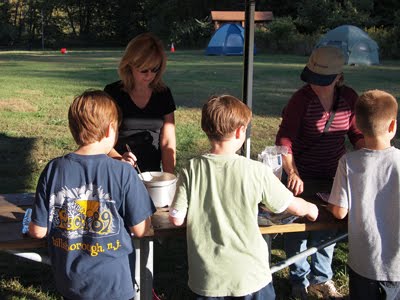
Hillsborough Cub Scout Pack 89 Fall Camping Trip, Teetertown Preserve


Yes, I know, you can get a permit for group camping for scouts at Colonial Park, but I still believe this falls short of the Parks Commission's original objectives.


In 1973, as the county was about to purchase 900 acres to add to the original 700 acres of what would eventually become the Sourland Mountain Preserve, the commission reiterated their desire to include overnight camping as a component of the park. Sadly, despite the preserve growing to 3000 acres, that has never come to pass.


Thirty years later, we are getting a second chance. With the pending cleanup of the former GSA Depot, Somerset County - which co-owns the properly with Hillsborough Township - will have an opportunity to allow camping on the edge of the Sourlands by incorporating the facilities needed into the plan for the proposed park.


What do you think?

10 October 2010

If You Build It, They Will Camp

I had the great pleasure to spend last weekend camping with the cub scouts of Hillsborough Pack 89 in the comparative wilds of northern Hunterdon County at Teetertown Preserve.

It was a super weekend with perfect clear blue skies and night time temps in the adventurous mid 40s - but there was one frustrating aspect to this trip....

...it wasn't setting up the tents...


Hillsborough Cub Scout Pack 89 Fall Camping Trip, Teetertown PreserveHillsborough Cub Scout Pack 89 Fall Camping Trip, Teetertown Preserve

...or the three mile hike...

Hillsborough Cub Scout Pack 89 Fall Camping Trip, Teetertown PreserveHillsborough Cub Scout Pack 89 Fall Camping Trip, Teetertown Preserve

...or getting the campfire going...


Hillsborough Cub Scout Pack 89 Fall Camping Trip, Teetertown Preserve

....or feeding the hungry hordes...

Hillsborough Cub Scout Pack 89 Fall Camping Trip, Teetertown Preserve

...or even losing to the ten-year-olds in the tug-of-war!

Hillsborough Cub Scout Pack 89 Fall Camping Trip, Teetertown Preserve

The most frustrating part of the entire weekend was the convoluted drive up into the Hunterdon hinterlands on the devious Cokesbury-Califon Rd. - guaranteed to fool your sense of direction, and your GPS.


If only the Somerset County Park System had a group campground somewhere nearby.....
(to be continued)

07 October 2010

"It's Somerset, N.J."

"It's Somerset, N.J."  That was the headline of the Franklin News-Record fifty years ago this week, as the paper reported the decision of the Franklin Township Council to name the township's first central post office after Somerset County.

When Hilsborough got its first central post office four decades later, there was never any doubt that the post office would be called "Hillsborough".  The Franklin Township councilmen of 1960 were faced with a much more difficult choice.  Federal regulations precluded naming the post office "Franklin" because of other communities in New Jersey already using that name - although Franklintown would have been an acceptable name, and was in the running.

Other possibilities under consideration included Somerfield, Rockingham, Middlebush, which was the name of the post office that would be closed when the new one opened, and Wilson, which was the choice of the Franklin Township Chamber of Commerce.

After several names were eliminated on successive ballots, the nine councilmen were left with a choice between Somerfield and Somerset.  The final vote was five to four.

Now, when someone tries to tell you that Somerset is a section of Franklin Township, you'll know where to send them your response!

04 October 2010

Claremont Hills, Middle Child

Here's an ad from June 1962 for the second of the three Hillsborough developments bearing some iteration of the "Claremont" name - the original Claremont Hills.

Claremont Hills ad, June 1962

Not to be confused with the mid-rise and two-story Auten Rd. condominium complex of the 1970s, or the Millstone River Rd. development from the 1950s, these houses can be found on the south side of Amwell Rd. between the high school and Pleasantview, and on the north side of Pleasantview.

By 1964 they had dropped the prices from $21,900 to $19,900 - but for a real bargain, you could have one of these exact same models in Manville for just $16,900!

See if you can spot all three models the next time you're in the passenger seat.

01 October 2010

Claremont Hills, Take Two

Did you know there are three residential developments in Hillsborough bearing the name Claremont? the first was Claremont Homes on Millstone River Rd. built in the 1950s.

This is the third - Claremont Hills, now commonly known as Claremont Towers. Here is an ad from June 1973, touting the luxury condominium's proximity to Princeton.

Claremont Hills Ad, 1973


The following ad from 1974 takes the form of a telegram to Gerald Ford, pledging their support of the President's plan to fight inflation by maintaining their 1973 prices and by offering mortgages "well below the allowable maximum"!

Claremont Hills ad, 1974


The 1975 ad gets into the spirit of "The Godfather" by making "an offer you can't refuse".


Claremont Hills ad, 1975


The second Claremont development is also called Claremont Hills, and was built in the 1960s. I'll give you a couple of days to guess where this development is. One clue - even a newcomer to Hillsborough has probably already driven past these houses hundreds of times.

22 September 2010

Own it all at Brookside Square

Welcome to Hillsborough's Brookside Square, circa 1976, where the dreams of home ownership all come true.

Brookside Square Ad, 1976


Own your townhouse. Own your lot. Own your membership in the private club. Own your full basement "suitable for dozens of uses". All for the low, low price of $37,990.

Put that in your pipe and smoke it!

18 September 2010

Check, Check, Check

I imagine one of the most frustrating aspects of working in local government is the inability to provide residents with the instant results they deserve - and that you would like to give.  Often, an elected official is given little or no grace period before he hears the cry of "broken promises!"  Go a little beyond that, and the conspiracy theorists begin their insinuations that the work was never intended to be done - or worse.

The fact is that some things take time.

Establishing railroad "quiet zones" at the Norfolk Southern crossings required much more than money.  Navigating the bureaucracy of the Federal Railway Administration took time.  And the payoff, notwithstanding a few stray horns this past week due to signalling issues, has been worth it - at least to my ears.

The concept of a new limited access highway through Hillsborough probably goes back more than 50 years to the initial construction of Interstate 95.  This "Somerset Freeway" took many forms over the decades, until finally being scuttled in the 80s.  Renewed plans for a 206 bypass have been around for more than ten years.  Interesting to realize that the first shovels went in the ground the same month that the missing link of Route 95 has at last been mapped out.

Hillsborough's "mercury problem" has also been around for decades, but it wasn't until 2001 that our township committee became aware, inadvertently, that most of the nation's stockpile was being stored in our backyard.  Hillsborough officials not only navigated the usual Washington bureaucracy, but also had to deal with the trepidations of the stockpiles new home.  The announcement by Hillsborough mayor Frank DelCore that one-fifth of the mercury was trucked to Nevada earlier this month, and the rest will be going soon, should come as no surprise to those who knew that this issue was much more than a perpetual campaign promise - it was actually a top priority.

Sometimes, those priorities take time.

03 September 2010

"...formerly known as Hillsboro"

On November 7, 2006, the village of Toms River swallowed Dover Township.  That was the day township voters approved a measure to change the name of their municipality from "The Township of Dover" to "Toms River Township".  Already generally known as Toms River by the public - and the Post Office - the change made sense.

Nearly 100 years ago, the village of Manville may have been on the verge of gobbling up Hillsborough.  Even though Manville didn't exist as an actual municipality until its separation from Hillsborough in 1929, the Boro was known as Manville right from the start.

Look at this newspaper ad from October of 1912.  This was before the Johns-Manville plant was even finished building.


At least Hillsborough, or "Hillsboro", gets top billing.
 
More telling is this newspaper story from the October 26, 1912 edition of the New Brunswick Times:

Terence P. Murphy, of this city, who is connected with the Brooks & Brooks Corporation of New York, which is developing the land at Manville, Somerset county, has arranged to take a number of people from this city to that place tomorrow, who are going there to look over lots. The car will leave this city tomorrow afternoon at 1.08 o'clock. At Bound Brook there will be a special train on the Lehigh Valley to run from that place to Manville. Tickets have been furnished to all those who are going to make the trip.  There have been factories recently erected at Manville at a cost of $8,000,000 and employing  3,500 people. Manville was formerly known as Hillsboro.
Check out the last sentence.

How do you think this played out with Hillsborough's farmers and villagers?  Was "Hillsborough" nearly wiped off the map?  Brooks & Brooks, who no doubt penned this press release-type story for the newspaper, obviously preferred their new name.  And I am sure Johns-Manville would have had no objection to the change either. 

02 September 2010

Now with....Expanso!

Here's a May 1955 ad for Hillsborough's first post-war development, Green Hills.


I'm all over the Expanso.

01 September 2010

City Sewer Coming Soon!

Here's an August 1958 advertisement for the brand new Claremont Homes development on Millstone River Road.

18 August 2010

So Good, They Banned It

Check out these two ads from 1962.  Hillsborough's Village Green was the first post-war cluster development in New Jersey.

Cluster-zoning allowed for smaller individual lot sizes than the one to three acres usually permitted, with the remaining acreage being reserved for parkland and recreation.


Cluster-type developments were so innovative - and successful - that after Village Green, Hillsborough promptly disallowed future development of this type - a ban that lasted for many years.


16 August 2010

"...sleeping late...and...good living..." at Country Club Homes

Barbecues, fishing - sounds good.  But what really intrigues me about this September 1956 sales pitch for Hillsborough's Country Club Homes is the promise of "sleeping late".  Fifty-four years later, who among us wouldn't pony up $13,990 for a couple of extra hours in the morning?  


Why were the 1956 Country Clubbers able to sleep so late?  Well, you have to read the small print for the answer.  According to the ad, our forebears only had a 3-minute ride to the train station!  And Manhattan was just 45 minutes away!

The above ad features two models - the Lanai, and the curiously named Foursome.  I'm hoping this model was supposed to have a golf connection - otherwise, I'd be inclined to wonder what the Threesome model looked like!

Need something a little smaller - or just looking to save $500?  This ad from 1957 features the charming "Nantucket Cape".


The last time I was in the Country Club Homes development, I believe I spotted a few of these "Capes" in pretty near original condition.  Not bad, not bad at all.

13 August 2010

Happy 50th "Island" Park!

Somerset County residents and VIPs who came out on a rainy Saturday morning fifty years ago today for the grand opening of Somerset's first county park may have done a double-take when they looked at their programs.  What had been often referred to as "Raritan River Park", and most recently as "Island Park" had a new name.
As recently as August 11, the Thursday weeklies were touting the upcoming dedication of "Island Park".
The News-Record even provided a map, showing the location of Island Park on Old York Rd.

But careful readers may have noticed a second news story in the same newspaper - on the same page!


The Park Commission had just selected - indeed had received permission - to use the name "Duke Island Park".  Permission was granted by Doris Duke, who had already been instrumental in getting the park up and running even before the groundbreaking back in February.

The heiress, who resided just across the river on her Hillsborough estate, had provided $30,500 to repair the Headgates Dam, and had donated 55 acres of land - plus trees, shrubbery, and maintenance equipment.
 
 
It's obvious that Doris Duke felt an attachment to the park that bore her name. Less than four years after the park was dedicated, she magnanimously gave the county a staggering $493,000 for repairs and improvements - no strings attached.

12 August 2010

Scenes from the Hillsborough Family Campout

Hillsborough Township Parks and Rec held their annual Family Campout August 6th and 7th at Ann van Middlesworth Park.

I brought my camera.


11 August 2010

Hibernia Mine Railroad Bridge

On my way with the kids to Duke Island Park a couple of weeks ago, I pulled off Old York Road to take a few photos of the Hibernia Mine Railroad Bridge.


Constructed in 1879 for the Hibernia Mine Railroad, and used as a railroad bridge for fifteen years, the structure has now been incorporated as part of Somerset County's Raritan River Greenway and is in use as a pedestrian bridge over the Raritan Water Power Canal.


The bridge also received a restoration award earlier this year [2010] from the Somerset County Cultural and Heritage Commission.


The span also has a connection to Hillsborough Township history.  In 1894, The Central Railroad of New Jersey bought the bridge and moved it from Morris County to Hillsborough - but not for use by their trains.  The bridge was used to carry carriages - and eventually horseless carriages - on Mill Lane over the tracks of the CNJ's South Branch Railroad as part of a grade-separation project.


Below is a photo taken by rail enthusiast Michael Kull in the early 1980s showing the bridge in its second location at the end of Mill Lane in Hillsborough.