02 July 2018

World War I Ends in Raritan, 1921

Most wars have two endings - the end of hostilities, and the signing of a treaty. Such is the case with the Great War of 1914-1918 which formally ended on July 2, 1921, in Raritan, New Jersey.


3 July 1921 New Brunswick Sunday Times
President Warren G. Harding and New Jersey Senator Joseph Frelinghuysen were golf buddies from the time when they served in the Senate together - often spending hours together on the links in Maryland. After Harding became President in 1921, it was only natural for him to spend some vacation time with Frelinghuysen at his Raritan Estate. After all, it was adjacent to the Raritan Valley Country Club.


The Frelinghuysen Mansion circa 1891 -
P.C. Richard & Son is on the site today

With the July 4th holiday falling on a Monday in 1921, the President came north to enjoy a long weekend of golf in the country. On July 2nd he received word that a messenger was on his way carrying the Knox-Porter Resolution - the document that officially ended America's role in World War I.


10 July 1921 Home News

Harding signed the resolution with little fanfare in the Frelinghuysen mansion, surrounded by family, friends, aides, and a few politicians. Afterward, reporters were eager to ask the President about the big prize-fight the previous evening with Jack Dempsey retaining his world championship. Harding seemed oblivious to the bout the whole country was talking about, asking, "Was it a good fight?"


19 July 1921 Home News
Harding golfed every day that weekend, including on July 4th. Before heading to the first tee on that day, he christened a nine-foot rowboat built by Frelinghuysen's son Joseph, Jr. It was noted that this was the first "ship" launched by the President.


8 July 1921 Morning News
After eighteen holes, the President and the Senator returned to Frelinghuysen's home, where they spent the afternoon greeting hundreds, maybe thousands, of area residents on the lawn of the estate.


8 July 1921 Home News
Frelinghuysen served in the Senate until March 1923. He contemplated running again in 1938, but decided against it and instead retired to Arizona where he died in 1948.


27 August 1957 Courier News
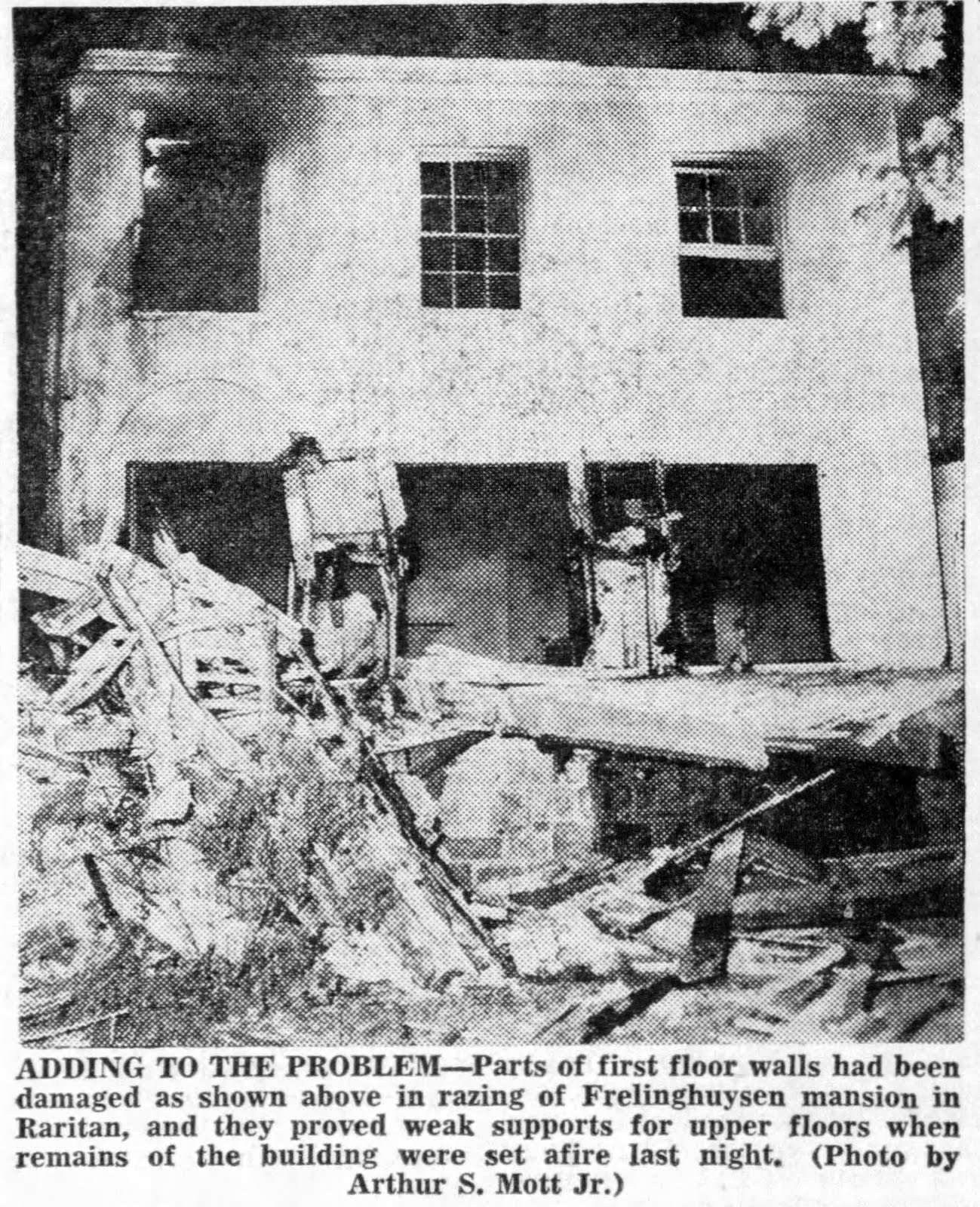
The mansion was used for a time by the State Police before being acquired by real estate developer Philip J. Levin in 1952. He planned a shopping center on the site, and eventually got around to razing the house in 1957.

The original concept for Raritan shopping center


Less than three weeks into the demolition, the house - which was built in 1874 and also visited by presidents Taft, Coolidge, and Hoover, was struck by an arsonist.

12 September 1957 Courier News
Today there is a marker near a spot that would have been the entrance to the estate. Electronics retailer P.C. Richard & Son sits at the approximate site of the mansion.


March 2014

30 June 2018

Mermaid Pool Picnic Area, Then and Now

Many of the century-old architectural landscape features at Duke Farms in Hillsborough, New Jersey, are made of cast concrete, also known as cast stone.

Picnic Area at Duke's Park, postcard circa 1907


A good example of this is the terrace along West Way near the Mermaid Pool, which also happens to feature in an for Medusa White Cement - a material applied to the concrete which is supposed to keep it "permanently white, stainless and waterproof."


Medusa White-Cement ad, 1917
Take a walk along West Way, over the bridges, and to the Old Foundation and see for yourself how Medusa has held up over the years. Do you think it's time for a new coat?


Mermaid Pool Picnic Area at Duke Farms, 2016


23 June 2018

Lovers Lane West End, Then and Now

Today, Duke Farms calls the road that runs east-west across the northern end of the "historic core" of James B. Duke's Hillsborough, NJ estate Overlook Way. At the time the postcard image below was captured in 1907 - half a decade into Duke's transformation of his gentleman's farm into a world-class semi-public park - it was called Lover's Lane.


Lovers Lane at Duke's Park, postcard circa 1907
But the road predates Duke's 1893 purchase of the property by centuries. It is simply a continuation of the River Road from South Branch to Somerville. In the center of the intersection with the road that leads across the Nevius Street Bridge into Raritan Duke installed a massive imported marble fountain with bronze figures. In those early days, there were no gates at any of the entrances, including of course at this public road which led straight past Duke's house to Frazee's Hill then South Bridge Street.

Postcard circa 1906
After Duke's 1925 death, his widow, Nanaline, and daughter, Doris, sought to have the road closed. Hillsborough Township was willing, but virulent opposition from Raritan, Somerville, Manville, and Bridgewater nixed the plan. Finally in 1931, with Duke Farms assurance that Roycefield Road to Woodville Road (Duke's Parkway West) would remain open, the road was closed.


Overlook Way, Duke Farms, 2016


16 June 2018

Wood Duck Lake and Falls, Then and Now

Also known as Willy Jones Lake, Wood Duck Lake is easily the most obscure large body of water at Duke Farms. Despite being approximately the same size as Heron Lake and Turtle Lake, its location on the far side of Duke's "mountain" definitely puts it off the beaten path.


Willy Jones Lake and Falls, 1920s postcard

I've hiked out that way numerous times, and have never had any company except for red-winged blackbirds!


The main feature of the lake is a waterfall that occasionally spills down from the western end of Great Falls Lake. I have only observed the waterfall in action a couple of times over the past six years. It's best to go after a few days of heavy rain.


Wood Duck Lake and Falls, 2015


09 June 2018

Farm Barn, Then and Now

When James B. Duke purchased the first properties of what would become his country estate along the Raritan River in Hillsborough in 1893, he immediately decided that creating a world-class stud farm would be the proper pursuit for a millionaire bachelor tobacco magnate.


Stables at Duke's Park, postcard circa 1913

To that end, he hired a trainer, built the stables that we know of today as the Coach Barn, built another set of stables - now lost-, and began assembling a collection of champion stallions. 

1894 Duke's Farm trade journal advertisement

As the property grew through the acquisition of neighboring farms, Duke ordered the construction of a massive stable on the south side of Duke's Parkway (in those days called Woodville Road). The 22,000 square foot stone and timber building was completed in 1906. If you take a walk behind the building today, you can picture trotters and pacers being exercised on the intersecting looping paths through the meadow.


The Sower at Duke's Park, postcard circa 1905

Waiting for the completion of the stables was an impressive bronze statue purchased by Duke while on a tour through Europe. "The Sower", or more fully, "The Sower From the Time of the Great Elector", was created by German sculptor Stephan Anton Friedrich Walter and depicts a peasant of the 1600s sowing his fields. Look closely at the postcard at the top of this post and you can see The Sower at the entrance to the barn. In 1914 Duke gifted the statue to Trinity College - now Duke University - where it remains today.


The Farm Barn in the 1980s - photo by Arthur Brecknell

Duke was also breeding cattle during this period - his most famous prized Guernsey bull was Lord Stranford - which in the decades after James Duke's death in 1925 led to the conversion of the stables for a full-scale dairy operation.

The Farm Barn in the 1980s - photo by Arthur Brecknell


The Farm Barn underwent a Platinum Leed Certified renovation for its adaptive reuse as the orientation center for the Duke Farms opening in 2012.


The Farm Barn at Duke Farms, 2017


22 May 2018

19th Century MeetUp at Belle Mead Part 2

 In 2014, partly as an excuse to post some photos of the old Belle Mead and Flagtown train stations, I described a July 5, 1894 letter from New York patent attorney Edmond Brown to his wife who was staying with her parents in Plainville - today the site of the Carrier Clinic's East Mountain Hospital. The letter was full of details about trying to arrange a brief Rendez-Vous as Mr. Brown's train passed Belle Mead on his way back to New York City from a Philadelphia business trip the next day. You can read the post here. 


Three years later while browsing eBay I miraculously happened upon another letter between the couple - this time from wife to husband - dated October 23, 1894. You may recall from the earlier post that through the use of census records we were able to discover the reason that Mrs. Brown was "feeling poorly." Now, three-and-a-half months later, she knows what we knew - that back in July Mrs. Brown was in the first month or so of pregnancy. 


1896 Central Railroad of New Jersey Timetable

An excursion by train from New York City to Belle Mead/Plainville in 1894 would necessarily begin by consulting a timetable such as the one above. Then it was off to the foot of Liberty Street and the Central Railroad of New Jersey's ferry terminal for the trip across the Hudson.


CNJ Liberty Street Ferry Terminal circa 1938
Mrs. Brown will pick it up from here: 
Oct 23/94
On the train.
My dearest - I have been having a pleasant ride; it was beautiful crossing the river. I stood outside and enjoyed it. I was thinking of you all the way over, and how it would have been if you were there too.


Central Railroad of New Jersey Ferry Terminal, Jersey City
I am just at Cranford & Westfield now and the trees look so pretty. They always seemed to me prettier down here than at Belle Mead.


Cranford Station circa 1908
And it is such a nice day. I wonder if I can't send some of the pleasure to you. I shall try. And I shall think of you every night. Perhaps it will be only two nights after all.


The view from Westfield Station circa 1908
There are two such nice boys across the aisle from me. I don't think I should be broken hearted if E. is a boy. They are eating a lot of candy. We have reached Bound Brook, so will soon be at B.M. I won't mail this until I am met. I do hope my boy will keep happy. Try to believe that your wife is near you, and she is going to try to keep near you and to be happy, and see if she can send some of it to her boy. She loves him very much, dear, and he is such a good, dear husband, and she appreciates it. She loves him.

Central Railroad of New Jersey Bound Brook Station circa 1908
I have brought out a couple of the little dresses to sew - though I may not do much on them. I am afraid I must stop now. With a heart full of love,
Your wife.

Belle Mead Station

I do hope you will be able to come out.


13 May 2018

Mary, Mother of God Church, Flagtown

Martin and Susanna Bergen came to America fleeing the Great Irish Famine around 1850. He was twenty-two, she was eighteen. Whether they met and married here or in their home country is unknown. They settled in Newark on a farm on Bloomfield Avenue and had their first child, Nora, in 1857.


The Hoagland-Wyckoff-Bergen-McHugh House photographed in 2009

In the Irish-Catholic tradition, more children followed - including daughters Sarah and Mary. They lived for decades in Newark then moved to Hillsborough Township before 1900. They bought the house and farm off South Branch Road in Flagtown that in previous generations belonged to the Hoagland and Wyckoff families. By 1910, with Martin and Susannah both deceased, Nora, widowed sister Mary, and sister Sarah inherited the house where they lived with Mary's two teenaged sons. 

12 July 1920 Courier News

Religious life in Hillsborough's first two centuries was dominated by the Dutch Reformed denomination and its many area churches. Roman Catholics, of which there were few, traveled to Somerville, Raritan, or further to worship. Things began changing between 1910 and 1920 as eastern and southern European immigrants ventured out of the Eastern cities to New Jersey's suburbs and rural villages. Around 1916, Nora Bergen began arranging for a priest from Immaculate Conception Church in Somerville to conduct a service for area residents in the family home.


Early View of Mary, Mother of God Church, Flagtown

Over the next fifteen years, with the help of Immaculate Conception's Reverend Richard T. Ryan, Miss Bergen grew the congregation far beyond the capacity of the house, and it became obvious that they would need to build a church. She donated part of her property closest to the road, and on March 17, 1931, ground was broken for the Mission Church of St. Martin's. It was to be of red brick and to have a capacity of 450. Construction began the next month on a scaled-down plan - still called St. Martin's - with a capacity of about 300 at a cost of $20,000.

On Sunday, July 12, 1931, one thousand people - including various councils of the Knights of Columbus and twenty assorted clergymen - witnessed the dedication ceremonies of the newly-renamed Catholic Church of Mary, the Mother of God. Monsignor James T. Mckean of Bernardsville delivered the sermon from the front steps of the church. Until 1948 Mary, Mother of God was not its own parish, but rather a mission church directed by the parish of Immaculate Conception.


Mary. Mother of God Church, Flagtown, 2012

In 1981 the congregation of Mary, Mother of God constructed a new church on a portion of a 90-acre tract they purchased on South Triangle Road. At that time there were more than 1,000 families in the parish. By the time the church undertook an expansion project in 2009, that number had grown to 3,200.

Nora Bergen passed away on December 29, 1940, at the age of 85, in the home where she had lived for more than 40 years. She never married and outlived all of her family save her two nephews - but what a legacy! We might be tempted to call her the Mother of Mary, Mother of God!

05 May 2018

Hillsborough Township Postwar Residential Development Part 3: 1981 - 1993

Readers who follow the Gillette on Hillsborough Facebook Page are participating in a year-long house-hunting expedition through the real estate ads of yesteryear. In this third and final group of posts, represented by the brief excerpts below, we have taken a look at residential development in the township from the end of the Planned Unit Development period into the beginning of the McMansion era.

Enjoy the recap below, and be sure to follow the Gillette on Hillsborough page by clicking the link here, and "liking" the page. Thanks!


We begin the third phase of our exploration of Hillsborough's residential development by looking at some vintage real estate ads from 1981, 1982, and 1983. The homes of Contempo West - on Longfield Drive and side streets - have their own unique contemporary style, differing from the colonials featured in most of Hillsborough's developments. This was nothing new for Parisi Building and Investment Co., Inc. as they had already built similar developments at South Plainfield, as you can see in the ad. 


We are back in the Planned Unit Development this week to visit Weybridge Place circa 1982-83. This development was advertised as Authentic Federalist Townhomes and makes a nice contrast to last week's visit to Contempo West.


We are continuing our chronological exploration of Hillsborough's residential development this week by visiting Woodfield Estates. This large development - over 300 homes - debuted in 1983 south of Amwell and west of Pleasantview Roads.


Throughout the 1980s the Planned Unit Development (PUD) Zone - an area bounded roughly by Triangle Road in the north, Route 206 in the east, Homestead Road in the south, and Pleasant View, Amwell, New Amwell, and Auten Roads in the west - continued to fill in with higher density projects. This week we visit The Manors, a handsome townhouse development south of Amwell Road near the high school.


Our continuing trek through the real estate ads of yesteryear brings us this week to the intersection of Willow and Matthew Roads circa 1984 where you'll find the entrance to "the Seasons". This development was advertised as having wooded lots, and, uniquely, lot sizes varying from 3/4 acre to 2 1/2 acres.


In this third phase of our exploration of Hillsborough's post-war residential development, we have been jumping in and out of the Planned Unit Development Zone. This week we are back in the Zone and visiting Huntington Park circa 1985. This townhouse development which used the slogan "Now you don't have to go a long way to look like you've come a long way" is located south of Raider Boulevard at Greenfields Lane.


The story of New Center Village - a development of around 100 single-family homes north and south of Triangle Road west of its intersection with Auten Road - begins in 1978 when the owner of the property challenged Hillsborough Township re-zoning that limited the number of homes that could be built. A 1980 agreement restored the original zoning and included a provision that required Hillsborough, with a $294,000 developer contribution, to pave Auten Road from New Amwell to the intersection of Triangle Road, and eventually to the railroad crossing by 1985. I am not sure if Hillsborough made the deadline, but in any event, New Center Village began advertising at the end of 1985 and opened section 2 north of Triangle in 1989. The developer also set aside a few acres at the southwest corner of Auten and Triangle for a retail complex aptly named New Center Village Square, commonly known as the CVS strip mall.


Our year-long survey of Hillsborough's post-war residential development brings us this week to Majestic Knolls. Approval for this single-family-home development was granted in 1984 - provided that the developer finish the missing piece of Triangle Road between South Triangle and Auten. The necessary property was acquired from Mary Mother of God Church the next year, and the first models were up by 1987. Wrap-around porches and central air were some of the selling points in the 1989 ad below. 


Today we journey back in time to 1988 to visit the beginnings of one of Hillsborough's most well-known developments, Country Classics. The sprawling construction project in the Millstone Valley along Amsterdam Drive has been ongoing now for almost 30 years! Ironic to think that it was approved in the late 80s amid a looming federally mandated construction ban caused by incomplete sewerage upgrade projects. It is also interesting to realize that in the past 30 years people have raised their families in Country Classics and moved on, and the development isn't even finished!!


Whenever I think of the large, unique townhouse development on Bloomingdale Drive near New Amwell and Auten Roads, I always think of the Third Stooge - First there was Curly, then there was Joe, and finally, there was Curly Joe. In Hillsborough we first had the award-winning Meadows - then there was The Glen, and finally...Glen Meadows! Coincidence? While you're pondering that, take a look at these two ads for The Glen and Glen Meadows from 1989 and 1991.


What's unique about Brittany Estates, the single-family-home development which debuted in the southeast corner of Hillsborough in 1989? How about the fact that their home designs were dubbed "The Working Woman's Dream House"? According to the ads, designs were "created based on input from a panel of female professionals"!! So, are you a working woman? Do you find that the homes of Brittany Estates have the "perfect combination of function and luxury"?


This week we venture boldly into the 1990s with a development that exemplifies the new era of much larger homes - Steeplechase Manor. Master Bedroom suites, 3-Car Garages, 2-story Entrance Foyers....there is a pejorative commonly used for homes with all of these features, but I reject it on the basis that people may use the same term to describe my home - which is not very different than the circa 1965 house I grew up in. Interestingly, brokers reported that nearly all of the initial sales in this 57 home subdivision were to people moving from somewhere else in Hillsborough. Were you one?


Hillsborough residents were well familiar with the name Crestmont Hills long before the opening of the first model home northeast of the intersection of Auten and Triangle Roads in 1992 thanks to a builder's remedy lawsuit filed against the township by the aforementioned Crestmont Hills way back in October 1984. Following close on the heels of the Mount Laurel II court decision which stated that ALL municipalities had to provide more moderate and low-income housing regardless of what had been built in the past, builders began suing towns whose zoning didn't allow the density necessary to build that type of housing. An agreement that allowed the developers to build 91 low-to-moderate-income units at the intersection of Auten and Triangle, as well as provide funds to rehabilitate houses in Phillipsburg and improve Auten Road was finally reached in 1988. We looked at Crestmont Hills when we were house hunting in Hillsborough in 1992 - how about you? 


We only have a few more weeks in our chronological exploration of our town's post-war residential development. This week we visit Pleasant View Farms - approved in 1988 and debuting in 1991. The development consists of three distinct subdivisions, all south of Amwell Road and west of Route 206.


Branchville Estates - the upscale development near the Raritan River - gave a nod to history by using the historic name for the village of South Branch, then backed it up by agreeing to preserve the historic Vroom Burial Ground on property they owned on River Road - eventually deeding the cemetery to Hillsborough Township.


I hope you have enjoyed our weekly journey through the real estate ads of yesteryear as we've traced 40 years of Hillsborough Township residential development. Today we arrive at the final stop, Rohill Country Estates. This development on both sides of Beekman Lane first appeared in 1983 under the name Rohill Village, Inc., one of a confederation of companies known as The Hallmark Group. You could write three or four full newspaper pages about the interconnected principals of The Hallmark Group and their activities in Somerset and Hunterdon counties. In fact, The Courier News did just that in 1993. In any case, this development did lead to the improvement (i.e. paving) of Beekman Lane from New Amwell Road all the way to River Road, which was certainly beneficial to commuters.
When we decided to relocate from Monmouth County in 1992 we looked at many developments under construction in Hillsborough: Majestic Knolls, Crestmont Hills, Woodfield Estates, Pleasant View Farms, etc., but settled on Rohill. This weekend marks our 25th anniversary in the township. I am very pleased to have had the opportunity to present this year-long series to you in commemoration of our 25 years as Hillsboroughians. Cheers!