16 February 2021

The Boat House, Then and Now

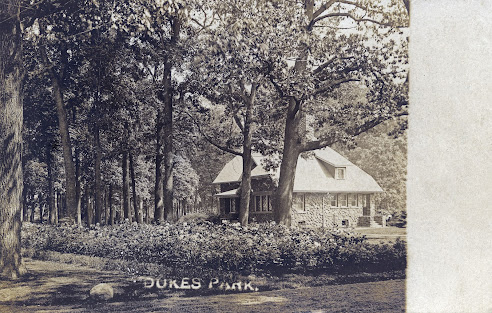
Around 1898 James B. Duke had a rectangular boating lake constructed on the north side of the residence at his Hillsborough, New Jersey estate. Shortly thereafter he built a boathouse at the west end of the lake. 

Duke's Park Boat House circa 1905

The small one-story building originally had two rooms - a lounge with a fireplace on one end and a room to store boats.


The Boat House at Duke's Park, 2018

Only the west and south facades are easily viewed today - the building itself is inaccessible to visitors.  In the photo above of the west facade taken from behind the security fence, one can just glimpse the stone bridge on the left so prominent in the first postcard above.

The Boat House at Duke's Park circa 1907

Above we see the east side of the building in an early postcard. In the distance, the riverfront factories of Raritan can just be made out.


The Boat House at Duke's Park, 2018

Shown above is the south side of the boathouse. A half-dozen years ago the building was in disrepair and was generally worn out. Minor repairs stabilized the building and a coat of fresh paint brought it to the state you see in the 2018 photographs.


The Boat House at Duke's Park circa 2010

The boathouse was much photographed a century ago also. No fewer than six series of postcards featured views of the building.


The Boat House at Duke's Park, 2018

The Boat House has been much altered over the years. Windows and doors have been changed and moved and the bracketed posts supporting the overhanging roof on the lakefront side have been replaced with simple posts at the front edge of the roof as can be seen in the photo above.


The Boat House at Duke's Park circa 2010

In the photo below of the west side - opposite the lake - we can observe that the covered porch with the gabled roof as seen in the first postcard has been enclosed to form a new room.


The Boat House at Duke's Park, 2018

Doris Duke enjoyed boating on the lake as a child as we can see in this selection from her home movies below which also includes a glimpse of the Boat House.


The Urchins' Band, Then and Now

Of the many bronze figures that inhabited the Hillsborough, New Jersey estate of tobacco mogul James B. Duke in the last century, the grouping of the barefooted boy musicians has always been one of the most beloved. 

The Urchins' Band, Duke's Park, circa 1905


Not only were the bronze figures well-loved, but also much photographed. Images of the boys appeared in no fewer than eight separate postcard series between 1905 and 1920.


The Gypsy Band, Duke's Park, circa 1905

The musicians have gone by several different names over the years - the Gypsy Band, the Brownie Band, even the Wandering Minstrels. But we know from correspondence between Duke and Italian fabricator Sabatino de Angelis & Fils that the figures were originally called "Urchin Band of Musicians".


The Urchins' Band, Duke's Park, circa 1910

Sabatino de Angelis was responsible for many of the bronzes at Duke's Park, notably the Thorn Puller, and the Farnese Bull.


The Urchins' Band, Duke's Park, circa 1910

The boys with their makeshift instruments were originally placed in what was called the Coach House Woods. This was a wooded area near the Coach Barn and Stables that no longer exists. In the first four postcards above we can observe what was likely their original configuration.


The Wandering Minstrels, Duke's Park, circa 1912

In the postcard above and the two below, we observe that the orientation has changed somewhat.


The Brownie Band, Duke's Park, circa 1915


The Brownie Band, Duke's Park, circa 1915

And finally, in the last historic postcard below we see that the statues have been moved once again.

The Brownie Band, Duke's Park, circa 1915

In the years after Doris Duke inherited the estate, she moved the Urchins' Band one final time to an island in a lake near her residence. This area of the estate has only been open to the public again in the last couple of years. Unfortunately, the passage of time has not been kind to the urchins as you can see in the photo below.


The Urchins' Band, Duke Farms, 2018


15 February 2021

The Hunting Lodge, Then and Now

Sometimes referred to today as the "Hunting Lodge", this gothic cottage on the estate of tobacco king James B. Duke in Hillsborough, New Jersey appears much the same today as it did 120 years ago. The cottage is 1 1/2 to 2 stories high and constructed of uncoursed boulders. It is said to have been built shortly after the coach barn and stables and is believed to be where Duke stayed during the many early extensive renovations to his main residence, the Veghte house.


Duke's Hunting Lodge circa 1905


The Gothic Revival style of the cottage differs from the later architecture of the estate - including the Veghte house remodeling - which is in more of a Tudor style. Today, the cottage with its two stone chimneys and interesting irregular rooflines remains nestled in the woods of Duke Farms much as it was in 1900.


Duke's Hunting Lodge in 2019


14 February 2021

In The "Red Coats'" Power - The Capture of Thomas Van Camp - 1777

In The "Red Coats'" Power is one of the tales published by George Quarrie in his 1910 collection Within a Jersey Circle. It is the story of the capture of Branchburg farmer Thomas Van Camp by the British during the American Revolution as told to the author by the then 83-year-old grandson of the protagonist, Peter Van Camp. I am reprinting it here along with notes and images of my own inserted for those interested in Hillsborough, New Jersey history.

HOW FIVE JERSEYMEN, DRILLING NEAR THE PRESENT
TOWN OF SOUTH BRANCH, WERE CAPTURED BY THE
BRITISH.

One day in June, 1777, five men were drilling and practising target shooting in a wood, near the South Branch River. It was at a place a little above the vil- lage then called Branchville and now known as South Branch. They had met there every day for some time and were very earnest in their work, first learning the military steps and turnings for marching and afterward firing with long-barreled muskets and the round, leaden balls of those days, at a barked spot on a tree.
 
On the day in question, which, to be accurate, was the 
16th of June, having finished their drill evolutions, four 
of the men grounded their muskets and began loading 
them. First they measured the charges of powder in 
the palms of their hands and poured them into the ca- 
pacious barrels; then they rammed them down with 
pieces of paper doubled up into wads, and next they 
hammered the charges home with their ramrods, until 
the latter bounced back clear out of the barrels. The 
balls being put in and driven down beneath more paper 
wads, the guns were loaded. After that the flint-mailed 
hammers were raised and some extra powder poured into 
the flash pans. This was called priming. Having fin- 
ished loading, the four men, under instructions of the 
fifth, formed in firing line. 
Just two days earlier, on June 14, 1777,
the Continental Congress passed a resolution
adopting the United States Flag.


One of the four, a tall, lanky youth called Hank, 
was exceedingly awkward at drill but a “dead shot” and 
proud of it. He was about to shoot when right in the 
line of the target and not much beyond it, he saw some- 
thing. 

“Tom, do you see that ‘redcoat’?” he asked in an ex- 
cited whisper. “That’s my target! I’m going to shoot 
him!” 

“No, don’t!” ordered Tom, who was the instructor. 
“That’s one of our men in disguise, most likely. Hold 
on a bit till I see.” 

Hank frowned. He wanted to show his marksman- 
ship on the real thing, and again he leveled his gun, de- 
claring that he would shoot the man. 

“Don’t do it, I tell you!” Tom commanded, and again 
Hank was restrained. But as Tom shifted his ground 
for a better view, “Lanky Hanky,” as they called him, 
covered his man with his gun and was on the point of 
firing when one of his mates interfered. It was lucky 
he did, for at that moment a crackling of many feet over 
the twigs behind them was heard and they found them- 
selves surrounded and taken prisoners by a strong com- 
pany of British soldiers. If Hank had shot the man the 
five of them would have been shot or hanged on the 
spot and this story would never have been told. 

“Tom,” the instructor of Hank and the others, was 
Thomas Van Camp, who had served in the Continental 
army from the first skirmish down to the glorious ac- 
tions of Trenton and Princeton. His time having then 
expired he had repaired to his ancestral homestead, which 
is now the home of his grandson, Peter Van Camp, to 
whom I am largely indebted for this story. 
[The Van Camp homestead was located in Branchburg where the Neshanic Valley Golf Course is today. It was in the Van Camp family from when the land was originally partitioned in the early 1700s until it was sold in December 1933. Peter Van Camp, the grandson of Thoams Van Camp, died in 1923 at the age of 97.]
Thomas Van Camp’s activity in collecting and drilling 
men for the army he had fought with, showed that he 
was a true patriot. But for the time his lamp was ex- 
tinguished ; for he and his recruits were in the hands of 
the enemy. And, as he used many a time to tell his 
grandson, who now retells it, the worst of their capture 
was that, being all big fellows, they were subjected to 
far more indignities than if they had been of smaller 
stature. For instance, they were made to run the gaunt- 
let, one at a time, between two facing lines of their 
enemies, every one of whom administered the best kick 
he was capable of to each runner as he passed down the 
line. The redcoats seemed to hugely enjoy the work, 
too; for with every kick they would shout some taunt. 

“Why don’t you fight, you lumbering rebels,” they 
cried. “You’re big and ugly enough,” etc. 

But the captives soon had the satisfaction of seeing 
their enemies themselves cowed. For they had only pro- 
ceeded a short distance further up stream when suddenly, 
like a clap of thunder, a cannon belched from the hills 
to their left and a ball came whistling over their heads 
and tore up the earth only a few -yards beyond them. 
Simultaneous musketry fire from a wood ahead of them 
seemed to fill the invaders with terror, for sheltering 
themselves in a convenient wood, they beat a double- \ 
quick retreat along the river, taking good care, how- 
ever, that their prisoners were well surrounded and made 
to scamper away along with them. For some time that 
well-planted cannon kept guessing their whereabouts, by 
shot after shot. Just opposite the Van Camp home- 
stead, where the river is now crossed by a fine bridge, a 
ball went crashing among the trees right over their heads. 
This brought down a heavy limb which pinned several 
Britishers under it, hurting one or two badly, and nar- 
rowly missing Thomas Van Camp. 
Branchburg and Hillsborough circa 1850 - 


The men thus sent back the way they came were a 
force some seventy strong. They had been sent on a 
reconnoitering and foraging expedition by General Corn- 
wallis, who, with Colonel De Heister, was posted with 
two divisions of their army at Middlebush and Som- 
erset Courthouse. They had marched there from New 
Brunswick in the hope of drawing Washington from his 
stronghold at Middlebrook, which event they awaited 
with impatience but in vain. At the same time General 
Sullivan, by order of Washington, having come from 
Princeton, had left small corps of observation on Haunts 
Rock, on the Sourland Mountain, and encamped with his 
main body at Clover Hill. It was from there that the 
gun was sent by Sullivan, and it, with a few sharp- 
shooters, successfully defeated the purpose of the for- 
agers. 

Major General John Sullivan


Nearly a hundred years after this occurrence, two can- 
non balls were unearthed on the Van Camp farm. They 
are still in the possession of Peter Van Camp, the grand- 
son of that same patriot soldier, Thomas, at whose cap- 
tors while he was among them, these very balls were fired. 
As there is no record of any other engagement ever having 
taken place in the vicinity, there seems to be no doubt as 
to the origin of these balls. 

When Cornwallis saw that Washington was not to 
be enticed from Middlebrook he marched back to New 
Brunswick, determining to move on Philadelphia by way
of the sea. Thomas Van Camp and his fellow-prisoners 
were shipped under hatches in a vessel and taken to Long 
Island. There Hank and three of his mates received bad 
treatment in prison for five months; but Van Camp, who 
was wonderfully good natured, did whatever was re- 
quired of him, and knew so well how to humor his jailors 
that he got off after two months of imprisonment. He 
was paroled on leave to go and see an aunt, and needless 
to say the moment his feet touched the Jersey shore he 
took to his heels through swamps, rivers and woods, till 
he got back to his home. 
Interior of the British prison ship New Jersey,
moored at Long Island during the American Revolution


Peter Van Camp tells me that his grandfather lost his 
gun and other equipment at the time of his capture, but 
the musket used in the Revolution by his great uncle, 
John Van Kampen, as well as the latter’s sword, after 
he was made an officer, is still preserved at the old home- 
stead. Mr. Van Camp has also a very old French gun, 
supposed to have been among the first firearms ever used 
in Jersey. It was brought here by his great-great-grand- 
father early in the seventeenth century, and is said to be 
at least 250 years old. 

It does not appear that Thomas Van Camp re-entered 
the army. Subsequent to his capture and release from the 
British lines, tradition and history seem to conflict a good 
deal as to his movements. In the second series of New 
Jersey Archives (as pointed out to me by Arthur S. Kim- 
ball, a relative of the Van Camps, through the Halls) 
there appears a letter, dated at Newark, February 7, 1778, 
which says: 

“A correspondent informs us that one William Pace, 
of Schoolie’s Mountain, and Thomas Van Camp, of Som- 
erset County, both bound for Staten Island, the latter 
with a quantity of flour, and the former with four quar- 
ters of beef which had been stall-fed two years, and was 
intended for a British general, were apprehended and 
brought before the President and Council of Safety the 
twenty-eighth of January last. It not fully appearing to 
the board that their respective cargoes were to have been 
carried into the enemy’s lines, which would have been 
high treason. Van Camp was adjudged to forfeit his 
flour and to pay the fine prescribed by law for asking more 
than the regulated price, and also the fine for asking a 
higher price in continental currency than in specie and 
Pace to forfeit his fat beef and to pay the fine for asking 
for it more than the regulated price, and both being 
bound over they were dismissed. 

“Evidence being produced the day after that one Jacob 
Fitz-Randolph, who lives at the Blazing Star, had met 
them (Van Camp and Pace) at Spanktown (now Rah- 
way) and engaged to take their cargoes if they would 
bring them to his house, and to convey them to Staten 
I Island so soon as the ice would permit; the said Pace and 
Fitz-Randolph have since been committed to gaol for pro- 
curing provisions for the enemy, and as dangerous to the 
present government; and a warrant is issued to apprehend 
the said Van Camp.” 

History failing to note any further penalty as inflicted 
upon Thomas Van Camp, we may fairly assume that his 
I actions were satisfactorily explained to the authorities. 
Martha Washington arrives at the Ford mansion in Morristown, 1779


Tradition here enters and informs us that Thomas Van 
Camp conveyed Martha Washington in a supply wagon 
from Princeton to Morristown in the month of Decem-
ber, 1779. Although there is no official record of this, it 
had undoubtedly as good a chance of being authentic as 
most other family traditions have. And as to Thomas's 
attempted contraband transaction, perhaps he was not the 
first loyal citizen up to that time or since then who has 
been tempted into making large profits at the expense of 
an enemy of his country — if he really did attempt that. 
But the natural inference seems to be that he was ulti- 
mately exonerated from everything, except, perhaps a lit- 
tle pardonable venality in those hard times. 

The present Peter Van Camp, Thomas’s grandson, is 
the oldest surviving descendant of two very old and im- 
portant families, the Halls and Van Camps, or Van 
Kampens. He lives at the original Hall homestead, one 
of the first places of the kind established in Somerset 
County. The Halls of this line especially have an ancient 
and decidedly interesting lineage. 

I have on several occasions noticed how remarkably old 
people in these regions seem to carry their weight of 
years. But wonderful as former instances have appeared 
to me, I am bound to admit that they are surpassed in the 
person of Peter Van Camp. He is eighty-three years of 
age, or as he humorously puts it: 

“Yes, next year I’ll have come of age four times.” 

And yet he is so alert in mind and body, and so very 
far from looking his great age, that no man could hon- 
estly guess him to be over sixty. Though he does not 
now do the heaviest work on his farm, he takes full care 
of his own horse, cows and chickens, does his own garden- 
ing and raises what are admitted to be the finest pigs to be 
seen for miles around. 

12 February 2021

The Battle for the Sourland Mountain (1953 - 1959)

The Battle for the Sourland Mountain didn't take place during the American Revolution, though it lasted nearly as long as that entire war. Rather, the battle began in January 1953 when Minnesota Mining and Manufacturing - better known today as simply 3M - announced their intentions to build a stone quarry and roofing granules manufacturing plant in Hillsborough and Montgomery Townships.


24 January 1953 Home News


The Minnesota company began buying options and researching titles of mountain properties in the final few months of 1952. They planned a $2 million operation with the mining being conducted in Hillsborough and the manufacturing taking place in Montgomery. Organized opposition to the plan from residents in both towns arose almost immediately after a public information session was held at the Hillsborough Consolidated School in February 1953. 


14 April 1953 Home News


Residents raised questions about water use, noise from blasting, increased traffic on local roads, and general quality-of-life issues for mountain property owners. They focused on opposition to the approvals that would be necessary for both towns to change the zoning from residential and farming to industrial. Minnesota Mining and Manufacturing responded by publishing two open letters on consecutive weeks in April in an attempt to allay the public's fears.


April 1953 Courier News


Enter Dr. George Gallup - Montgomery Township resident and founder of the famous Gallup Poll - and the Community League of Montgomery. They presented the Montgomery Planning Board with an 840-signature petition in opposition to the quarry focusing on the tax impact of industrial development. 


29 April 1953 Home News

According to Dr. Gallup and the League, "the long term effect of industry is to increase taxes", "municipal debt and bonded debt increase rapidly as industry moves in", and, "industry increases population density, and population density brings high taxes."


23 May 1953


Opposition to 3M - and to the proposed zoning changes - was just as strong in Hillsborough as in Montgomery. At a May 22, 1953, public meeting attended by 225 residents, 3M went so far as to offer to buy the house of every concerned citizen within one mile of the quarry.


28 July 1953

With the various government bodies in both towns in favor of the development, the opposition turned to a new tactic - changing the forms of government. From their inception in 1771 and 1772, Hillsborough and Montgomery Townships respectively used the township committee form of municipal government. In the 1950s this consisted of a three-member committee, elected at large for three-year overlapping terms, with each committee member having an equal vote and a nominal mayor being selected among themselves.


28 July 1953 Home News


New Jersey state law offers a couple of different ways to change government forms. The one attempted in Hillsborough and Montgomery was to petition for a special election. Hillsborough's Community League submitted a petition to the town clerk at the beginning of August requesting an election on August 25th to change to a council-manager form of government. Montgomery had already submitted their identical petition a week earlier.


4 August 1953 Courier News


The council-manager form allows for 5,7 or 9 Council members or Mayor and 4, 6, or 8 Council members with the Mayor elected at large. The Council is elected all at-large or a combination of wards and at-large and serves 4-year concurrent or staggered terms. A municipal manager serves as the chief executive and has responsibility for the budgets and the appointment and removal of department heads. Eight out of nine former Hillsborough committeemen weighed in with their opposition to a change, and even Doris Duke was asked for her opinion (she declined to provide one).

19 August 1953 Home News

After Montgomery's voters rejected the change by a vote of 538-382, the writing was on the wall for Hillsborough. And indeed Hillsborough voters followed suit, keeping the township committee form by a vote of 981-410. For many residents of both towns, these votes were more reflective of a desire to keep their nearly two-century-old government than they were indicative of acquiescence to the quarry. Dr. Gallup compared the tumult that raged all summer to the Civil War. "Sometimes a father will be on one side and a son on the other. Men who have been good friends all their lives are arguing. Next-door neighbors are no longer in agreement." And so the battle continued.
26 August 1953 Home News


After the defeat at the polls, the Hillsborough Community League directed its energy toward stopping the zoning change. They argued that the quarry and plant would depreciate home values and that the zoning laws would be neutered if changes were made solely for the benefit of individual companies. At a three-hour meeting in October, many residents were still voicing concerns. Even Dr. Russell Carrier - of the noted clinic - testified that his patients would be adversely affected by the quarry one mile down the road.

9 October 1953 Home News


The battle had its first political casualty a month later when Hillsborough Mayor Richard Van Doren was upset in his bid for reelection by the Community League-backed candidate Richard Musa. Van Doren cast one of the two Yes votes in the 2-1 approval of the "3M" zoning ordinance on October 8. 

15 January 1954 Home News

The ordinance was passed again due to technical errors on December 10, 1953 - but with a new township committee in January with a seeming 2-1 opposition to 3M (as well as a new planning board), all bets were off. Thus began six years of constant litigation in the courts and changes in stance by the governing bodies, especially after Van Doren was elected back to the committee in November 1954.


6 July 1956 Courier News

The various lawsuits between and among the two townships, residents, and 3M were consolidated in 1954 and came to trial in 1956 with Hillsborough prevailing in Superior Court. Zoning ordinances were again proposed and adopted and the New Brunswick Home News even ran a headline on December 16, 1956, that read, "Battle Nears End". But the zoning ordinances were ruled invalid upon appeal by the plaintiffs to the New Jersey Supreme Court in April 1957.


31 January 1959 Courier News

In March of 1958, the Hillsborough Planning Board again recommended an amendment to the zoning ordinance to allow 3M to operate on the mountain. This set off another round of lawsuits with Hillsborough prevailing in Superior Court on January 30, 1959. A ruling on June 1, 1959, by the Supreme Court, upholding the validity of Montgomery Township's zoning ordinance seemed like it would be the final shot in the six-year battle but Hillsborough residents were back in court that October with more objections to the zoning ordinance - namely that the setback requirements for the zone (reduced from 1,000 feet to 100 feet to satisfy a previous lawsuit) were "arbitrary and capricious".

17 January 1960 Home News

A final ruling was handed down by the Supreme Court on November 23, 1959, upholding the Superior Court's previous decision. Within weeks, contractors were on the site resuming the engineering work required to build the facility. 

Gibraltar Rock Quarry, 2011


The quarry and roofing granules plant opened in 1961 and was operated by 3M until being sold to Gibraltar Rock in 2009. Gibraltar continues quarrying at the site and in 2011 stated that they could continue digging there for another 100 years! 

10 February 2021

Saint Mary's Catholic Church of the Byzantine Rite

When the Johns Manville company moved its plant to Hillsborough in 1912, the rural township changed practically overnight. A whole new town sprung up, taking its name from the asbestos manufacturer, and filled with workers and their families. These new Hillsborough residents were of mostly Eastern European descent and within a few years, they began organizing new churches where they could worship in their own languages and with their own customs and rituals. 

Saint Mary's Catholic Church of the Byzantine Rite,
Main Street, Manville, circa 1920s

Among these new congregations - which by the end of the decade caused the number of churches in the township to double - were St. Peter and Paul Orthodox Church (1915), Manville Magyar Reformed Church (1915), Hungarian Reformed Church (1915), Sacred Heart Roman Catholic Church (1917), and Emmanuel Baptist Church (1919). A sixth church - Saint Mary's Catholic Church of the Byzantine Rite (1917) -   is significant for Hillsborough history because it began in Hillsborough, found itself in Manville after the 1929 separation, then moved to Hillsborough in 1996.

The three dozen men who met on July 22, 1917, to organize the church traced their roots to the Carpathian Mountain region of Europe. They were followers of the Greek - or Byzantine - ecclesiastical tradition and were anxious to have their own church in Manville where they could worship with their families.


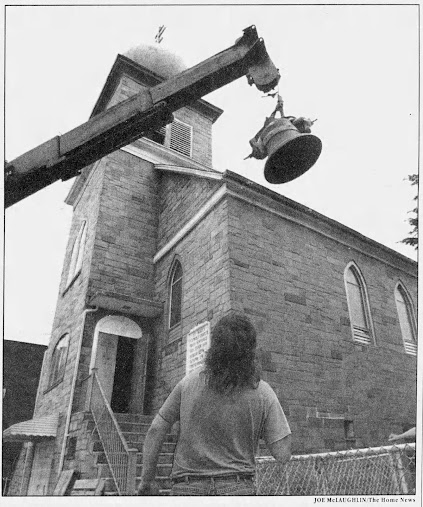
Bells being removed from St. Mary's to be reinstalled in the new church.


Within a month a charter had been granted officially forming the church, and four lots were purchased on Main Street where a building would be constructed. According to the book, Manville: A History Enduring by Kathryn Quick, no area building contractor wanted to tackle making the onion-shaped dome for the top of the church, so the job fell to local cabinet maker William Nagle.

After renovation and remodeling in the 1950s, Saint Mary's continued to serve the faithful Byzantine community from Manville and surrounding towns for decades. In 1974, the church purchased eleven acres of land on Brooks Boulevard in Hillsborough - and soon after another seven acres. Here they built a parish center for use by the CCD program, basketball, cheerleading, bingo, and other church events.


The "new" Saint Mary's on Brooks Boulevard in Hillsborough


In 1992 a plan was presented to erect a new church on the property adjacent to the parish center. The new church building, which was dedicated in June 1996, was built in the Byzantine style with three domes and an interior design in the Byzantine Ruthenian/Ukrainian tradition by Christina Dochwat.


9 June 1998 Courier News

Sadly, the old church on Main Street - only recently purchased and in use by the Faith in Action Church - was accidentally burned down during a renovation project on June 7, 1998.

04 February 2021

General Foundry Co. (1947 - circa 2000)

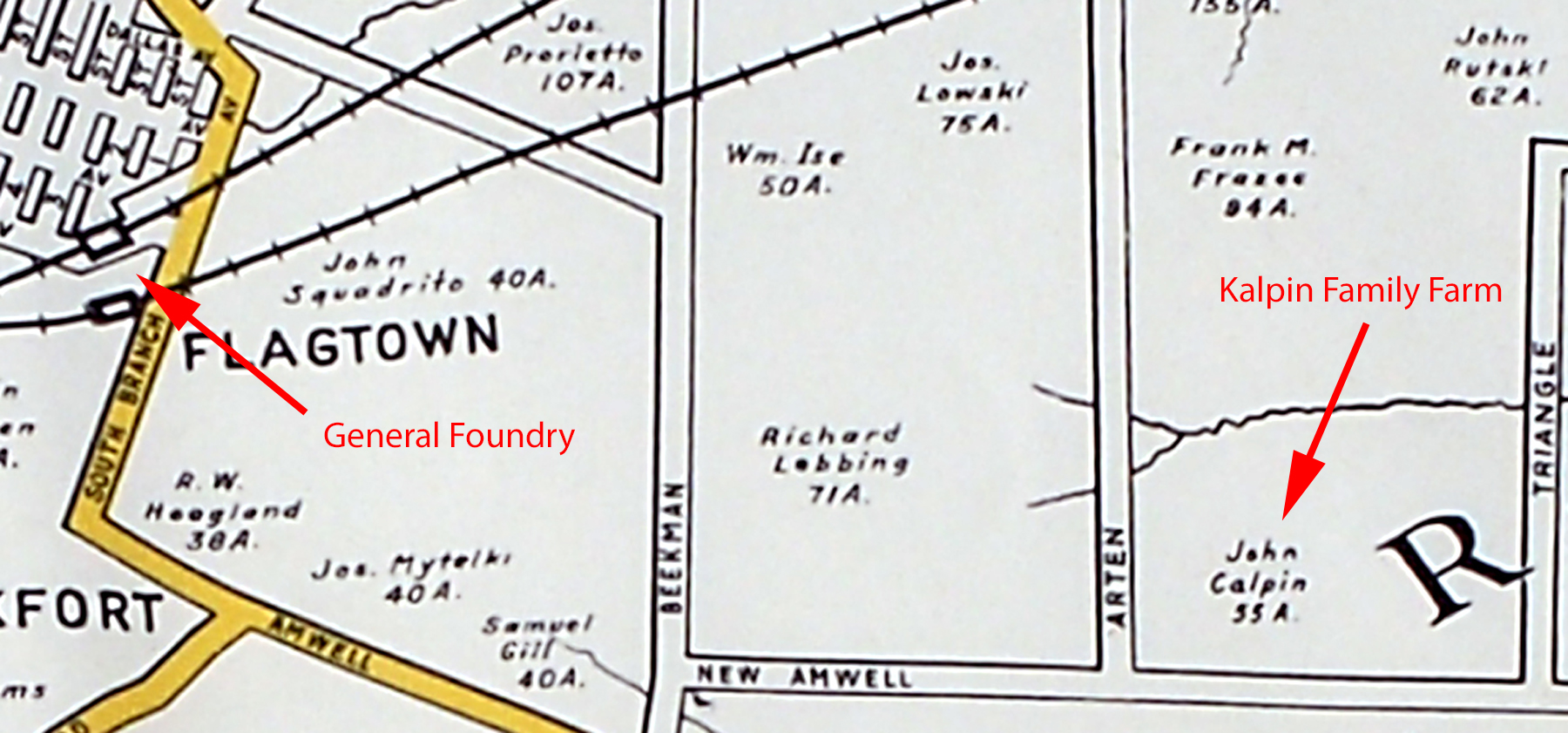
In 1925, four-year-old John W. Kalpin, Jr. moved to Hillsborough with his Russian immigrant parents and grandparents, one sister, and two brothers. The family had a farm of 55 acres on New Amwell Road between Auten and Triangle (South Triangle). Three more children soon followed, but the death of John Kalpin, Sr. early in the next decade forced John to leave school at the age of 15 to help support the family. 


Kalpin served a three-year apprenticeship in the foundry trade, and in 1939 went to work for the Bendix Aviation Corporation. Within five years he was the assistant superintendent with responsibility for 400 employees. It was 1944 and he was just 23 years old.

10 April 1957 Courier News

In May of that year, he began a two-year stint in the army, spending 18 months in Europe during World War II receiving the Bronze Star. Upon returning stateside, Kalpin had an idea to start his own foundry in his hometown of Hillsborough. In 1947 he purchased a 7-acre tract in Flagtown on Clawson Avenue between the Lehigh Valley and Jersey Central railroads.


After six months of construction - which included the main 40 x 100 foot concrete block main building - the foundry began operations in January 1948. The company was mainly engaged in producing machine parts from gray iron - the most common form of cast iron so named because of its graphite content. Parts as small as a few ounces and as much as several tons were produced at the plant. To manufacture a cast iron machine part, first a model, generally of wood, would be made of the part that needed to be reproduced. From this, molds and cores are made using hardened sand that can withstand molten metal of approximately 2700 degrees.

23 June 1965 Home News

General Foundry operated without incident until 1965 when the state Department of Health reported that their smokestack was "emitting more solid particles into the atmosphere than allowable under state air pollution regulations." This was a problem that would vex the company for the better part of the next two decades, although in later years the DEP did not consider the emissions to be much of a problem since the smokestack was only operational about 90 minutes a day.

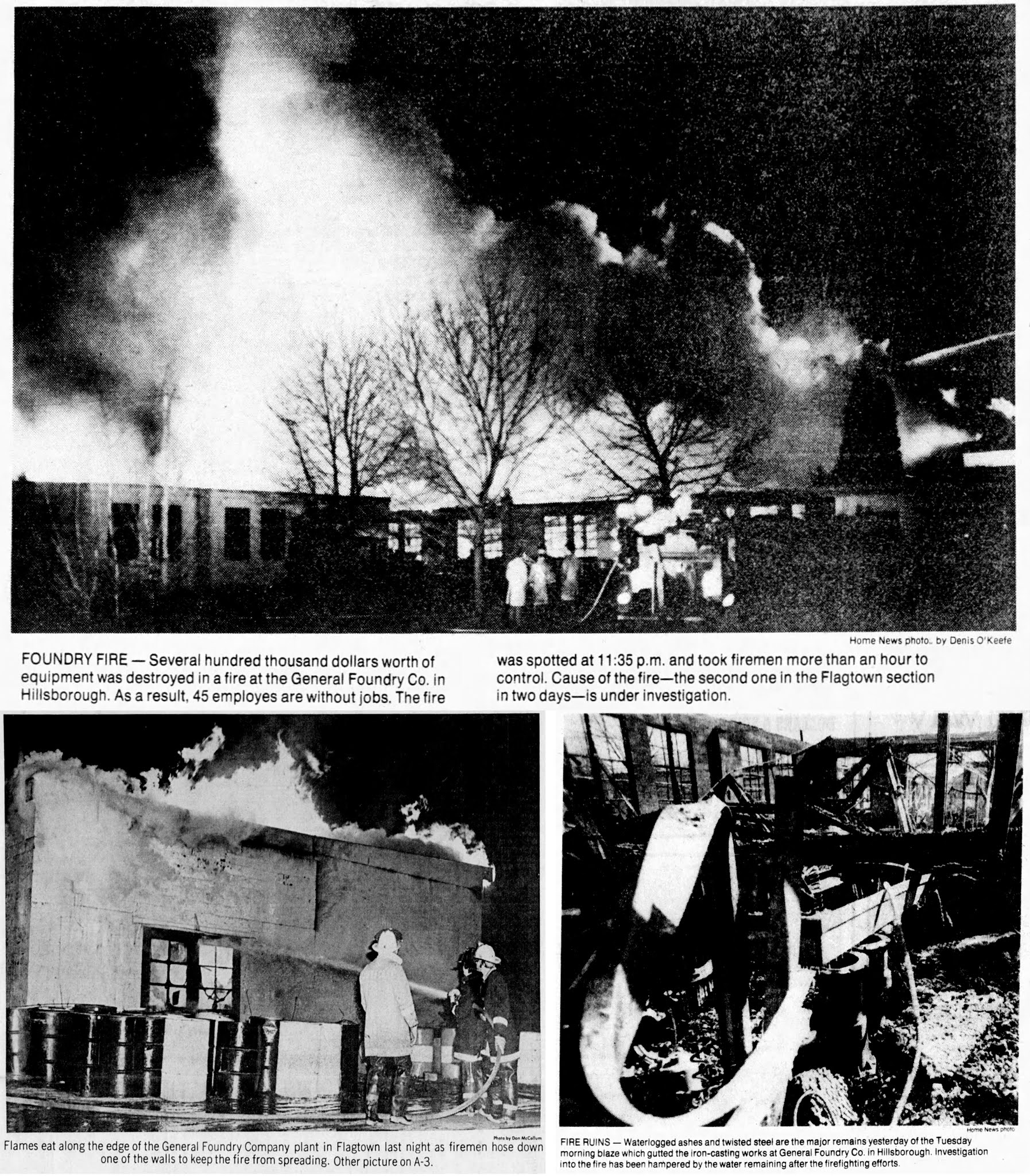
Scenes of the February 15, 1977 fire.


On February 15, 1977, a devastating fire tore through the plant causing $600,000 in damage. One hundred firefighters were on the scene in freezing conditions battling the blaze that gave off an orange glow that could be seen for miles. Flagtown Fire Chief Greg Kane explained how his men chopped through a thick layer of ice to drop their hoses into the company's pond in order to pump water - all other water sources were frozen. 

An extremely disheartened John Kalpin showed up at the scene from his home in Belle Mead and told reporters, "It's a shame, a real shame! I'm not going to rebuild. This is it." He was most concerned with the possible loss of the patterns and molds used in the castings. As it turns out, firefighters were able to save the nearby residences, the administration building, and enough of the nearly irreplaceable patterns and molds to allow Kalpin to reopen the foundry.


17 April 1984 Courier News

In April 1984 disaster struck again as an explosion ripped through part of the plant blowing out windows, walls, and moving the foundation. It was fortunate that the blast occurred during a shift change and only two employees were injured.

General Foundry recovered from the 1984 explosion and continued to operate in Flagtown for another decade and a half. Today the site is the home of Kyle Conti Construction.