31 March 2016

The Old Red School House

[Amazingly, everything we know today about the Old Red School House is due to the reminiscences of Governor Peter Dumont Vroom. He was the youngest student in the very first class taught at the school in 1796. His remembrances were collected in Abraham Messler's 1899 book First Things in Old Somerset.]

Master Warburton was a "kind and affectionate" teacher. Look not to the neatly trimmed birch rod resting against the side of his leather armchair in the corner of the room, but rather be reminded of the fact that he sometimes pretended not to see that the last grains of sand had slipped through to the bottom of the hourglass signaling the end of midday recess.

This circa 1785 schoolhouse in Eureka, Vermont
 is probably of much the same size and type as
 Hillsborough's Old Red School House

An Englishman by birth, past middle age but not elderly, John Warburton was the first teacher at Hillsborough Township's Old Red School House. The one-room school, twenty-four feet square, finely built with one door and few windows, was notable for its red paint with white trim. This was Master Warburton's domain. Built on a little knoll on a sliver of land between River Road and the Raritan east of Beekman Lane in 1795, the school was also his home.


Detail from the 1850 map of Somerset County
 showing the location of Pawnepack Creek,
Beekman Lane, and the Old Red School House

In those days, the little stream which runs northward through the fields and under the road by way of a large diameter steel pipe before exiting to the Raritan, flowed year-round and had a name - The Pawnepack. The little schoolhouse with its chimney on one end was just to the west of this tributary. Inside, the smallest students sat on rows of backless benches, while those who could read and write and work out their arithmetic problems sat on similar benches on each side of a long table. Two smaller tables, each at a different height for those just learning to write, were placed at the front of the room near the master's aforementioned chair. The only other adornment, aside from the large fireplace at the back wall, was the trap door in the ceiling.

Today you could hardly squeeze any sort of building
 into this location between River Road and the Raritan

It was customary for teachers to board week by week at the homes of their students. This arrangement made it possible for the farmers to afford to pay a good teacher, who otherwise would need a salary commensurate with the expenses of keeping a home. In this Master Warburton was the exception. He preferred at all times to make his home in the schoolhouse. Each Sunday morning he would arrive at the home of one of his pupils and enjoy breakfast with the family. Before leaving, he would fill his wicker basket with provisions for the week, and a quart bottle with milk. A fresh quart of milk would be brought to the master each school day by one of his students, along with assorted foodstuffs as required.

Dilworth's Spelling-Book, 1796

Master Warburton only taught subjects that he knew well - no history or geography or higher mathematics. He relied solely on four texts - Dilworth's Spelling and Arithmetic books, The New England Primer, and the Bible. At recess, children played along the Pawnepack and in clearings on both sides of River Road - no traffic in those days. Then it was back to class.


In the evening, Master Warburton pulled two long benches together, and by placing blankets upon them made up his bed for the night. His private place was up through the trap door into the garret. This is where he kept his few small possessions and secreted away his earnings - a portion of which he dutifully sent to his elderly parents in England. At a time when everyone went to church, no one ever saw the Master in attendance. It was supposed that, being English, as opposed to most of his charges who were of Dutch descent, that he observed the ways of the Church of England, and that one of the fancy books on the table near his chair was the Book of Common Prayer - though no one ever knew for sure.

A view of the Old Red School House site from across the Raritan in Duke Island Park -
notice the pipe which carries what remains of Pawnepack Creek

After many years at The Old Red School House, changing demographics and newly constructed schools in the area forced John Warburton to move on. He taught for a while at another school in the vicinity, eventually using his savings to retire to a small parcel in the hills north of Somerville, where he built a small house and lived out the last years of his life.

The Old Red School House stood on the banks of the Raritan for many years afterward - sometimes pressed into service again as a school, or a Sunday-school. Without regular use, the paint began to peel and chip, the clapboards loosened up, and the changing banks of the river washed the land away until the building was only a memory.


11 March 2016

Clover Hill Cider-Vinegar Works (1869 - 1906)

Take a drive west from Hillsborough down Amwell Road, and just past the village of Clover Hill, you will come to the intersection of Cider Mill Road. Only a few Hillsborough residents will know firsthand why the road is so named, but the rest of us can surely guess!


Advertisement for Case's Cider and Vinegar

Around 1869, Zebulon Stout started making cider and vinegar at his farm near Reaville. After partnering with John P. Case sometime in the 1870s, the operation was relocated to Case's farm near Clover Hill.

Advertising postcard showing the cider-vinegar works
 at the Case farm just west of Clover Hill


They processed apple juice, but their biggest seller was apple cider vinegar. The Clover Hill location produced and sold between 2,500 and 5,000 barrels a year during the last decades of the 19th century right up through the sale of the business to E. B. VanAtta in 1906. 


VanAtta built a new plant in Flemington, at which time Case's son repurposed the property as a chicken farm. The cider-vinegar works distillery burned down in 1957.


Aerial view of the farm today.
 The cider - vinegar works building burned down in 1957

The original farmhouse - built in the early 1800s, enlarged in 1883, and lovingly restored by Jo-An' Van Doren in the 1980s - as well as some of the outbuildings pictured in the advertising postcard, can still be seen on the north side of Amwell Road, as shown in the aerial photo above.

10 March 2016

Maggie's Farm

Upon entering the office of Miss Margaret Smith in the great coach barn of James B. Duke's Hillsborough, New Jersey estate, the first thing you would notice is a sign hanging over her desk with the simple request, "Be Brief". Visitors would do well to take heed, for, you see, the general manager and ultimate authority at Duke's Farm is a very busy woman.

Miss Maggie Smith in her office
 in an illustration from a May 1904 Syracuse Herald story

The child of immigrant parents - her mother came from Germany in 1859, and her father was born in France - Maggie and her four sisters and two brothers moved back to New Jersey from Easton, Pennsylvania in the mid-1880s, possibly when Mrs. Smith was widowed. A teenager at the time, Maggie and her elder sisters Mary and Kate found work at the Raritan Woolen Mills, earning about $40 a month. After several years at the loom, Maggie decided to go to school in Newark to learn bookkeeping and accounting - and she arranged for Kate to go to cooking school and to receive training in professional housekeeping. The timing couldn't have been more perfect. As the Smith girls were completing their programs, J. B. Duke was making the first purchases of the acreage that would become his New Jersey estate.


The Raritan Woolen Mills circa 1906

It is not known how the Smith girls and J. B. Duke found each other. We do know that Maggie started work as an assistant to the estate manager as early as 1893 when Duke was just beginning to assemble the properties that would become Duke's Farm (later Duke Farms, then Duke's Park, then Duke Farms again!). She kept at this apprenticeship for five or six years and was given the reigns in 1898.  


11 November 1900 New York Herald

Duke soon turned over near-complete control of every operation of the estate to Maggie. It was reported that it was absolutely no use calling him at his New York office or apartment. When he wasn't around, she had the last word - and eventually, even when he was around. The tobacco tycoon had such confidence in the Raritan mill girl that she was in charge of the cash, the books, hiring, firing, approving all requisitions - whether for a set of crockery or thousands of shrubbery - and writing all checks on her own account. 

Maggie Smith at her desk in the Coach Barn,
12 February 1905 St. Paul Globe

She had the combination to the huge safe in her office (you can still see it today) and held her ground during the violent labor strikes of 1903 and 1907. The years between 1898 and 1908 were undoubtedly the busiest decade ever at Duke Farms - with the series of artificial lakes being excavated, hundreds of thousands of trees and shrubs to plant, and upwards of 400 laborers of all kinds employed on the estate at any one time. In 1904 she even hired a private mounted police force to patrol the grounds. They all answered to Miss Smith.


Maggie Smith deploys Duke's mounted guards,
from an illustration in the 15 May 1904 New York Press

Along with sister Kate, Maggie also supervised all of Duke's social events at "the farm". Arranging for transportation for guests, planning meals and activities, and often acting as hostess for the millionaire bachelor. For all of this, she was paid around $5,000 a year - a ten-fold increase from her wages at the mill - as well as being given trips to Europe and valuable tobacco stock as Christmas gifts. 

24 May 1905, The Chanute Kansas Daily Blade


Maggie, and Kate - and another sister Mary who was later employed as a housekeeper - were frugal with their wages, accumulating enough to donate generously to Catholic charities and even have a large window installed in the church in Raritan as a memorial to their mother.


Maggie Smith and her sisters were known to be very protective of Mr. Duke. When he suddenly, secretly, wedded wealthy New York divorcee Lillian McCredy in 1904, Maggie must have been shocked. When Duke sued for divorce a little more than a year later, Mrs. Duke counter-sued, alleging that the Smith girls rebuffed all of her requests and made her feel like an unwanted guest at the Hillsborough estate. She went on to allege improprieties between Duke and Mary Smith - vehemently denied by Duke.

Maggie Smith's desk and chair at the Duke Farms Coach Barn, 2016

In May 1907, the Daily Press of Plainfield reported that Maggie Smith had resigned from Duke Farms to take a job in New York as treasurer of one of the Duke companies, ending her time in our area. But for a few years, a mill girl from Raritan was the most powerful woman in Hillsborough, perhaps the county. In her own words, all it took was "hard work and a will to succeed." You couldn't ask for a briefer prescription than that.

22 February 2016

Peter Dumont Vroom (1791-1873)

Peter Dumont Vroom was the only New Jersey governor born and raised in Hillsborough. This is a brief chronology of his life and many accomplishments.


  • 12 December 1791 - Born in the village of South Branch (then called Branchville) to Colonel Peter Dumont Vroom - a veteran of the Revolution and subsequently a politician who held many offices at the local, county, and state level - and Elsie (Bogert) Vroom. Their home was actually just north of the village near the confluence of the north and south branches of the Raritan River.
  • Spring 1796 - Was the youngest of the first set of pupils to attend the newly constructed school house between River Road and the Raritan River just east of the Beekman Lane intersection. This building, removed in 1830, became known as the Old Red Schoolhouse.
  • Circa 1805 to 1813 - Attended the Somerville Academy, then Columbia College in New York, then studied law in Somerville and passed the bar in 1813.
  • 1813 - 1826 Practiced law in Sussex and Hunterdon Counties before moving back to Somerville.
  • 1826-1829 Elected as a Jacksonian to the NJ General Assembly.
  • 1829-1832 First term as governor. Accomplishments included prison and militia reform, Promoted the chartering of a company to build the Delaware and Raritan Canal. and a company to build the Camden and Amboy Railroad - and later endorsed the merger of the two companies, creating a virtual transportation monopoly.
  • 1833-1836 Second term as governor. Acting in his capacity as chancellor of the court of chancery, wrote decisions affirming the government's right to use eminent domain.


The Vroom Homestead - childhood home of Governor Vroom,
once located on River Road.


  • 1837 Sent to Mississippi by President Van Buren to adjust land claims concerning the forced removal of the Choctaw Indians.
  • 1838 - 1840 Served in the US House of Representatives as a Democrat. Although defeated on election day, suspicious results from Monmouth County that led to a Whig victory were overturned by a Democratic-controlled US Congress as part of the "Broad Seal War", and Vroom was seated.
  • 1844 Led the New Jersey Constitutional Convention, calling for greater power for the executive branch.
  • 1853 - 1857 Served as Ambassador to Prussia in Berlin during the Crimean War.
  • 1861 - Served as a commissioner to the Virginia peace conference attempting to hold off the Civil War.
  • 1865 - 1873 Served as a law reporter for the NJ Supreme Court.
  • 18 November 1873 - Died and was buried in the Dumont Burial Ground on the south side of River Road in Hillsborough.

18 February 2016

Anna Case on Opening Night

Metropolitan Opera soprano and South Branch native Anna Case made 154 appearances with the famous company between 1909 and 1920, but not once on opening night. She made up for that in a big way in 1931 in a decidedly non-singing role - that of Mrs. Clarence H. Mackay, patron of the arts.

Mr. and Mrs. Mackay arrive for the Metropolitan Opera's opening night,
 2 November 1931
(Collection of Gillette on Hillsborough)

For an ex-diva such as Anna Case as well as the other members of "high society", the purpose of opening night was not so much to see Rosa Ponselle singing the part of Violetta in La Traviata but to be seen. And doubly so for the Mackays as this was one of their first public appearances after their July 18th wedding.

Metropolitan Opera audience, opening night, 2 November 1931

Mackay, the millionaire telegraph and cable tycoon, had long been on the board of the Metropolitan Opera and had held a box in the "golden horseshoe" going back decades to the time of the Vanderbilts and Astors, When Anna Case made her return to the opera stage as Micaela in Carmen for the 1916-17 season, he watched her from box 28. Only the year before - having admired the soprano's work in such operas as Der Rosenkavalier and Boris Godunov - Mackay engaged her to sing at a private event at his Long Island estate, Harbor Hill. So pleased was he by that performance, that he sent a truckload of flowers to her October 11, 1916, Carnegie Hall recital - enclosing within a diamond band with a small enameled bluebird. He was just beginning.


The "Mackay Emerald" is an astounding 167.97 carats
 and is set in platinum  
with 35 emeralds and 2191 colorless round brilliant and step-cut diamonds

Although Mackay's first wife had left him in 1913 - running away to Europe with her doctor - his strict Catholic upbringing prevented him from acknowledging the ensuing divorce. While the first Mrs. Mackay was still living, Anna Case would have to wait. From a jewelry perspective, it was worth the wait. On their wedding day, Mackay gifted his bride with a diamond necklace adorned by the world's largest cut emerald weighing in at an astounding 167 carats! The necklace, which Anna Case can be seen wearing in the two opening night photos here from my personal collection, was bequeathed to the Smithsonian upon her death in 1984.


The Mackays at their final opening night together, 29 November 1937
(Collection of Gillette on Hillsborough)

Their final opening night as a couple came on November 29, 1937 - Clarence Mackay passing away the following year. Anna Case continued to attend opening nights and gala events at the Metropolitan for decades afterward - including the 1949 opening night with step-daughter Ellin Berlin (wife of the songwriter Irving Berlin) and step-granddaughter Mary Ellin Berlin. And she was still wearing the emerald necklace as seen in the photo below.

Metropolitan Opera Opening Night, 
21 November 1949
(Collection of Gillette on Hillsborough)


Fittingly, after the opera relocated to Lincoln Center in 1967, the Museum of the City of New York restored one of the boxes from the "Old Met" and put it on display. The box they chose? Number 28.

Newspaper clipping from The New York Times, 9 May 1967

04 February 2016

Silvia Dubois

When contemplating the life of Silvia Dubois - one of the most remarkable women in the history of Hillsborough Township - one needs to first dispose of the idea that she ever lived to be 125, or 120, or even 116 as claimed by her biographer Dr. C.W. Larison in 1883. The reality is that upon her death in 1888 she was perhaps 100, which is remarkable without exaggeration - and fitting for a former slave who lived such a remarkable life of freedom.

Dr. Larison published his interviews with Silvia Dubois as her "biografy" in 1883.


That we know anything at all about the life of Silvia Dubois is due to the work of Larison. He was a physician, an educator, a scientist, a local historian, and, notably, a spelling reformer. The biography he produced from the interviews he conducted with Silvia in 1883 was written in a phonetic spelling of his own creation - perhaps somewhat useful in capturing Silvia's colorful language, but maddening for the modern reader, and unwittingly destined to keep the narrative from becoming widely accessible until transcriptions were made in standard English, about 100 years after publication.

An etching made from a photograph of Silvia Dubois taken in Flemington in 1883
which became the frontispiece for her biography. P.S. She wasn't born in 1768.

Although Larison is an interesting subject - and we can learn much about him from the biography and his other works - the real interest is Silvia Dubois. She was born about 1788 in the tavern owned by Richard Compton just north of Rock Mills in Hillsborough Township, NJ. Silvia's mother, Dorcas, was a slave belonging to Compton, whose name she took and used throughout her life. Silvia's father was Cuffee Bard, a fifer during the Revolution participating in the battles at Trenton and Princeton.

Dr. C.W. Larison (1837-1910) of Ringoes, NJ


Silvia remarked that her mother was "ambitious to be free". To that end, she borrowed a considerable sum of money from prominent Hillsborough farmer Dominicus Dubois - indenturing herself and her children to him while using the cash to buy her freedom from Compton. When she found herself unable to repay Dubois, she and Silvia became his slaves. Still striving for freedom, Dorcas endeavored upon a similar transaction with one William Bard - this time sadly leaving Silvia, who was still only a toddler, behind.

Silvia Dubois would have been familiar with this stone house
constructed by Abraham Dubois in 1757 near today's Eisler Lane.


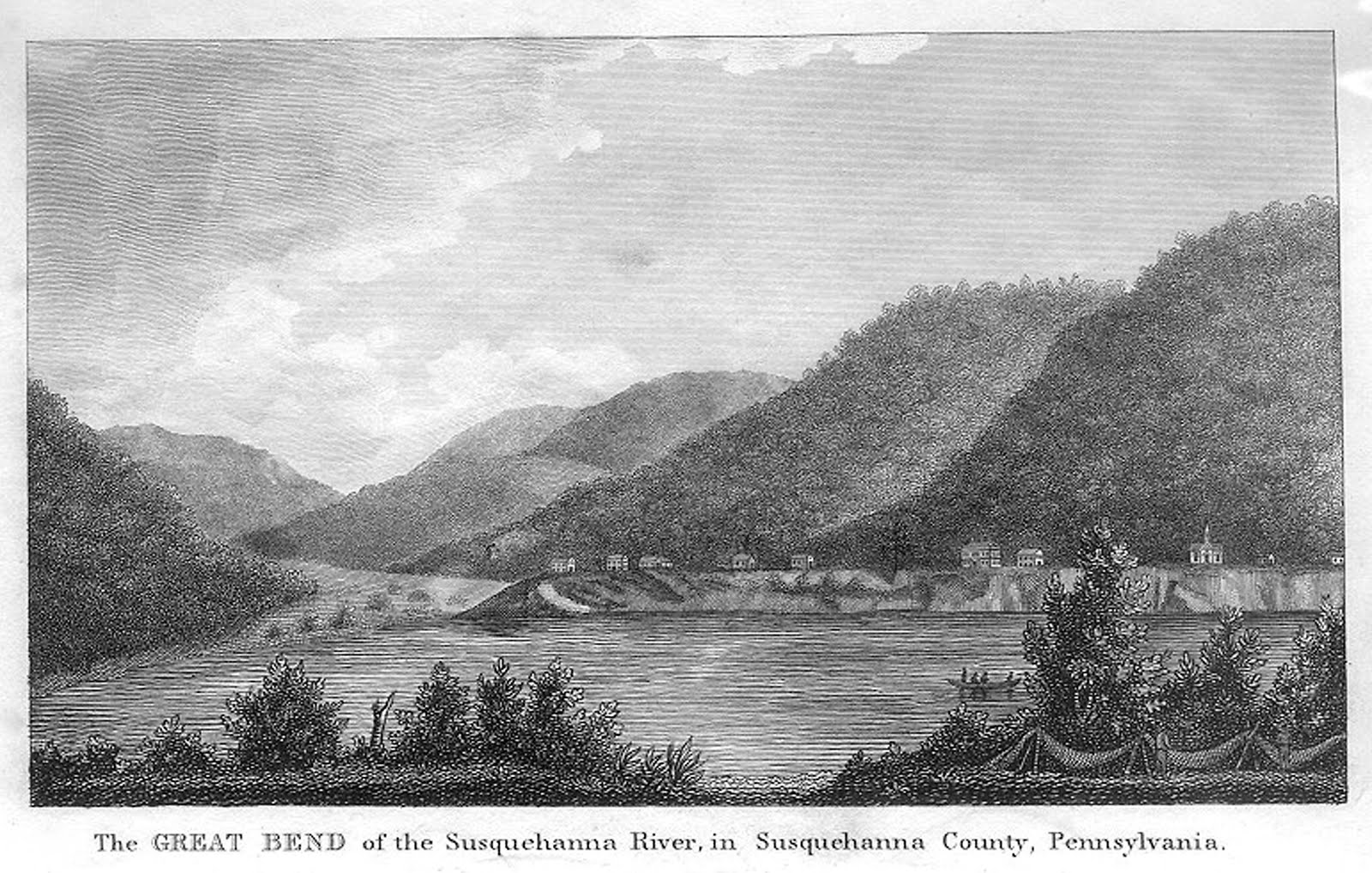
Dominicus Dubois - called Minical in Silvia's remembrances - was the youngest of three brothers who were the grandchildren of an original settler of Hillsborough, Abraham Dubois. The eldest, also named Abraham, moved to Philadelphia and became a jeweler. The second, Nicholas, remained in Hillsborough eventually inheriting his grandfather's home and estate south of Amwell Rd. near the present-day Eisler Lane. Dominicus struck out on his own, opening a tavern in the frontier wilderness of Great Bend, Pennsylvania, and hoping to make his fortune in the fledgling turnpike business.


Great Bend, PA on the Susquehanna River circa 1811

Silvia was only fourteen when she made the 152-mile trek with the Dubois family to Great Bend. She walked the entire way. Already big and strong for her age, she became bigger and stronger in Great Bend, eventually reaching five feet ten inches tall and weighing 200 pounds. Silvia was employed by Dubois in ferrying passengers across the Susquehanna  - in competition with a ferry service owned by a Captain Hatch. The way she was able to steal customers from Hatch, and her speed in rowing single passengers across in a skiff, endeared her to Dubois.

Although she got along well with Dubois during this period - stating that when she pleased him, he pleased her - relations with his wife were more than brutal. She was repeatedly beaten by her mistress, once being hit about the head so furiously with a fire shovel that Silvia was left with a three-inch depression in her skull. When she was about twenty years old, while Dubois was away serving on a grand jury in Wilkes Barre, Silvia unleashed her fury, delivering a mighty blow to Mrs. Dubois that drove her back against a door and left her unconscious on the floor.

Silvia immediately ran away across state lines to New York, but soon returned to retrieve her 18-month-old son Moses, who she had left behind. By this time, Dubois had decided to give Silvia her freedom, telling her that he would write her a pass so long as she took her child back to New Jersey and didn't return.


The cabin home of Silvia Dubois and her daughter Elizabeth Alexander
 at Cedar Summit near Rock Mills

The 152-mile journey back to Flagtown, carrying her child the entire way on foot, through wilds where there were few roads or paths to follow and where wild animals howled each night was bad enough, but one day as she came closer to civilization she heard a man call out to her, "Whose n****r are you?" A piece of paper in the pocket of a freed slave often wasn't enough in a frightening situation such as this. So Silvia set her child on the ground, adopted her best pugilistic stance, and answered, "I'm no man's n****r - I belong to God - I belong to no man."

Hoping to find her mother in Flagtown, she was disappointed to learn that Dorcas was now living in New Brunswick with yet another master, Miles Smith. Silvia lived with her mother in New Brunswick for three years finding menial or household work. In 1811 she went to Princeton and became a house servant for the Tulane family for many years.


Silvia Dubois, right, and her next-to-youngest daughter Elizabeth, circa 1883

About 1830, Silvia accepted an invitation to come back to the Sourland Mountain and help run the notorious tavern at Rock Mills owned by her maternal grandfather - a freed slave named Harry Compton who went by the name of Harry Put after his first owner General Rufus Putnam. Put's Tavern was the kind of place where people went to get a little wild. A completely unlicensed establishment, the entertainment featured boxing, gambling, cockfights - and plenty of booze. As Harry became ill, Silvia took over more and more of the responsibilities of the tavern, inheriting it upon his death. Around 1840 the tavern was burned to the ground by, in Silvia's words, "those damned Democrats" and she lost everything. She rebuilt a wigwam style hut on the land and for a couple of decades made a living raising hogs.

Sometime in the 1870s, her home was again burned down and she went to live with her daughter Elizabeth, also known as Big Lib or Lizi, the only one of her six children still living, just across the county line at Cedar Summit in East Amwell Township. Already 85 years old by this time, Silvia and Lizi lived in a log cabin with no windows, little furnishing, and an ancient wood cookstove in the corner of the room. In her later years, she would come down from the mountain just twice per year, usually visiting the village of Harlingen, to entreat on the generosity of her neighbors.

Still drinking and smoking her clay pipe well into her 90s, Silvia deigned to allow herself to be exhibited as a curiosity at the state fair at the Waverly fairgrounds in Elizabeth in 1887. Despite newspaper claims that she had perished in the great blizzard of 1888, she, in fact, survived until the spring of that year, newspapers trumpeting that at 125 years she was certainly the oldest person to have ever lived! In fact, she was 100 years old - full of freedom to the end.

28 January 2016

William J. Keys, South Branch Farmer

Here's a political trick that never seems to get old - put doubt in the minds of voters by accusing your opponent of not being able to serve because they don't meet the eligibility requirements. No, I'm not talking about Donald Trump and Ted Cruz in 2016 (or Hillary Clinton and Barack Obama in 2008), but rather about the Somerset County Republican power-brokers and their eve-of-the-election campaign against political newcomer William J. Keys in November 1890. 


NJ state senator William J. Keys
from an engraving in the September 18, 1893, New York Times

Days before the election for New Jersey state senator, with the realization that the traditional Republican stronghold was about to pass to the Democrat Keys, Republicans began distributing fliers and posters insinuating that the native New Yorker had not been resident for the required amount of time in Somerset County or New Jersey. 

The Ellis Stock Farm, home of NJ state senator William J. Keys, 1891

The truth was that Keys, on the advice of friend and former NJ state senator Rynier H. Veghte, had moved to Hillsborough in 1884, purchasing the large estate on the Raritan River just east of the village of South Branch. 


William J. Keys was born in Dobbs Ferry, New York in 1838. He made his name and fortune in the produce business running Manhattan's famous Washington Market. He made his political connections during the Civil War when he was given the contract - amid riots and unrest - of supplying the troops quartered in the city with rations. After the war, he added to his wealth by having interests in various steamboat lines. 

1891 advertisement for the Ellis Stock Farm


Still, when he retired to Hillsborough and spent thousands renovating the three-story mansion on River Road, his desire was to only be a farmer. That didn't last long. Before he knew it he was being recruited to run for office. Now he was going to follow in Veghte's footsteps by being elected to the NJ Senate - because, of course, the Republicans last-minute dirty tricks campaign backfired and Keys was elected easily.


The Keys home, 13 East High Street, Somerville


Keys was well-liked by his neighbors. He threw enormous parties at Ellis Stock Farm (named for his wife's family) and was known to help all in need. He was not a sporting man as far as hunting goes - but did have a racetrack on the property, and had one of the finest stables of trotters and pacers in New Jersey at that time. He served in the senate for only one term, eventually selling the farm and moving to East High Street in Somerville, where he died in 1911.

07 January 2016

The Mercer & Somerset Railroad

The Mercer and Somerset Railroad has many notable distinctions, not the least of which is that it was the first railroad in New Jersey to go bust when it folded operations in 1880, just less than six years after making its first run. If the road is remembered at all today, it is for the incident that took place 140 years ago this week - the fabled Frog War. But the Mercer and Somerset should mean much more to residents of our town because this is the railroad that put Hillsborough on the map.

1960s Hagstrom map of Somerset County,
 placing "Hillsborough" at the crossroads of Hillsborough and Willow Roads.
When people use that phrase, it is usually meant figuratively, but I mean it literally. It's why most maps from the 1870s onward if they designate Hillsborough at all, place it at the crossroads of Hillsborough and Willow Roads - as if that is or ever was the center of "Hillsborough", or that there was ever a village of that name at that location. No and No. 

1873 railroad map of New Jersey showing the route of the Mercer and Somerset
 and the proposed route of the National Railway

The Mercer and Somerset Railway Company was chartered in 1870 and was soon controlled and operated by the Pennsylvania Railroad. Work commenced on a rail line that was built for only one purpose - to block a potential Philadelphia to New York railroad proposed by the National Railway Company. 

1876 railroad map of New Jersey showing the "Hillsborough" station stop
of the Mercer and Somerset Railway
The first trains rolled over the completed line - from Millstone to Somerset Junction on the Delaware River north of Trenton - on February 6, 1874. Stations were located at West Millstone (Millstone), Hillsborough, Harlingen, Blawenburg, Stoutsburg, Hopewell, Marshall, Pennington, Woolsey, Burroughs, and Somerset Junction.

This 1905 postcard view shows the abandoned bridge pier used to carry the tracks of the Mercer and Somerset
 over the Millstone River to connect with the Millstone and New Brunswick Railroad

A connection across the Millstone River to the Millstone and New Brunswick Railroad provided connecting service through to New York - but that didn't deter the National Railway - operating as the Delaware and Bound Brook Railroad - from continuing to build. 


Hillsborough Station as it appeared in the 1930s -
also the post office, general store, and blacksmith shop!

It was said that in order to secure the right of way through the farmland northwest of the intersection of Hillsborough and Willow Roads, the Mercer and Somerset agreed to build a station on the property. There was no obvious choice when it came to naming the station because the route did not pass through or near any village. According to author Henry Charlton Beck in his classic book of Jersey lore "Fare to Midlands", the first choice was Oleander. Odd since the poisonous plant is not native to New Jersey. It was finally decided to simply name the station for the township.


Although hundreds of thousands of dollars were spent on building the railroad, there was only one profitable year, 1875. The profit amounted to about $600! On January 6, 1876, the Delaware and Bound Brook Railroad - laying track south from Bound Brook and north from Trenton - reached Hopewell where they would need to lay a "frog" across the Mercer and Somerset track. The Pennsylvania Railroad had been anticipating this eventuality for some time, fighting in court and placing a heavy locomotive on its tracks at the exact spot the frog would need to be laid.


Each time a Mercer and Somerset train would approach the area, the Pennsylvania engine would be temporarily moved to a siding so the train could pass, then moved quickly back into position. The Delaware and Bound Brook officials had observed this behavior, and on the night of January, 5 moved 200 men into a nearby cornfield. The next day, as soon as the Pennsy loco went to the siding, the DBB men rushed the scene - chaining the engine to the tracks and blocking it with rails and ties. They quickly set the frog in place and brought one of their engines to the spot. The Mercer and Somerset countered by telegraphing to Millstone and ordering another locomotive down the line to ram the DBB train. By the next day, thousands were on the scene - railroad employees, spectators, reporters, and the New Jersey National Guard. All-out war was narrowly avoided with the Delaware and Bound Brook formally given permission to cross the Mercer and Somerset.

The route of the Mercer and Somerset overlaid on a current map of Hillsborough -
the station was near the intersection of Hillsborough and Willow Roads.

That was basically the end for the Mercer and Somerset. The railroad limped along for three more years, never again turning a profit. The Pennsylvania Railroad bought the Mercer and Somerset outright at a bankruptcy foreclosure sale on November 28, 1879, and the train made its last run on January 21, 1880. The entire 24 miles of track was torn up within three days after the final run. 

Most sources declare that the right-of-way was immediately transferred back to the original property owners in Somerset and Mercer Counties. Research reveals this was not the case.

19 July 1909 Courier News
In 1909 the Pennsylvania Railroad contemplated switching their New Brunswick to East Millstone branch from steam to electric. Part of the plan included extending this electric railroad across the Millstone River to the Delaware River, utilizing the former right-of-way of the Mercer and Somerset which had been retained by the Pennsylvania Railroad. This would have been a light-rail line focusing on passenger traffic. Alas, it was not to be - but we can almost imagine a SECOND frog war as the construction crews once again neared Hopewell!

Today, the route of the Mercer and Somerset through Hillsborough Township is nearly completely obliterated. To draw the map shown above, I referenced a 1931 aerial view which still faintly showed the route. Even after the railroad was long gone, maps continued to print the word "Hillsborough" at the crossroads, just as they had when the trains were running.

Mercer and Somerset Pennington Station.
As of this writing, the building is still standing.

The Hillsborough station remained standing for many years. It was already being used as a post office while the railroad was still operational, and later was in use as a general store, and a blacksmith shop. In recent times, some Hillsborough residents and the otherwise curious may have come to the mistaken notion that the Hillsborough and Willow Road intersection was once the location of the village of Hillsborough - after all, there was a train station, a post office, a general store, and a blacksmith shop! Not to mention that all of the maps put "Hillsborough" on that spot.


Late 1870s Delaware and Bound Brook passenger ticket.
Now you can tell them the truth about the Hillsborough crossroads  - and the railroad that put "Hillsborough" on the map.