16 August 2013

We're All Supermen


What is it about Lois Lane?  She's intelligent and tenacious, sure.  And generally unflappable in the presence of gangsters or mole men.  But for all of that, and all her smugness, she is just as clueless as Jimmy Olsen.


Superman is right there, sitting at the next desk.  All he has to do is remove his standard issue 1940s eyeglasses and he would be indistinguishable from the "man of steel".  But Lois can't see it.

And that's the way it should be.

Clark Kent's alter ego has been endowed by his creator (DC Comics, or the god of Krypton, take your pick), with certain unalienable rights - the foremost of which is the absolute right to privacy.  Superman's secret identity is sacred.  We don't need to know who Superman is - we don't even need to know why his anonymity is so important.  It's none of our business.

Somewhere along the line - in the pursuit of motion picture profits and comic book sales, perhaps - this concept was discarded.  Lois Lane discovered all - the tights, the cape, the fortress of solitude, everything.  Which is fine for the sweet reporter depicted by Margot Kidder or Teri Hatcher.  Ultimately, it's not these Loises that should worry Clark.  The problem is the future unpredictable evil Lois Lane, certain to make an appearance sooner or later in a "Superman" sequel.  At first she will use this information for good - then the power will corrupt her.

And what about your own privacy?  Are you o.k. with recent NSA and Google revelations because you think the powers that be are only looking out for your best interests?  If so, you are probably correct.  After all, we are still in the Margot Kidder era of government corruption - like England in the 1750s.  The sinister stuff is yet to come.

Our older Founding Fathers - Benjamin Franklin, or even George Washington - wouldn't have imagined in their youth that they would one day fight a revolution to separate themselves from one of the most progressive governments of the 18th century.  Where, despite the presence of the monarchy, there was still representative government and unbridled capitalism.  Then things turned.

After the Revolution, the framers of our Constitution knew that the rights of the people must be enumerated - not to protect Americans from the good, honest, virtuous men that were certain to make up the first United States government, but rather to offer protection from that sinister, corrupt, tyrannical government of the future.

The further we become removed from serious corruption - Watergate, for example - the easier it is to lose sight of why we have the 1st, 2nd, 4th, etc. amendments.

Lois Lane has no right to know what Clark Kent does when he takes off his glasses and slips into something more comfortable.  And the NSA has no more right to read our email than the USPS has to steam open envelopes. 

The value of our Constitution is that it makes us all Supermen.  Even Jimmy.

23 April 2013

The Mystery That Was George Garretson

A death certificate from 1918, a single white evening glove, and a well-worn valentine signed "Helen", all carefully wrapped in tissue paper and found in a junk-filled Hillsborough home near the lifeless body of its owner, George Garretson.  Perhaps three of the most important clues into the life of one of Somerset County's most mysterious residents.


Born in 1878 into one of the area's most prominent families, George enjoyed a privileged life as the only child of Garret and Sarah Garretson.  A somewhat precocious youth, his inquisitive nature once led him to wire his childhood home for electricity at a time when nearly all in the area were still using gas lamps.  He studied engineering at a college in Pennsylvania, and by the turn of the century was living and working in San Diego, California.  He started a successful business manufacturing three inventions for use by electricians.

Garretson's boring machine allowed electricians and plumbers to quickly drill holes through joists.
Photo from the 10 July 1909 issue of "The Journal of Electricity, Power, and Gas

A reporter touring the old Hillsborough estate at the time of his death in 1950 observed two of the framed patents, one for a new kind of drill chuck, the other for a boring machine.  Not on display was Garretson's 1911 patent for an electrical binding post.  Significant because despite his prominent family, wealth, and personal success in business, the crumbling Hillsborough estate, with it's grand staircases, numerous outbuildings, and old servants' quarters which betrayed its prominent past, had no electric, gas, or telephone service.

Garretson came East at least a few times during this period - to visit friends in 1913, and, presumably, when his father passed in 1914. Then in 1915, the New Brunswick Home News reported that 300 people gathered at the East Millstone Reformed Church to witness his marriage to one Theresa Geisler - a name that disappears from the historical record almost as quickly as it enters.

Headline from the 6 July 1915 Home News

By 1950, Garretson - who had moved back to the old homestead on Amwell Road after the death of his mother in 1933 - had filled most of the twelve cobwebbed rooms of the mansion with broken furniture, old stoves, papers, and assorted junk.  He lived in just two rooms, coming out often to walk to the homes of old friends in the area.  When he hadn't been out for a few days, a neighbor who went to investigate spied him through the window lying dead on the dirty sofa.

The Garretson home on Amwell Road near the racquet club

It might be assumed that this is the story of a man who had fallen on hard times, lost it all in the stock market crash or an ill-advised business venture.  Nothing could be further from the truth.  Garretson owned several valuable properties in the area and had a substantial financial portfolio with a good income.  He was, indeed, well-off.

Boring Machine patented by George Garretson in 1909.


So, as a reporter for the Franklin Record asked in 1950, "Why would a man, financially well off and accustomed to a moderately wealthy life as a child, be contented to live as a semi-hermit amid a junk-packed old home?"
Drill Chuck patented by George Garretson in 1909.

My own armchair investigation sheds little light on the mystery.  Census records always show him living alone or with unrelated lodgers, never with a wife - although one does list him as widowed.  A patent search revealed the three inventions, but not much else.
Electrical Binding Post patented by George Garretson in 1911.

The only other clue, besides the three precious items previously mentioned, is what he revealed to a close friend late in life.  He told a tale of his one and only love, an actress who appeared in the area with a traveling troupe, and how she left him on their wedding night. 

Could a broken heart truly have broken the man?  Perhaps we will never know.

21 March 2013

Anna Case, The Hidden Truth

A typical movie set during the silent film era was anything but - silent, that is.  With no live microphones or audio recording of any type taking place, directors shouted out instructions, carpenters plied the tools of their trade, laborers moved equipment to and fro, and clinking cutlery and candid conversation could be heard around the buffet.  All while a serious melodrama or precision-timed comedy was being filmed a few feet away.  Add in the fact that many movies in the teens were produced at studios situated amid the hustle and bustle of midtown Manhattan, and what occurred on East 48th Street one September day in 1918 is even more remarkable.


On that day, Metropolitan Opera diva, and noted concert soprano, Anna Case was shooting her first motion picture at the Norma Talmadge Studios.  "The Hidden Truth", directed by Julius Steger - and sadly now lost - called for realistic scenes of drama and action, including singing.  Miss Case, playing an Old West saloon singer who is transported by a series of mistaken identities to New York society, was called on to shoot a scene where she gives a drawing-room recital for friends.


Still photo of Anna Case in "The Hidden Truth"


The moment the director called "action" and the first notes of Anna Case's exquisite soprano were heard, the entire studio fell silent.  Tradesmen laid down their hammers, conversation halted, all motion ceased.  

The Hidden Truth publicity still
(collection of Gillette on Hillsborough)


Outside on 48th street, deliverymen pulled up their wagons, street merchants who had been hawking their wares were suddenly mute.  People up and down the block hung out of their windows to listen to "America's Favorite Soprano".


The Hidden Truth lobby card
(collection of Gillette on Hillsborough)


Released by Select Pictures as a five-reel feature in the Spring of 1919, "The Hidden Truth" was not a hit.  Anna Case admitted she had a lot to learn about film acting.  In an interview coinciding with the picture's release, she recalled seeing her performance for the first time, remarking candidly, "as a motion picture actress, I make a pretty good singer".


Anna Case with costar Charles Richman in "The Hidden Truth"


Despite promotional tie-ins with music stores who carried her records on the Edison label, the movie did little business beyond the initial curiosity seekers.


It is impossible today to see for ourselves why Anna Case's acting chops did not translate from the grand opera stage to the movie set, but judging from contemporary reviews, she appears to have been somewhat wooden in her role.  The kindest of reviewers noted that at least she didn't partake in the grandiose overacting so common to melodramas of the period.


Unfortunately, all that remains of "The Hidden Truth" are these few still photos taken on the set and a sheet of musical cues for the theater organist.


Oh, and perhaps a few notes floating high in the air above 48th Street.

19 March 2013

Anna Case Breaks Through in Boris

 Anna Case often stated that she was never given her "big break" by anyone - that she earned all of her success through her own hard work and determination.  There is no better example of that than her performance as Fyodor in the American debut of Modest Mussourgsky's "Boris Godunov".  

Anna Case, Maria Duchene, Adamo Didur, Leonora Sparkes

When she stepped onto the stage of the Metropolitan Opera House on March 19, 1913, she brought with her more than just her exquisite soprano voice - namely, ninety-seven superb performances in eleven different supporting roles over a grueling three-and-a-half years.


Boris Godunov Coronation Scene

For years she had been requesting the roles that went with the arias she was singing to rave reviews at the Met's Sunday Night Concert series and in her own concert tours.  She was told repeatedly that she did not have an "above-the-title" name that would sell tickets.  As she recounted for an Opera News reporter in 1970, her reply was, "put me on with Caruso, and I will draw".

Anna Case with Enrico Caruso, May 1917


Indeed, she did share the stage with Enrico Caruso in a few lesser roles, but it wasn't until she threatened to quit the company - a bold move that shocked the Met's directors ("No one quits the Metropolitan Opera!") - that she was cast as Boris's son Fyodor in Mussourgsky's unique opera.


Anna Case, Adamo Didur


Almost forty years old by the time of its American debut, Boris Godunov is interesting not only because of its long compositional history - it was extensively reworked by Rimsky-Korsakov after Mussourgsky's death - but also for its use of scenery and costumes.  Sets were not "built out" in the traditional manner, but instead consisted entirely of enormous canvas backdrops, one for each of the opera's eight scenes, painted in a modern, almost cubist, style.  Costumes were not designed but were authentic antique Russian wardrobe of the depicted era.

Anna Case as Fyodor in Boris Godunov, her first starring role.


Anna Case continued in the role of Fyodor until the conclusion of the 1912-1913 season in April.  She would not again grace the Metropolitan stage until December when she would sing what would become her signature role, Sophie, in the American debut of Strauss's Der Rosenkavalier.  Although, from the photo below which appeared in a 1919 issue of Theatre magazine, it seems she held a special place in her heart for the role in which she created her big break!


13 March 2013

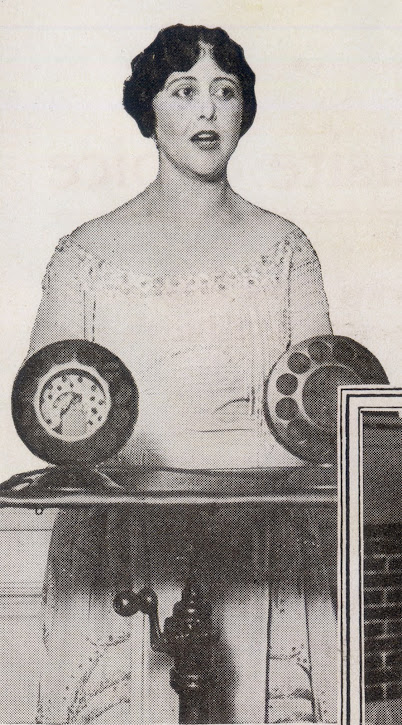
Anna Case is On the Air

Thomas "Tommy" Cowan made his way carefully up the ladder to the hatchway that led to the roof of the Westinghouse plant in Newark, one hand on the iron rungs, the other gently cradling a few Edison records.  Just the day before, on September 30, 1921, Tommy had called around to the headquarters of his former employer Thomas Edison in West Orange, hoping to borrow a phonograph and some Diamond Discs.  The phonograph, too large to fit through the hatch, had been hauled up the outside of the building and was sitting in the tiny shack that housed the transmitter for one of the nation's first commercial radio stations - WJZ.  This was the day of their first official broadcast - and the first record to be played was "Annie Laurie" by Anna Case.


It's possible that Cowan requested the Anna Case disc because of a broadcast that originated from the National Electric Light Association's annual convention in New York on September 28.  On that day the former Metropolitan Opera diva and noted concert soprano sang "Ave Maria" and "Oh Mother, My Love" to one of the largest audiences yet in radio's infancy.  Hobbyists and enthusiasts, thirsting for any sort of signal on their receivers, tuned in from as far away as Boston, Richmond, and Pittsburgh. 


Anna Case sings live over the radio at the NELA convention in September 1921.


She followed that up less than two years later with another triumphant radio first.  On June 7, 1923, from the stage at Carnegie Hall, she gave a concert recital broadcast simultaneously by four radio stations: WEAF, New York, WGY Schenectady, KDKA, Pittsburgh, and KYW, Chicago.

Singing to a radio audience of five million from the stage at Carnegie Hall,
June 7, 1923


It is estimated that up to five million listeners in the US and Canada were able to tune in, making it by far the largest radio audience up to that time.  And that figure probably doesn't include hundreds of fans gathered in the public square in Flemington, where the town set up a primitive public address system to transmit the historic broadcast of the "local girl". Compare that to just four years earlier in 1919 when the twenty-one-year-old Miss Case sang over the radio for the very first from an amateur "wireless" transmitter - station 2ABA located on State Street in Brooklyn. On that day she was heard by perhaps several dozen ships at sea that possessed the expensive radio equipment and a few dedicated amateurs that had the means and the know-how to tune in.

Anna Case (seated at right) signs a contract with Atwater Kent 
to appear on the Sunday Night radio broadcasts, 1925.

By 1924 Anna Case was such a popular radio performer that when the two leading national booking agencies agreed not to contract with any concert performer who also appeared on the radio - in the belief that ticket sales would be depressed if you could hear the same for free over the airwaves - only one exception was made - Anna Case. While lesser lights were effectively banned from radio if they wanted to maintain their careers, the booking agents knew that Anna Case was too big a star to ever be blacklisted.


Anna Case with Atwater Kent host and radio pioneer Phillips Carlin.


Throughout the 1920s and into the 1930s Anna Case could be heard "coast-to-coast" on various radio programs, including a show in 1928 celebrating her twenty years in music.  She also featured prominently on the fledgling NBC radio network.


She confessed a fascination for the equipment itself - her younger brother was a radio engineer - desiring to know how each component worked.  It could be argued the essential component was the one that made you walk over and turn the radio on for the first time - and that component was Anna Case herself.

18 October 2012

Annie Beekman, Strangled. Part Two

The home of Jacob Johnson, Hillsborough, NJ, Sunday, September 15, 1895.  Annie Beekman, a twenty-three-year-old former Hillsborough resident visiting the area for the first time in two years lies in the backroom of Jacob Johnson's modest cabin on the Elmendorf estate.  She is dead.

16 September 1895 New York Herald


In the front room are Johnson and his wife, along with the Somerset County Prosecutor, Constable Moore, and railroad flagman Joseph Gorman.  It was Gorman who alerted authorities that he could positively identify the dark-skinned black man and lighter-skinned woman who he saw crossing the tracks of the South Branch Railroad near the Raritan River late the previous evening - and that is what he has just done.

16 September 1895 New York Telegram


Annie Beekman's body was discovered by local laborer Peter Dow earlier that same morning.  It was obvious as he approached the body lying in a wooded area between the wagon road and the river that the woman was dead - and that she had been murdered. Her bodice was torn, corset wire ripped out, and finger marks were about her throat.  Coroner Brady, one of the first officials at the scene, ordered the body be taken to the nearest house, that of Jacob Johnson - a laborer employed on the estate of James B. Duke, and a preacher of some renown in the local black community.

Despite the failure of Coroner Brady to adequately secure the crime scene - evidence including footprints was trampled by curiosity seekers - it was obvious that the murder had taken place on the road, and the body had been dragged into the woods.  An empty purse lying nearby pegged the motive as robbery.

Somerset County Courthouse, 1891

The prosecutor confronted Johnson: hadn't he been seen all over Somerville the previous evening with the deceased, drinking in at least two different establishments?  How could he answer the accusation of Joe Gorman, who saw him and the deceased together not far from the site of the murder after 10 pm last evening?

Johnson insisted that he left Annie Beekman alive in the company of two white men at around 10 pm, and immediately returned home.  Johnson's son later admitted in court that his parents had argued that night upon Johnson's return, his mother demanding an explanation as to why he had been out all evening with Annie, instead of home with his family.

19 September 1895 New York Herald


Overwhelming circumstantial evidence which placed Johnson at the scene of the crime with motive and opportunity was enough for a grand jury and eventually a trial jury conviction.  He was convicted of murder and sentenced to death.

Johnson went to the gallows in Somerville on May 5, 1897.  In an ironic twist, he was cut from the scaffold after seven minutes but was not yet dead. As doctors felt for a pulse and listened for a heartbeat, the noose, still tight about his neck, continued to do its work.  A few minutes later, he was pronounced dead - cause of death: strangulation.

17 October 2012

Annie Beekman, Strangled, Part One

Somerset County Fairgrounds, Somerville NJ, Thursday, September 12, 1895.  Jacob Johnson hadn't seen young Annie Beekman in more than two years.  Some people said that she was dead or hospitalized - others, that she had married a much older man and was living in Newark.  In any event, she was there at the Somerset County Fair, standing at his peanut and soda-water stand.  By the end of the week, Johnson would be in the Somerset County Jail, accused of her murder.

Somerset County Fairgrounds, Somerville, NJ - 1891

Annie Beekman had indeed been living in Newark.  She told Johnson that she had returned to Somerset County to visit her brother in Hillsborough and to collect $45 that was being held in trust for her by Calvin Corle of Neshanic.  Annie and her brother, both of biracial descent, had been bound by their mother to Neshanic farmer Edward Horner.  Upon reaching the age of maturity, each was given $50.  Her brother had taken the full amount directly, but Annie withdrew just $5, leaving the rest with Corle.

The Elmendorf House on the Duke Estate, 2018


Jacob Johnson worked as a laborer on the estate of James B. Duke.  He lived with his wife, son, and daughter in a cabin on the Elmendorf property near the banks of the Raritan River, not far from the tracks of the South Branch Railroad.  He was well-liked and admired, especially in the black community around Hillsborough, where he was well known as a preacher with a particularly strong religious fervor.

Johnson suggested that Annie stay with them while she was visiting in the area.  She spent the day Friday visiting with her mother, and upon returning that evening, asked Johnson to accompany her on Saturday to Neshanic in order to recover her money from Mr. Corle.  She explained that she did not feel comfortable traveling alone with such a large sum.


Somerville Train Station - 1891

On Saturday afternoon, they boarded the train at the Roycefield Depot near Johnson's home for the short trip to Neshanic.  Annie received $45 from Mr. Corle, which she placed in a small purse and tucked into the bosom of her corset.  On the return trip, she suggested to Johnson that they get off the train at Somerville, and celebrate with a drink.
 

Commercial Hotel, Somerville, NJ - 1891

They went first to the Commercial Hotel, where Annie bought them a couple of rounds of beer.  She then suggested Cawley's restaurant, where they dined on sandwiches and wine - Annie carefully removing her purse, paying the bill, and returning it safely to its hiding place.
 

Cawley's Restaurant, Somerville, NJ - 1891

Johnson later told police that Annie had wanted to continue drinking, but he begged off, on the account of the lateness of the evening - it was already close to 10 pm.  Johnson claimed that before he left Annie near the Somerville Station, he saw her with two white men, one tall, one short and that she had gone off with them.
 
That's not the story told by Joseph Gorman, a railroad flagman working near the Somerville Depot that Saturday evening.  Gorman told police that he clearly saw the pair cross the tracks in the vicinity of Bridge Street, and head towards the Raritan River.
 

11 October 2012

Elmer Clawson, Boy Murderer, Part Two

May 12, 1897, 7 o'clock.  Elmer Clawson, 19, sits down to his final meal - steak, coffee, cake, and strawberries.  His stomach is queasy, and he picks at the strawberries.  He is just three hours away from becoming not only the youngest person ever to be executed in Somerset County but also the first white man to go to the gallows in that place in over a century.


Just one week earlier, the only other death row inmate in the Somerset County jail - black Methodist minister Jacob Johnson - was hung by the neck for eight minutes, then cut down still alive while the doctor waited another eight minutes for him to expire.  Several weeks earlier, Johnson, convicted of robbing and killing Annie Beekman, had foiled Clawson's escape attempt by telling the guard that Clawson had hidden an iron bar in his mattress straw, and had been fashioning a key out of a piece of metal from the leg of the iron bed frame.

The Old Somerset County Courthouse complex, circa 1905.
The executions took place in the basement of the jail.


No doubt  Clawson was desperate.  Convicted of killing Pluckemin farmer Harry Hodgetts on August 29 of the previous year, all appeals were exhausted and entreaties by leading Somerset County residents to commute the boy's sentence because of his age were unsuccessful.  On the witness stand, Clawson freely admitted that he had discharged his pistol three times, striking his former employer twice in the chest before fleeing on his bicycle.  In fact, Clawson had admitted his crime from the start - even going so far as to tell his family on his way out that fateful morning, that he was going out to kill Harry Hodgetts.

12 May 1897 New York Evening Telegram


It was this bizarre behavior, and the subsequent testimony of Clawson family members as to the family's history of mental illness, that caused defense attorneys to be hopeful of an acquittal, or at least a sentence of life imprisonment.  Jurors heard from six mental health experts.  Unsurprisingly, the three put on by the prosecutor pronounced Clawson perfectly sane.

After breakfast, Clawson - dressed in black jacket, white shirt, and black tie - had a final meeting with his attorney, and is reported to have said, "I would rather go to state prison for life, but am not afraid and will go through it all right."

12 May 1897 Courier News


At precisely 10 o'clock, Sheriff Wyckoff, accompanied by Hangman Van Hise, retrieved the prisoner - Van Hise slipping behind Clawson and tying his hands while Wyckoff proceeded with final instructions.  They walked to the basement gallows.  Clawson stood on the spot inscribed by a chalk mark on the floor while Van Hise adjusted the silken rope about his neck and lowered the hood over his face.  The execution, including nineteen minutes in the noose, was completed by 10:26.

10 October 2012

Elmer Clawson, Boy Murderer, Part One

August 29, 1896.  Farmer Harry Hodgetts of Pluckemin, an Englishman who emigrated to America in 1885, had just finished breakfast with his wife and three small daughters and was heading outside to begin his day's work at his 64-acre farm on what today is Route 206.  He was met unexpectedly by eighteen-year-old Elmer Clawson, a lad who had worked for him the previous season, but who he hadn't seen in over a year.

Elmer Clawson, before his execution in 1897


Clawson set his bicycle down by the road and strode up to meet Hodgetts by the door of his home.  Clawson asked for work, and when Hodgetts refused, Clawson demanded to be paid wages that Hodgetts had withheld the previous year - an amount equal to what Hodgetts suspected the boy had been skimming from produce sales to local merchants.

Harry Hodgetts
(Photo Courtesy of Amy Bell Johnson)


When Hodgetts again rebuffed the youth, Clawson drew a pistol and fired three times - two of the shots hitting the farmer in the chest.


As Clawson sped away on his bike, the Powelsons, who occupied the neighboring farm and had heard the gunshots, arrived on the scene in time to hear the last words of the victim - "Be quick". They immediately took to their farm wagons and their own bicycles and followed the track of Clawson's tire clearly visible on the dusty Bedminster Township roads.


Although it was drawn 40 years after the incidents,
this 1935 map of the bridle paths and byways of the
Somerset Hills is useful to locate the scenes of the murder and chase.


By the time the pursuers reached Far Hills four miles away, their numbers had grown to include more men on bicycles, wagons, and buggies.  

The Far Hills train station circa 1890s


At the Far Hills train station, Clawson overheard the station agent repeating a phone message that included his description, and regaining his bicycle made a mad dash for Bedminster.

New York Times, 30 August 1896


The closing vigilantes forced Clawson to ditch his bike and take to the underbrush at the side of the road, but the posse cajoled him out of his hiding place.  Word of Hodgetts death having reached the mob, they considered lynching him on the spot.  Only Constable Thomas Moore, riding up through the crowd at a full gallop, dissuaded the men from committing an act that would surely leave a black mark on Somerset County.

more tomorrow....