Showing posts with label Churches. Show all posts

10 February 2021

Saint Mary's Catholic Church of the Byzantine Rite

When the Johns Manville company moved its plant to Hillsborough in 1912, the rural township changed practically overnight. A whole new town sprung up, taking its name from the asbestos manufacturer, and filled with workers and their families. These new Hillsborough residents were of mostly Eastern European descent and within a few years, they began organizing new churches where they could worship in their own languages and with their own customs and rituals. 

Saint Mary's Catholic Church of the Byzantine Rite,
Main Street, Manville, circa 1920s

Among these new congregations - which by the end of the decade caused the number of churches in the township to double - were St. Peter and Paul Orthodox Church (1915), Manville Magyar Reformed Church (1915), Hungarian Reformed Church (1915), Sacred Heart Roman Catholic Church (1917), and Emmanuel Baptist Church (1919). A sixth church - Saint Mary's Catholic Church of the Byzantine Rite (1917) -   is significant for Hillsborough history because it began in Hillsborough, found itself in Manville after the 1929 separation, then moved to Hillsborough in 1996.

The three dozen men who met on July 22, 1917, to organize the church traced their roots to the Carpathian Mountain region of Europe. They were followers of the Greek - or Byzantine - ecclesiastical tradition and were anxious to have their own church in Manville where they could worship with their families.
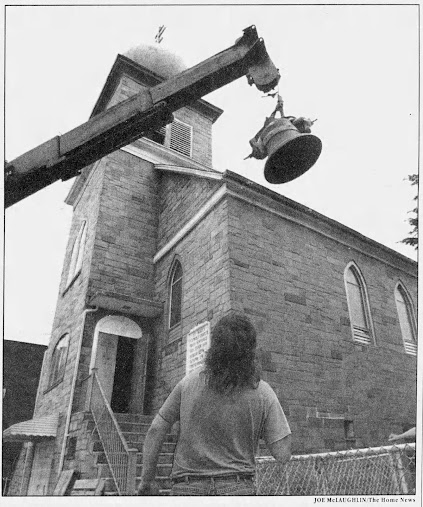

Bells being removed from St. Mary's to be reinstalled in the new church.


Within a month a charter had been granted officially forming the church, and four lots were purchased on Main Street where a building would be constructed. According to the book, Manville: A History Enduring by Kathryn Quick, no area building contractor wanted to tackle making the onion-shaped dome for the top of the church, so the job fell to local cabinet maker William Nagle.

After renovation and remodeling in the 1950s, Saint Mary's continued to serve the faithful Byzantine community from Manville and surrounding towns for decades. In 1974, the church purchased eleven acres of land on Brooks Boulevard in Hillsborough - and soon after another seven acres. Here they built a parish center for use by the CCD program, basketball, cheerleading, bingo, and other church events.


The "new" Saint Mary's on Brooks Boulevard in Hillsborough


In 1992 a plan was presented to erect a new church on the property adjacent to the parish center. The new church building, which was dedicated in June 1996, was built in the Byzantine style with three domes and an interior design in the Byzantine Ruthenian/Ukrainian tradition by Christina Dochwat.


9 June 1998 Courier News

Sadly, the old church on Main Street - only recently purchased and in use by the Faith in Action Church - was accidentally burned down during a renovation project on June 7, 1998.

19 June 2019

Faith Lutheran Church

Rev. Robert H. Loucks was something of an expert - not just in the Bible, but also in getting new churches up and running. So when the Lutheran Church in America was looking to organize a new congregation in Hillsborough in 1965, they knew who to call. Rev. Loucks had developed St. Stephen's in South Plainfield in 1955, and lately had served as pastor of Trinity Lutheran Church in Topton, PA. Now the Camden native was ready to come back to New Jersey and lend his guiding hand to a new Hillsborough church.

10 July 1965 Courier News

He spent the first two months in Hillsborough knocking on doors - 1300 doors to be precise - trying to find Lutherans or non-churchgoers who would be interested in supporting a Lutheran church in the township. Before long he reached his goal of sixty adults and forty children, and, with financial support from the New Jersey Synod of the Lutheran Church, Rev. Loucks held his first church service on October 10, 1965, at the Hillsborough Consolidated School (HES).


10 October 1966 Courier News
Exactly one year later, Faith Lutheran Church was officially organized as a congregation of the Lutheran Church of America. Now numbering 136, the congregation that had come together from 28 different area churches set their first goal - raising the first $1,000 for a church building fund. The Lutheran Church in America soon acquired 18 acres of land on the corner of Beekman Lane and what was then Amwell Road (now South Branch Road). Five acres were partitioned off for a church site.

19 May 1969 Courier News
In January 1967, Faith Lutheran Church purchased that 5 acres from their national organization and redoubled their fundraising efforts. To that end, the church employed a professional capital funds counselor and set an $8,000 "must" goal and an $11,000 "venture" goal - both soon surpassed. Groundbreaking for the initial structures at Faith Lutheran Church took place in May 1969.


15 December 1969 Courier News
The finished building consisting of a chapel and a classroom wing was dedicated on December 14, 1969. The contemporary church was designed by Michael Meloni. A major addition to the church was begun in 1992 and there has been yet another addition in recent years.

Aerial View from Google Maps
Faith Lutheran Church celebrated 50 years in Hillsborough in 2016, and will soon celebrate 50 years at its familiar location on Beekman Lane.

10 June 2019

Belle Mead Baptist Church - Fellowship Bible Church

As befitting the decentralized nature of the governing structure of the Baptist Church in the U.S., the Belle Mead Baptist Church didn't get its start as a mission project, or with permission from any regional church authority but rather, as explained by first pastor Rev. Harry B. Morris, "as a result of the spontaneous action of local people who felt a concern for the spiritual needs of their own area."


24 June 1967 Home News

The year was 1964, and Hillsborough residents who wanted to worship in a Baptist church found themselves having to travel miles to other towns. That, combined with the rapid growth of Hillsborough, almost guaranteed that a new church in Hillsborough would be a success. 


13 May 1967 Home News


The first Sunday service for the new church was held on November 22, 1964, at Hillsborough Fire company No. 2 on Route 206. The church also made use of the Rescue Squad building on Amwell Road, the Hillsborough Consolidated School (HES) and the Flagtown School. The church was officially incorporated in February of 1965 and one of its first acts was to establish a building fund.


18 November 1968 Courier News


In June 1966 the Belle Mead Baptist Church bought the 5 1/2 acre site at the corner of New Amwell and Auten Roads. It was correctly predicted that this site would be right in the middle of an anticipated housing boom. A year later, with the architect's plans and drawings in hand, the church launched a building drive to acquire the final funds needed to construct the $72,000 building.


7 March 1970 Courier News


Groundbreaking for the brick-veneered colonial style 36 by 92-foot building took place in November 1968, and the church was dedicated in March 1970. In 1976 the church changed its name to Hillsborough Baptist Church. In 2001 the church was renamed again to Fellowship Bible Church, possibly, as many Baptist congregations did during that time, to distance itself from the more fundamentalist Baptist churches in America.


Google Maps view


The nearly 50-year-old modest church building remains a treasured local landmark in Hillsborough.


11 May 2019

Hillsborough Presbyterian Church

The Presbyterian Church has a long, and more than a little disjointed, history in Hillsborough stretching all the way back to 1759. It was in that year that congregants borrowed a pastor from Bound Brook and met for the first time at the home of one of their members in Millstone. The next year they built their own church, sharing it with members of the Dutch Reformed Church until they built their own church in 1767.

18 November 1961 Courier News


In 1777, during the British encampment at Millstone, the English set fire to the Presbyterian Church, damaging it beyond repair. After the Revolution, the Reformed Church in New Brunswick and the Presbyterian Church in Princeton agreed that no new Presbyterian Church would be formed between Princeton and Pluckemin. Aside from a foray into Presbyterianism by the Clover Hill Church between 1840 and 1862, this agreement held into the middle of the 20th century.

Headline from the Courier News, 20 September 1961

In 1961 Rev. Dr. Orion Hopper got permission from the New Brunswick Presbytery to survey Hillsborough residents about a new church. Of approximately 450 households surveyed, nearly 200 expressed interest in joining a Presbyterian Church if there was one in the township. With this good result, a church was unofficially organized and the first Sunday service was held at the Hillsborough Consolidated School (now Hillsborough Elementary School) on September 24, 1961.

24 September 1962 Home News

The Consolidated School made a good initial home for the church - especially after they were able to negotiate the Sunday rental fee down from $240 to $148 a month - but what was needed was a site for a church building. Longtime Hillsborough resident Clifford Cunningham owned 8 1/2 acres at the northwest corner of Route 206 and Homestead Road. For years he had been trying to get suitable zoning to operate a number of small businesses on the property but was continually stymied by the Planning Board. He did have one business there - selling log cabins to Boy Scouts and other outdoor recreation concerns - and to further that enterprise he built a model cabin on the site that also served as his office. By the end of 1961, Cunningham agreed to sell the property to the church, thereby providing them not only with the space to construct a new building but also, with the addition in 1962 of a proper steeple, a building to hold their Sunday service and other activities. This became known as the Log Cabin Chapel.

3 April 1967 Home News

The church was officially organized with a service at the Log Cabin Chapel on May 12, 1963. Groundbreaking for the current familiar church building took place in April 1967.


The Hillsborough Presbyterian Church celebrated its 50th anniversary in 2013, becoming one of the longest enduring congregations in Hillsborough, whichever way you count it!


27 April 2019

Mt. Zion AME Church

For a great part of its history, going back to colonial times, New Jersey was a slave state. Africans labored on the farms, worked at the ports, and were employed as domestics. So important was slave labor to the economy that New Jersey was the last of the northern states to abolish slavery in 1804 - and then in a piecemeal way that left many blacks with the status of indentured servants.


Mt. Zion AME Church October 2018

Hillsborough Township did not escape the scourge of slavery. But to find evidence of Hillsborough's black history today sometimes requires looking beyond the city limits. On Hollow Road in the Skillman section of Montgomery Township stands the Mt. Zion African Methodist Episcopal (AME) Church. Engraved on the front right cornerstone of the church is the marking "Nov. 19, 1899", representing the date that the church building was moved from its original location in Hillsborough and placed on a new foundation in Montgomery.


Historic maps dated, clockwise from top left, 1850, 1851, 1860, and 1873,
each showing the location of the Mt Zion AME Church
Because we know that freed slaves and their descendants lived in the Sourland Mountain region of Hillsborough going back to the 18th century it is not surprising to see the Mt. Zion AME Church shown as "African Church" on area maps as early as 1850. The church, originally located on Zion-Wertsville/Long Hill Road near the intersection of Spring Hill Road, became part of the African Methodist Episcopal denomination in 1866.


October 2018
Not much is known about the church or its congregation before it moved to Skillman in 1899. In the first decades of the 20th century, the church was known as the Skillman AME Church. The "ladies of the church" regularly organized fish pounds, oyster suppers, and strawberry festivals - but by far the most popular event was the annual Camp Meeting. Held each year over four consecutive Sundays from mid-July to mid-August at Brophy's Grove near the church, the Camp Meeting was a festival featuring religious speakers, gospel music, and of course, their famous chicken dinners served from noon to five each day.


Research project created by Hillsborough High School history students
on display in the church October 2018
The Mt. Zion AME Church continued to serve the African-American community until disbanding in 2005. Today the church building is owned by the Stoutsburg Sourland African American Museum. As of 2019, rehabilitation and restoration of the building has already begun, and there are plans to include a museum of African American history on the site.


October 2018


13 May 2018

Mary, Mother of God Church, Flagtown

Martin and Susanna Bergen came to America fleeing the Great Irish Famine around 1850. He was twenty-two, she was eighteen. Whether they met and married here or in their home country is unknown. They settled in Newark on a farm on Bloomfield Avenue and had their first child, Nora, in 1857.


The Hoagland-Wyckoff-Bergen-McHugh House photographed in 2009

In the Irish-Catholic tradition, more children followed - including daughters Sarah and Mary. They lived for decades in Newark then moved to Hillsborough Township before 1900. They bought the house and farm off South Branch Road in Flagtown that in previous generations belonged to the Hoagland and Wyckoff families. By 1910, with Martin and Susannah both deceased, Nora, widowed sister Mary, and sister Sarah inherited the house where they lived with Mary's two teenaged sons. 

12 July 1920 Courier News

Religious life in Hillsborough's first two centuries was dominated by the Dutch Reformed denomination and its many area churches. Roman Catholics, of which there were few, traveled to Somerville, Raritan, or further to worship. Things began changing between 1910 and 1920 as eastern and southern European immigrants ventured out of the Eastern cities to New Jersey's suburbs and rural villages. Around 1916, Nora Bergen began arranging for a priest from Immaculate Conception Church in Somerville to conduct a service for area residents in the family home.


Early View of Mary, Mother of God Church, Flagtown

Over the next fifteen years, with the help of Immaculate Conception's Reverend Richard T. Ryan, Miss Bergen grew the congregation far beyond the capacity of the house, and it became obvious that they would need to build a church. She donated part of her property closest to the road, and on March 17, 1931, ground was broken for the Mission Church of St. Martin's. It was to be of red brick and to have a capacity of 450. Construction began the next month on a scaled-down plan - still called St. Martin's - with a capacity of about 300 at a cost of $20,000.

On Sunday, July 12, 1931, one thousand people - including various councils of the Knights of Columbus and twenty assorted clergymen - witnessed the dedication ceremonies of the newly-renamed Catholic Church of Mary, the Mother of God. Monsignor James T. Mckean of Bernardsville delivered the sermon from the front steps of the church. Until 1948 Mary, Mother of God was not its own parish, but rather a mission church directed by the parish of Immaculate Conception.


Mary. Mother of God Church, Flagtown, 2012

In 1981 the congregation of Mary, Mother of God constructed a new church on a portion of a 90-acre tract they purchased on South Triangle Road. At that time there were more than 1,000 families in the parish. By the time the church undertook an expansion project in 2009, that number had grown to 3,200.

Nora Bergen passed away on December 29, 1940, at the age of 85, in the home where she had lived for more than 40 years. She never married and outlived all of her family save her two nephews - but what a legacy! We might be tempted to call her the Mother of Mary, Mother of God!

29 December 2016

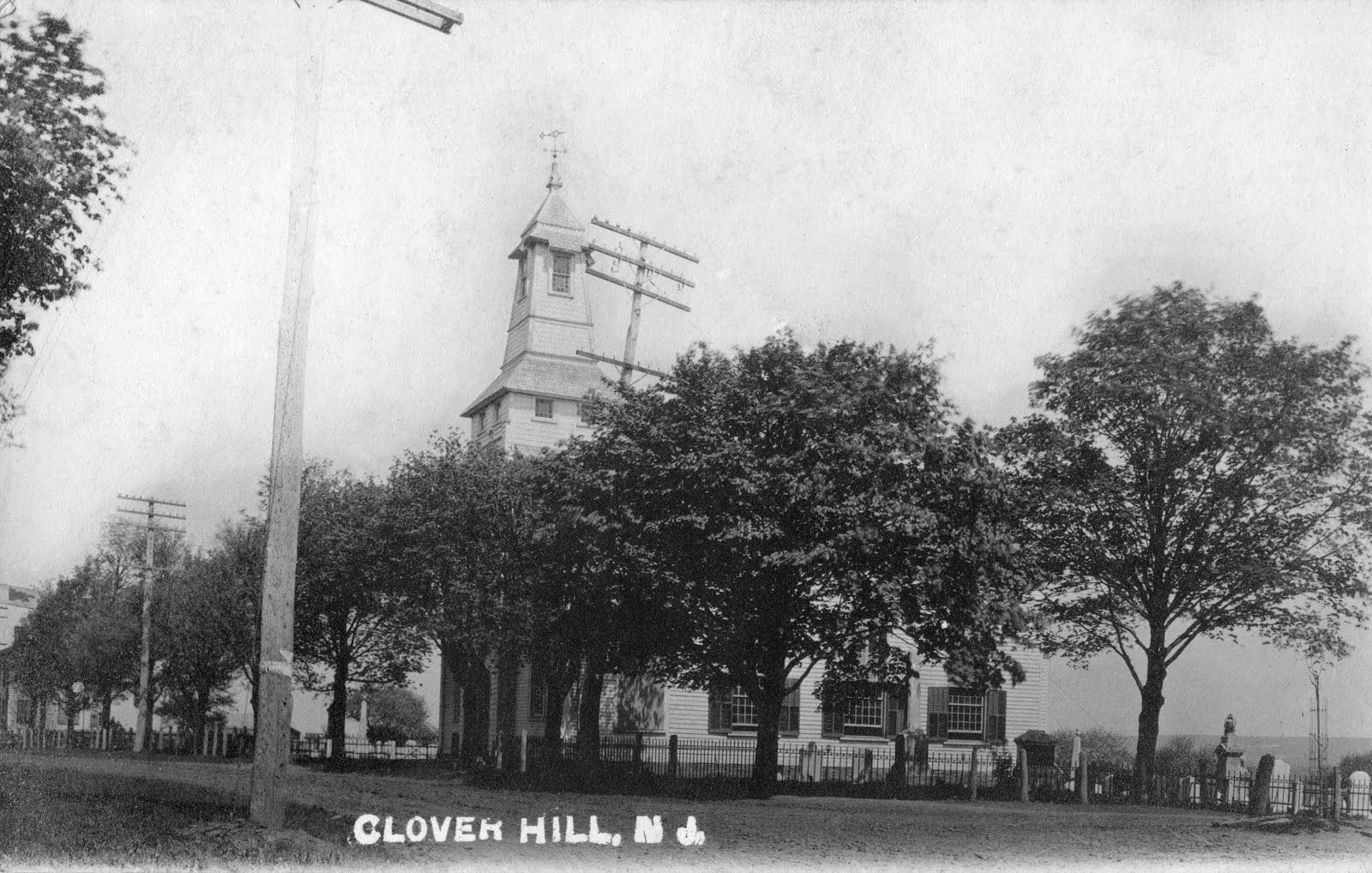
Clover Hill Reformed Church

Organizing of the 18th and 19th-century churches in Hillsborough Township, NJ followed a familiar pattern. Villagers who found it inconvenient to travel to nearby towns resolved to have a church of their own. 

The Clover Hill Church. postcard circa 1908

They applied to church elders in New Brunswick or elsewhere to be recognized by the wider church. After the church was formally organized, leaders would commence raising funds to construct a building - in the meantime meeting at any convenient space.

Aerial view from Bing Maps
The residents of Clover Hill had different ideas. They began working on an edifice before receiving permission from the Dutch Reformed Church, which was granted on September 4, 1834, while the church was nearing completion. 

From a postcard circa 1910
One month later on October 5, 1834, the Clover Hill Dutch Reformed Church was officially dedicated. Yes, the church was built on spec!


National Register application photo, 1977


Perhaps it was this independent streak which led the membership to secede from the Dutch Reformed denomination in 1840 to join with the Presbyterian Church - an affiliation which would last for twenty-two years. Abrahm Messler reports in his Forty Years at Raritan (1873) that ten years after rejoining the Dutch Reformed Church, the church was "enlarged and refitted" and boasted 75 families.


CLOVER HILL HISTORIC DISTRICT, HUNTERDON COUNTY
The rear of the church and the cemetery, 2007 By Jerry & Roy Klotz, MD (Own work) [CC BY-SA 3.0 (http://creativecommons.org/licenses/by-sa/3.0)], via Wikimedia Commons


The church is the centerpiece of the Clover Hill Historic District, entered on the National Register of Historic Places in 1980. The district encompasses properties in Hillsborough, Raritan, and East Amwell Townships. Here is the description of the church from the National Register nomination form:

Dutch Reformed Church, 1834. This is a two-story structure of wood frame construction, The foundation is of random-coursed rubble construction. There are three lancet windows on each side of the building and two round topped windows on the front (one on either side of the main entry-way). All of these windows are two stories tall. There are also two short round-topped windows directly above the main entry-way. The siding is of narrow width clapboard with the exception of the center section of he front of the building. This section is sided with a "fish scale" type of clapboard. The cupola presently found on top of the belfry replaced the steeple that was blown down in the 1880s. The roof is a simple gable type with asphalt shingles. The four corners of the main section of the building have short spires typical of the Gothic Revival style of architecture.

16 December 2016

Mt. Zion United Methodist Church

Religious life in 18th century Somerset County was dominated by Dutch Reformed and Presbyterian denominations. By the early 19th century, the Methodist faith was beginning to make inroads into the area - first with itinerant preachers, then through established churches.


Detail from the Somerset County 1850 Map showing the area of Rock Mill(s)
and the location of the original Mt. Zion Chapel

At first, the sparsely populated Sourland Mountain region in Hillsborough Township's southwest corner would seem an unlikely place to build a church in the first half of the 19th century. Originally populated by freed slaves and people that wished to remove themselves from society, and later by those looking to take advantage of water power for sawmills, gristmills, and especially earthenware production, there was enough enthusiasm by 1843 that a small plot of land was acquired and the first wood frame church was built.


Circa 1908 postcard view of the second Mt. Zion United Methodist Church.

Despite oftentimes having to share a minister with the Methodist churches in Neshanic Station and Centreville, the congregation grew - perhaps numbering as many as 200 by the time the original church was destroyed by fire in 1880. A new 30 by 60 foot building of random coursed stone was immediately built as a replacement, but the end of pottery manufacture on the mountain saw membership shrink and the church fall on hard times - such hard times that the church shut its doors between 1907 and 1916.

A more recent view of the Mt. Zion Church after the 1975 fire and reconstruction.
The interior of the church was restored after a 1975 fire, and you can view photos and learn more about the history of the church at their web site here.

02 December 2016

The Neshanic Reformed Church

According to historian Ursula Brecknell in her book Hillsborough: An Architectural History, it was the 1748 death of Reverend Theodorus Frelinghuysen that "brought to an end a long-simmering theological dispute and a desire to unite in brotherly love". Members of the Dutch Reformed faith in Hillsborough Township who had been variously "alienated and excommunicated" and split among different congregations in Harlingen and Readington now desired to reconcile and form a new congregation closer to home.

Postcard circa 1905


On the 25th of August, 1752, church elders met at Readington to hear the petition for a new congregation with a church to be built somewhere along Amwell Road. Permission was granted to form the Neshanic Dutch Reformed Church, and by October 11 a site was chosen. It wasn't until 1760, however, that a deed to the property - consisting of one acre of land with a dwelling on a knoll on the north side of the road - was obtained.


Postcard circa 1900.
Looking south with a view of the rear of the church and the Sourland Mountain

Surviving account books show us that work on the church actually began a year earlier, in 1759. Trenches were dug for the foundation, and enormous amounts of stone were cut and hauled from Sourland Mountain. It is likely that services were held in the church before the interior was completed in 1772. 

Postcard circa 1908


Aside from the massive stone walls, the church looked quite different in those earliest days. It was said to have had a hipped roof with only a weather vane on top - no cupola. The windows were markedly different - not in the Gothic style, and certainly no stained glass. And it is anyone's guess as to what the front facade looked like.

Anna Case returns to the church where she led the choir as an 18-year-old in 1905 and 1906
 - one of her first paying jobs - for a church fundraiser, on July 3, 1930. The caption states that she is playing the organ she played years earlier, and that may be so - but a new organ was donated by Andrew Carnegie in 1915

A cupola and bell were already in place by 1832 when church members debated how to lengthen the church. Should they add 12 feet to both the north and south ends - or 15 feet to the front (south)? The fact that today it is impossible to tell which they chose, or if another scheme was decided upon, speaks to the fine craftsmanship of the mid-19th century. The lengthening at the front of the church - and we can be pretty sure today we are looking at a 19th-century front facade because of the three entrances - is absolutely seamless in the stonework on each side. 

Postcard circa 1905


Stained glass windows were likely a late 19th-century addition, as was a remodeling of the interior to a Victorian style. In 1999, with the cupola in desperate need of repair, the church partnered with Bell Atlantic Mobile who provided a replica made of fiberglass in exchange for allowing a cell antenna to be installed within it.


1977 National Register photo.

Today, the Neshanic Reformed Church is the centerpiece of Hillsborough's Neshanic Historic District, entered the National and State Historic Registers in 1979.

04 November 2016

The South Branch Reformed Church

Around 1830 the inhabitants of Branchville, now known as South Branch, decided they needed a church of their own. Nothing much came of the idea until 1842, when a committee was formed to discuss the plausibility of raising enough money to build a church in the quiet Hillsborough hamlet on the south branch of the Raritan River. It was found that there were enough funds to erect a church building, but probably not enough to support a minister.


Members of the South Branch Dutch Reformed Church
 at the 50th anniversary celebration, 29 May 1900.

On December 17, 1849, townsfolk, many descendants of the original Dutch settlers of the village, met at the schoolhouse across the river in Branchburg - just north of the present one-room school -  to take up the matter once again. They soon had fifty-eight families committed to uniting and forming a congregation connected with the Dutch Reformed denomination.


Postcard circa 1908 showing the original smaller cupola

Things moved more quickly now, with the Classis of New Brunswick approving the church organization in April, and the membership meeting again at the schoolhouse on May 14, 1850, to officially be designated as "The Dutch Reformed Church of Branchville". They immediately began planning the construction of the church. The site was donated by the Amerman brothers, and a contract was made with William A. Voorhies of Griggstown for $3,174.


Illustration from the cover of a 1967 community cookbook.

The building was modeled after the recently completed church in Whitehouse. It is in the classical Grecian style, with fluted columns at the entrance that are set within the porch area - a feature of churches of this type in New Jersey. In her book, Hillsborough: An Architectural History, the architectural historian Ursula Brecknell gives us this interesting serendipitous tidbit.

Although rules existed for determining classic relationships of pediment to columns and again to the angle of pitch of pediment, they were largely ignored by 19th-century architects for numerous reasons; accordingly the matter of obtaining aesthetic relationships depended primarily on the skills of the carpenter for the "felt line". One of the graces of the South Branch Church is its success at this point in having a pleasing ratio.


This photo accompanied the 1976 Historic Register nomination form.

Reportedly President Chester A. Arthur attended services here in the 1880s during one of his many visits to the country home of his Secretary of State Frederick T. Frelinghuysen. But the most famous member was future operatic soprano Anna Case who attended services and sang in the choir from the 1890s to around 1906. Much later she gifted her family's home - directly south of the church - to be used as the second parsonage.

Anna Case singing in the choir as depicted in a 1912 illustration.


21 October 2016

Hillsborough Reformed Church at Millstone

This past summer, the Hillsborough Reformed Church at Millstone celebrated the 250th anniversary of their congregation. On July 28th, 1766 seventy heads of the families of Dutch settlers in the Millstone Valley petitioned the ministers and elders of the Dutch Reformed churches at Raritan, New Brunswick, Six Mile Run,and Harlingen, to be allowed to form a separate church at Millstone.

Postcard circa 1905

The petition was deliberated and approved on August 11, 1766. The church first organized under the name "New Millstone" because the church at Harlingen went by the name "Millstone". By the end of 1767, the first church building was erected on the site where the present church stands today. It had three aisles, sixty-six pews, and a stairway in the southwest corner which led to the belfry.


South Elevation, from the Historic American Buildings Survey, 1939


In June of 1777, the British set fire to both the Dutch Reformed Church, and the small Presbyterian Church. Although the interior was completely destroyed, the structure of the building was saved, and, through careful repair over the years remained in service to the church community for sixty years.


From the Historic American Buildings Survey, 1939

In 1827, eighty members petitioned church elders to either repair and enlarge the old church, or build a new one. Joachim Quick was contracted to build a new church. He received the sum of $5,000 ($120,000 today) and all the materials he could salvage from the old church. Mr. Quick put the boards and timbers from the old church to good use, using them the next year to construct the covered bridge at South Branch, which was in use for 100 years.


East Elevation, from the Historic American Buildings Survey, 1939

The building was to take its design cues from the third church at Six Mile Run, which had been completed just two years prior. Both churches were a spacious, for the time, 70 by 55 feet. The cornerstone for the present church was laid on June 8, 1828, and the church was dedicated at Christmas of the same year. 


From the National Register of Historic Places nomination form, 1974

The nomination form which placed the village of Millstone on the National Register of Historic Places described the church building:

This is a two story building with a random course rubble foundation. The exterior of the building is clapboard. Brick is used for insulation. The walls are full timbered and pegged. The windows on the sides are 16/12 while those on the south end (main entrance) are 15/15 with semi-circular tops. There are no windows on the ground level on the south end. The three doors are arranged in a symmetrical pattern with the windows of the second floor and quarter windows of the attic. A circular window is at the attic level directly over the center door as is a circular lite in the steeple. The bell turret is octagon in shape. The roof is slate on wood shingle and gabled. The building has brick chimneys.

Longitudinal Section, from the Historic American Buildings Survey, 1939


As you can see from the photos, the church building, which will reach its bicentennial in a dozen years, looks the same today as it did more than a century ago, and likely much as it did in 1828, 


West view, 2015