Showing posts with label Anna Case. Show all posts

11 May 2021

Anna Case - Roots in Hillsborough

Over the years people have asked me where Anna Case - the South Branch girl who became a national sensation as an operatic soprano, concert and recording artist, and radio and film star - fits in with Hillsborough genealogy. This post will serve as a repository for some of my findings.

Birthplace of Anna Case, Clinton, NJ

Yes, Anna Case was born in Clinton, New Jersey on October 29, 1887. This appears to be during a brief relocation of the family to Hunterdon County for reasons unknown. As for her often disputed birth year - most publications used 1889, which is what Anna Case herself may have been comfortable reporting throughout her life. Part of her story was that she came to the Metropolitan Opera at a very young age, so shaving a couple of years probably seemed like no big deal. When she was in her 90s she reverted back to her real age which left researchers with a dilemma. It appears they split the difference and began citing her birth year as 1888. The actual year was 1887 as can be found on nearly every authoritative source such as passport applications, ship's passenger lists (where a passport would need to be shown), and even the US Social Security Death Index. Now if someone would just tell the editor at Wikipedia who keeps changing it on me using secondary biographical sources to cut it out it would make this a lot easier!


1920 US Passport Application
Birth Date - October 29, 1887

When the family - Anna, father Peter Van Nuys Case (1863-1925), and mother Jeannette Ludlow Gray (1868-1949) - moved back to Hillsborough in 1890 they were coming back to their roots. Both Anna's mother and father could trace their ancestry back to the earliest Dutch settlers that came to Somerset County in pre-Revolutionary times. Surnames such as Van Nuys, Ditmars, Quick, Stryker, Van Arsdalen, Hegeman, Wyckoff, Stout, and Saums - all familiar to students of Hillsborough history - can be found in the fan-style family tree chart below.


Anna Case Family Tree - sourced from FamilySearch.org

Anna Case's paternal grandfather Elisha Case (1823-1885) had a blacksmith shop on the northeast corner of today's Triangle and Farm Roads. Peter Case - who for decades was one of two blacksmiths in South Branch learned his trade here at what was for many years known as Case's Corner. Peter's older brother James Staats Case (1852-1925) also plied his trade as a wheelwright at this location and later joined his brother's family in South Branch.


Clockwise from top left: 1850 Somerset County Map,
1860 Philadelphia and Vicinity Map, 1860 Farm Map of Hillsboro',
and 1873 Beers Atlas.

In 1891 a second child was born into the family. In what was a foreshadowing of future tragedy, Myrtle Jeanette Case died the next year at the age of one. Anna was not quite 11 years old when her brother Peter Stanley Case (1898-1948) was born. A second brother Jeremiah Lester Case (1901-1950) was born three years later. 


The South Branch blacksmith shop of Peter Case.
Brother James Case had his wheelwright shop in the rear of the property.

Anna Case often described how her mother was ill with various ailments during this time and much of the care of the two boys was left to the young teenager. 


Jeanette Ludlow Gray Case,
in the early 1900s

Peter and brother James both died in 1925, after which Anna Case repurchased the family home on the corner of South Branch and Orchard Roads and gifted it to her mother. 

Jeremiah's first wife, Lois Annie Alcock, passed away in 1933 when their son, Jeremiah Lester. Jr. was just five years old. Junior died in 1940 at the age of twelve from complications after mastoid surgery. 

In 1948, Peter Stanley Case, who had become a sound engineer, killed himself with a shotgun at his home on Mountainside Avenue in Bridgewater. He had been estranged from his wife since 1939 who had accused him of being obsessed with keeping up with his multimillionaire sister. He left a son and daughter.

Jeannette Case died in 1949 at the age of 80. Jeremiah Lester Case died the next year at the age of 49. He had become an appliance salesman and was living with his second wife in San Diego at the time.


Jeremiah Lester Case and Jeremiah Lester Case, Jr.
with, possibly, Lois Annie Alcock - Jeremiah's first wife
who died in 1933.


11 September 2020

Anna Case Is Made, Part 2

On May 4, 1909, Giulio Gatti-Casazza and Andreas Dippel - the co-managers of the New York Metropolitan Opera - sailed for Europe on their annual talent search. Before they left, the pair announced the singers they had already signed for the new season beginning in November, including the only singer up to that time who had not trained in Europe - a twenty-one-year-old soprano from South Branch, New Jersey named Anna Case.

25 May 1909, Butte Miner

Although she had been singing professionally full-time for just over two years - and had been making a reputation as a unique talent at least since her July 4, 1908 appearance at the famous Ocean Grove Auditorium - this was the first time the national public had heard the name Anna Case.

12 May 1909 St. Louis Post-Dispatch

Aside from being the first Metropolitan Opera singer with no European training, other now-familiar elements of Anna Case's story were promulgated by the press in those first weeks and months after Herr Dippel's announcement. Much was made of the fact that her father Peter Case was the village blacksmith at South Branch and that his daughter helped him in his shop, even shoeing horses on occasion.

The blacksmith shop of Peter Case from a circa 1907 postcard.
The house Anna Case grew up in is on the right.

Before long, syndicated feature stories began to appear in the pages of newspapers across the country. Although most got the circumstances of the chance meeting between Director Dippel and the budding singer wrong - they met at her performance at Philadelphia's Bellevue-Stratford Hotel, not at a church in Plainfield - other parts of her story came to light. Readers were fascinated by the story of the early life of Anna Case - how she scrubbed floors and worked in the kitchens of her neighbors, sold soap door-to-door, drove a hansom cab for fares to and from the local train stations, and gave piano lessons for children in the evenings - a revolver tucked into her belt for protection on the country roads.

30 May 1909, St. Louis Post Dispatch

In the first few years of her career with the opera, more aspects of the beginnings of Anna Case were revealed - how she borrowed seventy-five cents a week from the South Branch grocer so that she could take singing lessons from a Somerville music teacher, how she got a job playing the organ and leading the choir at the Neshanic Reformed Church, and then a job singing in the quartet at the First Presbyterian Church in Plainfield.

5 December 1909, San Francisco Examiner

By the time she agreed to meet a photographer on the roof of one of the big newspaper buildings in New York to have her photo taken holding a blacksmith's hammer, the story of Anna Case was already well known. It's not unusual or surprising that the press - and the Metropolitan Opera - would engage in myth-building - in later years they managed to shave first one, then two years from her age in order to promote an ever-youthful prima donna. What is surprising is that in the case of Miss Case the stories were essentially true. 

22 December 1912, Buffalo Sunday Morning News

Unlike other New Jersey celebrities, past and present, whose connection to our state became more tenuous the more famous they became, Anna Case belongs to that group which includes Frankie Valli and Bruce Springsteen - singers for whom the New Jersey of their youth became an essential element of their larger-than-life stories. 

25 August 1931, Brooklyn Standard-Union

But it wasn't only Anna Case's story which remained inextricably linked to New Jersey throughout her lifetime, but also Anna Case herself. After the death of her father in the 1920s, she repurchased her childhood home in South Branch and remodeled it as a home for her mother. After her mother's passing, Anna Case kept the home as a country retreat before gifting it to the South Branch Reformed Church in 1974 at the age of 86.

22 August 1957, Courier News


19 December 2017

Anna Case All Wrapped Up

Nearly every brief bio of Metropolitan Opera soprano Anna Case neatly wraps up the story of her life and career with a sentence along the lines of "After her 1931 marriage to telegraph and cable tycoon Clarence H. Mackay, she retired from the concert stage." The problem with that is that the South Branch girl lived for another 53 years! She must have done something between 1931 and her death on January 7, 1984, at the age of 96.


With conductor Albert Coates
 at the New York Philharmonic Symphony Orchestra concert
 at Lewisohn Stadium, 22 August 1932

In fact, although she did announce her retirement from the concert stage soon after the Mackays returned from their honeymoon, by the end of the year Mrs. Mackay was performing some benefit concerts. Over the next couple of years, as she settled into life at Harbor Hill - the Mackays gilded-age Long island mansion -  more charitable events were added to the schedule as well as a few professional engagements.


Dancing and singing "Sidewalks of New York", with former Governor Al Smith,
2 March 1935
(Collection of Gillette on Hillsborough)

Still enjoying her celebrity status throughout the 1930s, the former diva was much photographed at events from charity functions to dog shows.


At the Westbury Dog Show, 28 September 1936
(Collection of Gillette on Hillsborough)

In 1936, Anna Case renewed her songwriting efforts, which you can read about here.


30 April 1938 Des Moines Tribune

She also could be heard occasionally on the radio, most notably on a 1938 Mother's Day special which also featured silent screen star, Mary Pickford.


The Golden Rule Mother's Day radio special, 8 May 1938

The little village of South Branch was always in her thoughts. In the 1920s she purchased her childhood home just south of the church, renaming it Le Reve - The Dream -  and gave it to her mother. She visited often and sang at Somerset County's 250th-anniversary celebration in 1938, and at the dedication of Hillsborough's War Honor Roll in 1943.

At Somerset County's 250th anniversary,
23 May 1938 Home News

As she had during the first World War, Anna Case dedicated herself to the war effort. She entertained servicemen at the weekly dances held in New York City at the Arcadia Ballroom, and even wrote a song to rally America - "Hallelujah! Hallelujah! We'll Pull Together."

Performing for servicemen during WWII
at the Arcadia Ballroom in New York,
December 1943

After her mother died in 1949, she kept Le Reve and used it as a country retreat, dividing her time between her New York apartment and Hillsborough.

At the unveiling of fellow Metropolitan Opera diva Frieda Hempel's portrait,
February 1957
(Collection of Gillette on Hillsborough)

Always ready for a photo-op, Anna Case was on hand to honor past and current divas in the 50s and 60s.

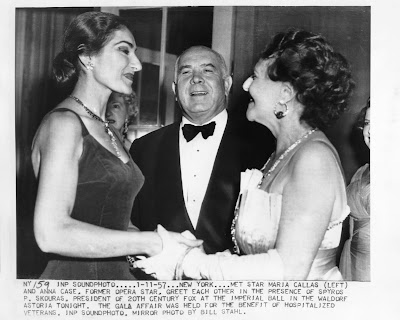
Veterans Benefit with Maria Callas, 11 January 1957
(Collection of Gillette on Hillsborough)


Congratulating Joan Sutherland at her Englewood, NJ recital,
23 February 1961


In 1974 she gave the house to the South Branch Reformed Church to be used as their parsonage - a function it still serves today.


22 August 1957 Courier News

Before she passed away in 1984, she bequeathed her 167-carat emerald necklace to the Smithsonian. She also provided the Metropolitan Opera with an endowment and set up a scholarship fund for young singers through the Santa Fe Opera.

At her East 92nd Street home.
From the cover of the 28 February 1970 Opera News

With all of the many "firsts" Anna Case had throughout her long career in the opera, concert, recording, film, and radio fields, one of the most interesting just might be something that took place twenty years after she passed away.


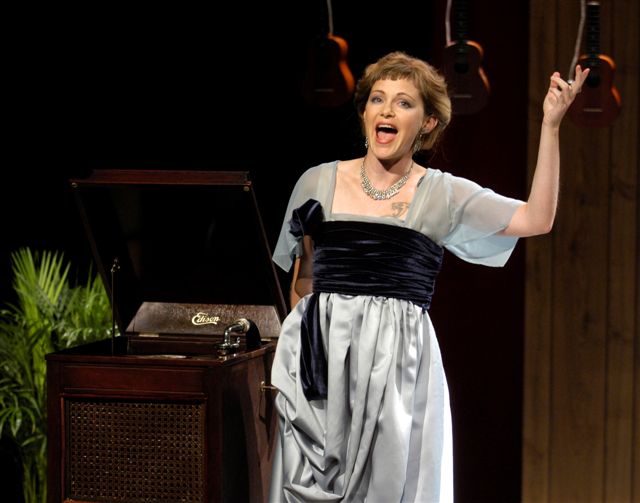
Dina Emerson in the world premiere of "Tone Test"

Dina Emerson as Thomas Edison's favorite soprano Anna Case. American Opera Projects and the Lincoln Center Festival presented the WORLD PREMIERE of "Tone Test" at the Clark Studio Theater as part of the 2004 Lincoln Center Festival.
[Photo by Richard Termine, courtesy American Opera Projects and Lincoln Center.]


In 2004 composer Nicholas Brooke debuted a new one-act opera titled "Tone Test" about a man obsessed with the music he hears on old Edison Phonograph records. The score for the opera actually uses samples of Edison Diamond Discs. The other character in the opera is none other than Anna Case - played by singer Dina Emerson. So, it appears that Anna Case may be the only real-life opera star that is also a character in an opera!

Now that's the way those bios should wrap it up!

05 December 2017

Anna Case Coming and Going

When operatic soprano Anna Case made her debut with the Metropolitan in 1909, much was made of the fact that she was the first American singer to appear with the famed company never having had any training in Europe. This fact only added to the fascination people had with the twenty-one-year-old daughter of the South Branch, NJ village blacksmith.


Anna Case waves to the cameras as she leaves for Europe on the liner La France,
28 June 1922
Unfortunately, her first trip to the continent in July 1914 couldn't have come at a worse time. As reported in the July 18, 1914, Courier News, her plan was to spend the summer traveling with a "girl chum" through France and Germany before returning for the fall opera season. The pair had the bad timing of being in the latter country when Germany declared war on Russia on August 1, and war on France on August 3.

Emergency Passport Application filed in Bern, Switzerland,
11 August 1914
With most of the continent mobilizing for war, Anna Case, along with thousands of other tourists, descended on the train stations looking for a way out. After an escape into Switzerland, she met up with another group of Americans at St. Moritz, including retired American Army Captain Philip Lydig. With the party now numbering a half dozen, and the mass of humanity on the train platform at St. Moritz threatening to bring a halt to their flight, Captain Lydig was able to snake his way through the crowd and commandeer a compartment - putting a sign in the window which read, "This compartment reserved for Capt. Philip Lydig, United States Army.

After some further subterfuge in Dijon, the group was able to board a military train bound for Paris. Anna Case eventually made it back the States by way of London and Montreal in time to fulfill an engagement for the home folk, giving a concert on October 9 at the Second Reformed Church in Somerville.


The Musical Courier, 19 August 1920

With war raging in Europe, Anna Case found herself stateside for the next five summers. She was finally able to satisfy her wanderlust in 1920, with an extended four-month trip that included a well-publicized recital at Queen's Hall in London, shopping in Paris, taking in the sights at St. Mark's square in Venice, and relaxing on the beach in Lido, Italy.

Newspaper photos from the 27 August 1922 New York Tribune
 and the 1 September 1922 St. Louis Post Dispatch

Her next trip across the pond in 1922 was notable for the number of intended destinations listed on her passport application - "British Isles, France, Switzerland, Holland, Italy, Belgium, Germany, Austria, Czecho Slovakia [sic], Jugo Slavia [sic], Spain, Monaco. Norway, Sweden, Denmark, Morocco, Gibraltar, Algier, Egypt, Palestine" - and for the return to New York, where she led the passengers in The Star Spangled Banner as the ship passed the Statue of Liberty in New York harbor.

10 March 1924 Harrisburg Telegraph

Something new for 1924 as Anna Case began the new year with her first concerts in Hawaii. She closed each concert with "Imi Au Ia Oe" - which she made a record of later that summer, along with three other Hawaiian songs. She even found time to be photographed in a grass skirt playing the ukulele!

News photos from August 1924

As her celebrity grew in the 1920s, news photographers were at the ports for nearly every departure and arrival. Calling out "Miss Case, Miss Case" - and even suggesting poses, like in the August 1924 photos where a reporter handed the departing diva a pipe, resulting in the iconic photo below.

2 August 1924 Minneapolis Star

Newspapers who ran the photo below of Anna Case returning to New York on the Leviathan after her summer 1925 European trek, proclaimed that she "looked glad" to be back. 


I'm sure she was, although it must have been bittersweet as her father Peter Case passed away on August 5th while she was still overseas. It was on this trip that she gave her first concerts in Germany.


20 January 1926 Honolulu Advertiser

She spent the 1925 Christmas holiday performing her second concert series in Honolulu. Fans and friends were sad to see her go in January, covering her in leis. She thanked them by singing a group of Hawaiian songs as she stood on the deck of the departing ship.

Sailing for Europe SS Mauretania, 27 July 1927
The trip to Baden-Baden in the summer of 1927 was advertised as being "for a rest", as were her 1928, 1929, and 1930 trips - photographic evidence shown below.

Coming and Going, 1928, 1929, 1930

After nearly two decades of being photographed at the port of New York, the most widely printed photos of Anna Case are undoubtedly the shots of her returning from her honeymoon in England and Scotland with husband Clarence Mackay - the telegraph and cable magnate - on September 15, 1931.

Returning on the Olympic, 15 September 1931

This photo, or variations, appeared in most daily US newspapers in September 1931.

28 November 2017

Anna Case on Record

In 1981 Tom Petty had a problem with MCA, the distributor for Backstreet Records. They wanted to raise the list price of his soon-to-be-released album Hard Promises from the industry standard $8.98 to the "superstar price" of $9.98. He was having none of it and withheld the master tapes of the album until MCA relented.


October 1912 Edison Phonograph Monthly trade journal

This was a big story that made all of the music rags at the time - I wonder if it was big enough to have caught the attention of 93-year-old Anna Case Mackay, the retired opera and concert soprano and renowned recording artist. 


February 1915 Edison Phonograph Monthly trade journal
She cut her first two sides for Thomas Edison's recording company in 1912 on the format that had only one side, literally - the cylinder. She followed that up in 1913 with two more selections for Edison's new invention, the Diamond Disc. These ten-inch diameter, quarter-inch thick, 80rpm records, with a song on one side, and an"explanatory talk" on the reverse, were such huge hits for Edison that he signed Anna Case to an exclusive contract in 1914.


November 1917 Edison Ad
Here is how the house publication, Edison Phonograph Monthly, described the signing:

"The cost to secure the exclusive services of this eminent artist, precludes the possibility of selling the records at $1.50. It has been decided, therefore, to list all solo selections by her in the $2.00 class. This applies to the two selections now in the disc catalog 80119 and 80120, which have been renumbered 82077 and 82078 respectively."
Anna Case was truly the Tom Petty of her day - the difference being that she didn't fight the price increase, but was probably honored to be elevated. And elevated it was. Just think about it. In 1914 a music lover had to pay $2.00 to own just one song - twice as much as MCA wanted to charge for the ten-track Hard Promises. Not only that, but $2.00 in 1914 was the equivalent of $18 in 1981 and $49 today! If record prices had kept up with inflation, we'd be paying $500 to download an album on iTunes.


1918 full-page ad

Edison didn't keep sales records for his Diamond Discs, so it's not easy to calculate how well the 100 tracks Anna Case recorded for the format sold between 1913 and 1926. But given the massive amount of promotion she received with Edison - with custom window displays for record stores, numerous cover photos on Edison publications, and prominent full-page ads, like the ones above, in popular magazines - we can assume she was one of his top sellers.


December 29, 1928, Music Trade Review

She cut her final two songs for Edison in June 1926 - the same month that her contract expired. She signed with Warner Brothers to make short subject sound movies using the new Vitaphone process - the first successful attempt at "talkies" - but only made two (La Fiesta, and Swanee River). 


September 1929 Columbia Records Ad
At the end of 1928, Anna Case signed with Columbia Records. She released eight 10-inch and two 12-inch double-sided 78s through the end of 1930, recording 20 tracks in all for the label. Unlike the status she enjoyed with Edison, she received little promotion from Columbia. Can you even find a mention of Anna Case in the ad above? With Edison, she would have been pictured prominently in an ad like this. With Columbia, you need to look closely to find the two listed records - I highlighted them for you. In the 1930 record catalog, below, she is relegated to a small photo on page 147.


Page from the 1930 Columbia Records catalog
For all that, the songs Anna Case recorded for Columbia - using the improved "electrical process" - hold up well for sound quality when compared to the Edison "acoustic" discs. And despite the fragility of the Columbia discs, which make them harder to find today than the near-indestructible Diamond Discs, good examples were able to be easily transferred to other formats. Which means that if you pick up one of the two available Anna Case CDs today, it will be comprised of about sixteen Columbia sides and only four Edisons!


26 September 2017

Anna Case's Garden Party, 1919

Anna Case spent much of 1917 and 1918 singing for the troops at army camps in New Jersey and New York, pitching war bonds, and appearing in patriotic concerts. She wrapped up her war efforts on June 14, 1919, by hosting a lawn party for hundreds of convalescent soldiers at her Mamaroneck, NY summer home.


29 June 1919 St. Louis Post Dispatch
The Metropolitan Opera soprano and South Branch, New Jersey native had just completed one of her most ambitious and successful national tours the previous month, including concerts up and down the west coast from Yakima to Los Angeles, and was looking for a way to give back to veterans of the Great War recuperating in military hospitals. When she hit upon the idea of hosting a day out at her country retreat, she asked that the most severely wounded, especially those not ambulatory, be given top priority on the guest list.


1 July 1919 Buffalo Enquirer


The piano was moved out onto the porch which was, according to newspaper reports, "decorated with masses of flowers and the flags of the allies and the Stars and Stripes." Miss Case's frequent tour companion, pianist, and composer Charles Gilbert Spross was enlisted to provide accompaniment.


1 July 1919 Buffalo Enquirer


Ambulances transported the wounded from Base Hospital 1 on Gun Hill Rd, in the Bronx to the prima donna's bungalow at Brevoort Farm. Cake and ice cream were served, and Miss Case provided the entertainment herself, singing for the assembled. Including nurses and army staff, there were about 250 total. The veterans serving then, as they do today, as a reminder of those who didn't come back.


6 July 1919 New York Herald


Telegrams from the governors of New York and New Jersey, stage favorite Frances Starr, and Thomas Edison were read. After supper, prizes were awarded in the categories of Longest Service in France, Most Prisoners Captured, and Most Wounds!

Photos are from newspaper accounts of the fete.