25 July 2015

Lover's Lane, Then and Now

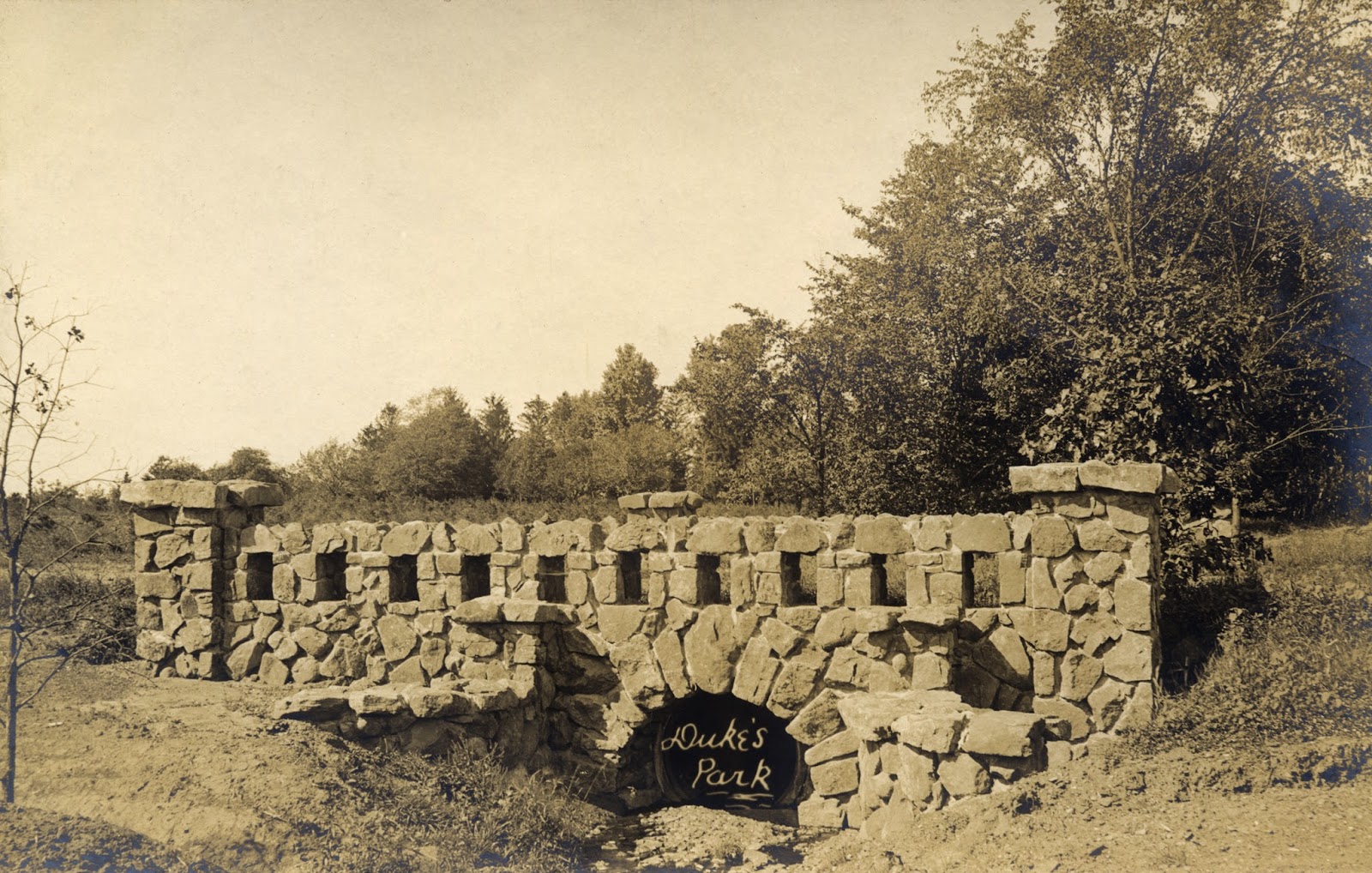
Old postcards are not only a great resource for discovering what Duke Farms looked like a century ago, but can also reveal long forgotten names of lanes, and bridges, and bodies of water at J.B. Duke's "Duke's Park".

Lover's Lane at Duke's Park, postcard circa 1907

I previously took note of "Hoo Doo Bridge" on Habitat Lane - but a study of the postcards in my personal collection provides us with "Swan Falls", "Woodville Falls", "Silver Cascades", "Shady Nook Drive", "Willow Lake", and other disused monikers.  This week, we have the practically unchanged view facing west on Overlook Way, formerly named "Lover's Lane" - at least at the time the original postcard view was printed in 1907.


Overlook Way at Duke Farms. April 1915

18 July 2015

Great Falls, Then and Now

Although the connected lake system at Duke Farms isn't functioning today as it did over 100 years ago when first conceived and built by James B. Duke, the Great Falls are operational and flow at least a couple of times each day.


Great Falls postcard circa 1915

Great Falls at Duke Farms, May 2015

11 July 2015

Conservation Lane Bridge,Then and Now

I am not sure what the stone bridge to the east of the Farm Barn at Duke Farms is called, but I'm calling it the Conservation Lane Bridge. 


Conservation Lane Bridge, postcard circa 1905

Yes, this is the first photo in this series where I've been foiled by sticking to my game plan of not venturing off the paths and into the brush to get the shot. So this one is from a different angle, but you get the idea.


Conservation Lane Bridge at Duke Farms April 2015
The bridge is still in very good condition well over a century since its construction - still, I wish Duke Farms would do more to preserve these beautiful structures.

04 July 2015

Vista Lake Fountains, Then and Now

Fountains of all kinds were a major attraction at Duke Farms a century ago when the Hillsborough, New Jersey estate of tobacco tycoon James B. Duke was still popularly known as Duke's Park. So important were the water displays that Duke wouldn't even consider having the grounds open to the public unless all of the fountains and falls were operational. 


Vista Lake Fountains, postcard circa 1915

It was eventually decided that the park would only be open to the public on Tuesdays and Fridays. The stated reason for the reduction was the unruly behavior of some guests, but it was also noted that the fountains would only be active while the park was open - no doubt saving a great deal of money.


New Brunswick Daily Home News, May 31, 1910

New Brunswick Daily Home News, September 19, 1910
If you take a walk on Fox Hollow Lane along the lower drive around Vista Lake you may still imagine the sight of the magnificent fountains with the overflow cascading down over the stone embankment. No wonder the editor of the New Brunswick Daily Home News decried the lack of access to the working people of central New Jersey!


The view from Fox Hollow Lane across Vista Lake at Duke Farms, April 2015

27 June 2015

Great Falls Lake Bridge, Then and Now

The next time you are hiking at Duke Farms, begin near Great Falls and follow Fox Hollow Lane until you come to this view of Great Falls Lake Bridge. Still impressive almost 100 years later.
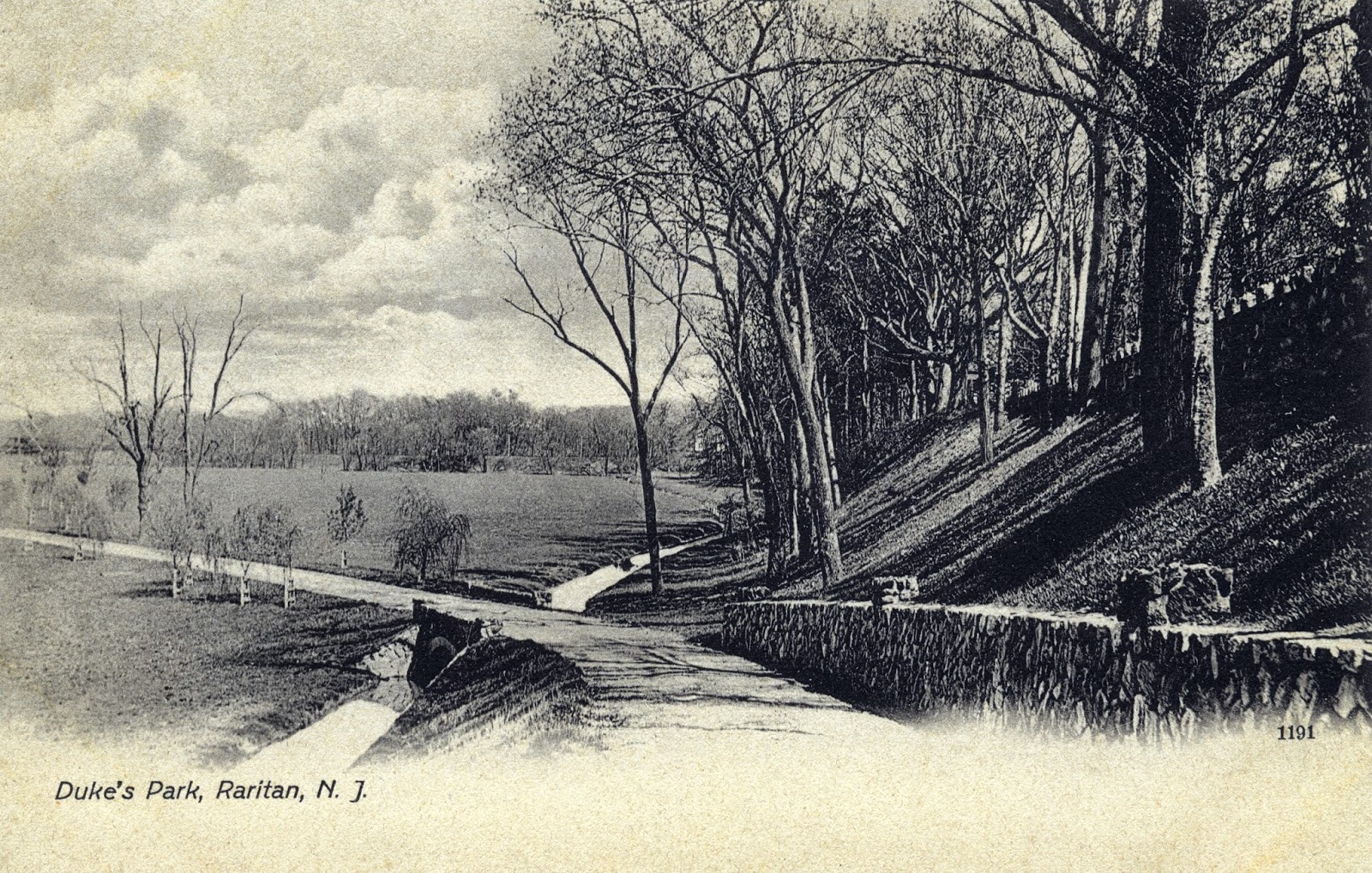

A view of Great Falls Lake Bridge from Fox Hollow Lane, postcard circa 1923

The lower drive around the lake must have been a favorite of James B. Duke and his wife Nanaline. They can be seen alighting from their coach near the underpass of the bridge in the second scene shown in the excerpts of Doris Duke's home movies. Take a look.


And here is the bridge today.

A view of Great Falls Lake Bridge from Fox Hollow Lane, May 2015

20 June 2015

Hoo Doo Bridge, Then and Now

Hoo Doo? Who knew? The bridge on Habitiat Lane over the small creek is Hoo Doo Bridge - at least according to the circa 1906 postcard below.  You can clearly see from the postcard how the estate was carefully landscaped at one time, and how much of it was left to grow in naturally over the years.


Hoo Doo Bridge postcard circa 1906

Hoo Doo Bridge at Duke Farms, April 2015

18 June 2015

"Yard" Sale at Belle Mead General Depot, 1946

Now that yard sale season is in full swing in Hillsborough, N.J., let's take a look back at what was likely the largest cash and carry outdoor sale in our history.


After the end of World War II, the War Assets Administration was given the task of disposing of millions of dollars worth of surplus goods, machinery, vehicles, etc.


Returning veterans were given the first chance to get their hands on unneeded clothing, household equipment, office supplies, farm equipment, hardware, and all the rest.


All of these ads appeared in the Brooklyn Daily Eagle in December 1946 and January 1947.


16 June 2015

Wedding Day at Duke Farms, 1915

Today, June 16, 2015, marks the 100th anniversary of what is likely the most lavish event ever hosted at Duke Farms in Hillsborough, New Jersey. The occasion was the wedding of J.B. Duke's favorite niece, Mary L. Duke, to Anthony Joseph Drexel Biddle, Jr. of Philadelphia. As most contemporary newspaper accounts noted, the marriage completed a unique union between two great families of New York and Philadelphia society, as the bride's brother was wedded to the groom's sister two months previously.

Mary L. Duke and A.J. Drexel Biddle. Jr. and their attendants
 in front of the residence at Duke Farms, June 16, 1915


To accommodate the 600 attendees, a special platform topped with a spectacular blue and white awning was built along the South Branch Railroad which transected the Duke Estate. Guests arriving from New York and Philadelphia on private rail cars were dispatched through Somerville and right to the platform in the heart of Duke Farms, where automobiles were waiting to take them to Duke's country manor at the northern end of the property.

Duke-Biddle wedding invitation, 1915

J.B. Duke spared no expense getting his estate ready for the grand occasion. It was said that he spent two weeks personally overseeing every aspect of the preparations. 


Postcard view of the Duke residence circa 1913

The ceremony, performed by Bishop Darlington, began at 5 p.m. in the Palm Room. This is how it was described by The New York Times:

The ceremony was performed in the palm room, which had a vaulted ceiling and a mezzanine gallery. This room, in the centre of the house, with a wide entrance hall leading to the porte cochere, was transformed into a chapel of flowers. The multi-paned windows, soft lights, and the tones of an organ gave the place the atmosphere of a chapel in the woods, for the boughs of the trees waved in the breeze close to the open windows, and from afar was heard the splash of many fountains.
An aisle was formed with high gilt standards, topped with great masses of peonies of roses, and connected with white satin ribbons. The bridal party, entering from the front entrance, passed up the aisle to a chancel of flowers, while the guests stood grouped close together on either side. [I should think so, I have been in those rooms, and they don't hold 600!] In fact, the capacity of the palm room was over-taxed, and there were guests in the mezzanine gallery. Outside the high windows, looking down from the second-story roof, were assembled many of the servants and employees on the estate.

Wow!

The Palm Room at the Duke residence in Hillsborough, New Jersey,
from a newspaper story circa 1911 

Newspaper stories were sure to describe the gowns, jewels, and flowers worn and carried by the wedding party and their guests. Suffice it to say that they are exactly what you would expect from a wedding where the gifts to the bride amounted to about $7 million in 2015 dollars, and Mr. Drexel Biddle, Sr. presented Mr. Drexel Biddle, Jr. a check for $200,000 (about $4.5 million today). 

The bridal party at dinner, 27 June 1915 New York Times


After the ceremony, guests adjourned to the lawn to congratulate the newlyweds and partake in refreshments. Special trains for New York and Philadelphia departed at 7:30, but many of the younger guests remained, dancing and partying as the orchestra played into the evening.

Doris Duke, not yet three years old, performed her flower girl duties
 in a white lace frock with a pink sash.

Pure conjecture on my part, but the Biddle-Duke wedding of 1915 may have been something of a test run for the event that was sure to have eclipsed it in every way - the eventual wedding of J.B. Duke's daughter Doris. The heiress who served as flower-girl for her older cousin was not yet three in 1915 and tragically was just twelve when her father died in 1925.

27 June 1915 New York Times

15 June 2015

No More Kings?

Today, June 15, 2015, marks the 800th anniversary of the signing of the Magna Carta at Runnymede, England. King John agreed that no man, not even the king, was above the law. The ideas about liberty in this document are what separate English-speaking people from the rest of the world, and from where American Exceptionalism is ultimately derived.

The Magna Carta is presented to King John at Runnymede, June 15, 2015
Now that we are almost as removed from the 1620 Mayflower Pilgrims as they were from the English barons who confronted King John, let's remember that unlike the tagline of "No More Kings" - the Schoolhouse Rock song from our Saturday-morning youth - "we're going to elect a president, he's going to do what the people say", the expulsion of the king and the election of a president is not what protects the people from tyranny.


Colonists lived in America for 150 years as Englishmen with the rights, privileges, and liberty - even under the sovereign - as other Englishmen. When new rules were made for them, and they found they did not enjoy the same representation as their forebears across the pond, they reacted to the tyranny, and the revolution was begun.

Two decades later, the Constitution - an improvement on the Magna Carta as it guarantees the liberty of all citizens, not just feudal barons - was adopted. The checks and balances therein were acknowledgements by the founders that all governments, even duly elected ones, could become tyrannical over time.

We see this around the world all the time when despotic rulers tout their "free elections", with no constitution guaranteeing any real freedoms at all!

On this day, we should look to our Constitution's Ninth Amendment, and remember the "other" rights and the Magna Carta:

 "The enumeration in the Constitution, of certain rights, shall not be construed to deny or disparage others retained by the people."

13 June 2015

Overlook Way "Summer House", Then and Now

A summer house is a place to enjoy a cool respite on a warm day.  The one at Duke Farms along Overlook Way delivers just that - and even provided refreshment in the form of well water when it first came into use at J.B. Duke's Hillsborough estate over a century ago.


Summer House at Duke's Park, postcard circa 1906


The well-preserved well house is one of many still standing at Duke Farms, although most are located outside the "historic core" of the property.  Stop by and escape the sun next time you are at the Farms.


Summer House on Overlook Way at Duke Farms, April 2015

11 June 2015

Marian Hulse Fenwick, 1930-2015

"I know where all the bodies are buried!" This is the euphemistic - and characteristically New Jersey - answer given to me by former Hillsborough Township mayor Marian Fenwick on more than one occasion when I asked her how she could be both loved and reviled equally by each of the local political parties in a town she once described as the most bitterly partisan in Somerset County. This answer was invariably prefaced by another favorite phrase, "you've got a lot to learn."

Marian Fenwick photographed on a site visit during her final stint on the
 Hillsborough Township Historic Preservation Commission, February 2010

I first met Marian - who passed away Monday, June 8, 2015, after a brief hospital stay just a week short of her 85th birthday - after my very first meeting as a member of the Hillsborough Township Historic Preservation Commission in 2006. Sitting in the audience that evening, she arose immediately after adjournment and came right up to me demanding to know what qualified me to sit on that commission. She was very amused upon hearing my boast that I had been a Hillsborough resident for 13 years.  She was 40 years ahead of me, having moved to Hillsborough as a newlywed from Cranbury in 1953. I think I spent the next nine years trying to convince her of my love for Hillsborough and Hillsborough's history.


Marian Fenwick, seated left, with members and officials 
of the 1971 Hillsborough Twp. Board of Education.
Mrs. Fenwick served on the school board
during the construction of the high school which opened in 1969.

We got to know each other better through our mutual interest in the change of government movement that took place in 2006 and 2007, and in the subsequent Charter Study Commission of which Marian's son, the late George Fenwick, was a member. For most Hillsborough voters, changing the form of government was a novel, if not ultimately well-received, notion. For Marian, who was a resident during the first vote to change government forms back in August 1953 - also defeated - this was old news.


In 1969, Marian Fenwick became the first woman elected to the township committee,
 and was chosen as the first female mayor in January 1972.

In 2007, during my first run for the school board, I was surprised and delighted to arrive at a campaign meeting one evening to find her already there ready to get to work. With Hillsborough's first woman mayor on our side, we were sure to sweep to victory. I soon found out that Marian's term on the township committee, 1970-1972, overlapped with one of her two terms on the school board, making her the only township official to serve concurrently in the posts - a practice that was eventually outlawed.


January 1966


When the polls closed on election night in 2007, and it appeared that I was hanging on to victory by a slim 13 vote margin, Marian encouraged me to be present when the provisional ballots were counted later in the week. I found out later that she had lost her first bid for the school board as a write-in candidate 42 years previously by 39 votes - an outcome that she contested due to "voting irregularities".

3 January 1972 Courier News

One of Marian's proudest moments in her public life was to have been an elected official during Hillsborough's bicentennial celebration in May 1971. For Marian, the preservation of the history of Hillsborough was of the utmost importance - she had no use for longtime residents who couldn't tell you where Clover Hill was located, or on which corner you could have found Woods Tavern. She was a founding member of the Hillsborough Historical Society, and later the Friends of the Van der Veer - Harris House - a non-profit working with Somerset County to restore the notable 18th-century township-owned house on Route 206.


The Van der Veer - Harris house was listed on the National Register of Historic Places in 2008

A regular attendee at nearly every Historic Preservation Commission meeting during my first years on that commission, Marian was appointed to a seat in 2009. The next year, I was pleased to work with her on the research for the plaque erected by Larken Associates at the site of the old Woods Tavern (on the Northwest corner of Route 206 and Amwell Road!)

Marian, center, with the designers of the Woods Tavern commemorative plaque,
township officials, and longtime residents, July 2011

In more recent years, as Marian's ability to get around easily began to diminish, we became "phone pals". At some point a few years ago, my kids took to calling her my "other mother" - as in "your other mother called again and left another message". I think she liked that moniker! Like a mom, if I didn't call her back for a few days, she knew something was wrong. And she was always there to answer questions about Hillsborough history for my blog - or just to satisfy my curiosity.

A spiritual person who believed in a hereafter - in some form - there is no doubt that Marian is reading this right now. So just let me say this: Marian, I deeply regret not returning your phone call a couple of weeks ago, and therefore missing the fact that you were hospitalized. And I know what you're thinking: I still have a lot to learn.

07 June 2015

Welcome Readers, Welcome, Welcome!

"Welcome to the new Hillsborough Blog." I wrote those words June 7, 2007.

Eight years, nearly 800 posts, and about a quarter of a million page-views later, I am still welcoming new readers to "Gillette on Hillsborough".


Courier News, June 13, 2007
The Courier News began excerpting blog posts on their editorial page beginning with the one above about "Locks of Love" - my third post.

If you know anyone who would enjoy reading about Hillsborough, Somerset County, or Central New Jersey please invite them to follow the Gillette on Hillsborough Facebook Page by clicking on the link below.


Gillette on Hillsborough Facebook Page

06 June 2015

Below Overlook Way, Then and Now

The next time you hike or bike at Duke Farms, you may want to venture to the far northern end of the "historic core" - essentially the area of the property bounded by the deer fence.  A stroll along Overlook Way - also called Lover's Lane a century ago - affords views across the Riparian Wetland Conservation Area towards the Raritan River. 


The Drive below Overlook Way, postcard view circa 1906

Walking west, turn down the driveway on your right before you reach the Coach Barn and peer through the chain link fence.  Can you picture the scene above from the 1906 postcard? If you can't find it, I have photographed it for you, below.


The Drive below Overlook Way at Duke Farms, April 2015

The watercourse is still there. This was part of the lake system which took water from the lowest lake - Snake Lake, west of the residence - back to the Raritan River.  The stone bridge is still there too, but impossible to see clearly from this view - even in early spring.  I took a photo of the bridge looking down in the opposite direction from Overlook Way, which you can see below.


30 May 2015

Coach Barn and Stables, Then and Now

One building that hasn't changed much at Duke Farms is the Coach Barn. Completed in 1900, it was the first major building to be constructed on the property.  The building provided space for stables and coaches, as well as an office for J.B. Duke and his farm manager.


The Coach Barn and Stables at Duke's Park, postcard circa 1906


The Coach Barn is occasionally open to the public.  Murals depicting hunting scenes on four continents feature in the center court area, where you can also find Doris Duke's 1949 Cadillac.


Although the clock tower is kept free of ivy today that wasn't always the case. In fact, it would befun to try to date the postcard images by how high the ivy has crept, as in the above postcard from 1907 - which also gives us a view of the long lost Frog Fountain.


The Coach Barn at Duke Farms, April 2015

23 May 2015

West Way Well House, Then and Now

According to the Duke Farms web site, J.B. Duke constructed well houses at Duke's Park in two phases, the first beginning in 1903, then again in 1906.  Wells were dug, then surrounded by a variety of structures - it appears that no two well houses are alike.  Many are still standing today, including this imposing dome of stone arches along West Way near the North Gate.


West Way Well House from a circa 1915 postcard

The only way to capture this scene is to shoot it during the winter or early spring.  The grounds today are nothing like the manicured landscaping of a century ago!


West Way Well House, March 2015

16 May 2015

Otter Lake Falls, Then and Now

The falls from Vista Lake down to Otter Lake at Duke Farms was somewhat more impressive a century ago, don't you think?  For those keeping score, Vista Lake is 45 feet above the Raritan River, Otter Lake is 31.  Duke Reservoir, where J.B. Duke's lake system begins, is at 81 feet.


Otter Lake Falls Postcard circa 1908


Ring-Necked Ducks on Otter Lake, March 21, 2015


Otter Lake Falls, March 2015

13 May 2015

Train Collision at Belle Mead, 1950

Messrs. Cinque, Townsend, and Dempsey, engineer, fireman, and brakeman of  Jersey Central Railroad train number 697 were busy trying to make out the signals in the dense fog between Bound Brook and Belle Mead on the evening of October 2, 1950. Conley, the conductor, and Crane, the flagman, were riding in the caboose behind 95 fully loaded freight cars headed to Philadelphia. As they rolled past Manville on track 1 at 10:35 and Weston at 10:38, conditions were clearly worsening.


About a mile east of the Belle Mead tower, Cinque urged the engine forward past signal 142a and began to look keenly for the next signal at the interlocking near the station. Townsend, too, searched in vain, and then Dempsey applied the brakes.

As soon as he felt the brakes, Crane threw a flare from the back of the caboose, and then jumped off, flag in hand, to protect the rear of the train.  The train was stopped while the gentlemen in the engine tried to see the signal that would allow them to move.


After 8 minutes the engineer recalled Crane, indicating he was ready to proceed. The flagman threw another caution flare, then hopped back aboard as the train increased speed.

After moving a few car lengths at a speed of about 12 mph, engineer Cinque was able to see the medium-clear signal indicating that, according to Reading's incident report, "the track was lined for movement of train from track no. 1 to track no. 3."


It was at that moment that conductor Conley and flagman Crane observed Reading train number 29 approaching fast from the rear.


Conley and Crane dove from the caboose just before impact, as had engineer W.R. Davis and fireman J.R. Byrne from the Reading engine moments after seeing the red flare and applying emergency braking.


It wasn't enough to stop the speeding Reading train, "deadheading" back to Philadelphia with just one passenger and one baggage car at 50 mph.


As you can see from the photos taken the next morning (from my personal collection), the impact was terrific. The CNJ caboose was completely destroyed, as were the two refrigerated cars just in front.  


The engine of the Reading train sustained $15,000 in damages, which would be almost $150,000 today.


The injured railroad employees were taken to Somerset Hospital in Somerville - amazingly the injuries were only minor.


Everything was put to rights within days of the accident. In fact, by virtue of the collision taking place in an area served by four sets of tracks, commuter service to New York and Philadelphia was able to resume the next morning utilizing track number 4 only.


According to the Hopewell Herald, the contents of the two refrigerated cars in the rear were scattered across the tracks. If you've read this far, take a guess what was in those cars.  It's a common item found in the produce aisle. Leave a message here or on the Gillette on Hillsborough Facebook page.