05 November 2020

Adams Air Park (1956 - 1967)

A search for the term "skydiving" on the newspaper archive website Newspapers.com yields just 68 hits for the year 1956 - the same year William C. Adams bought the initial 38 acres in Hillsborough and East Amwell Townships to develop a small airport to be known as Adams Air Park. By 1967 - the year Adams sold the property - that same search delivers a whopping 4,712 results!
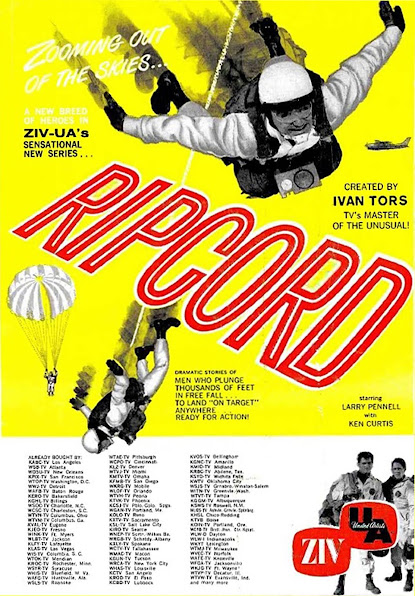

Ad for the 1961-1963 TV series Ripcord

It is not known if the 36-year-old former fighter pilot and New York native had parachutists in mind when he laid out the runway and had an artificial lake dug at the foot of the Sourlands south of Wertsville Road - but the sporting daredevils eventually found him.


1963 aerial view of Adams Air Park - 
look carefully near the top of the image to see the airplanes.

In its first few years of operation, Adams Air Park seems to have catered to recreational fliers/airplane enthusiasts. World War II veteran Adams - who after the war was a professor at Horace Mann School for Boys - hosted Civil Air Patrol cadets at the airfield in October 1957 for an overnight campout including training and rescue missions.


20 October 1957 New York Daily News - 
William C. Adams is on the far left

International competition in the sport of skydiving had been taking place since the mid-1950s but the adrenaline-inducing sport didn't take off as a recreational activity in the United States until the early 60s. Excitement for the sport spawned a popular 1961-63 television series called Ripcord - and even led to a plotline in a Frankie and Annette "beach movie" - 1965's Beach Blanket Bingo.


West Point graduate Captain George Gividen  - a paratrooper who lost his left leg to a grenade while serving in Korea - began skydiving on the weekends after he retired from the Army in 1960. Before long he formed the Tri-State Skydivers and began operating the Tri-State Parachute Center out of Adams Air Park.

5 April 1963 Oakland Tribune

Between 1961 and 1965 skydiving competitions and exhibitions were regular features at Adams Air Park. Tri-State boasted 218 members in 1962 - eighteen of which were women. It wasn't always fun. Local newspapers regularly featured headlines such as "'Chutist Plummets 7,200 Feet, Lives", and "Chute Fails, Skydiver Hurt". During a Civil Defense exercise in 1962, a parachutist drifted off course and landed in a Hillsborough farmer's field. He was fined $10 for trespassing!


4 June 1962 Bergen Record


A June 1963 competition which attracted 200 contestants was said to be the largest US skydiving meet up to that time. An exhibition by the US women's parachute team that August featured a stunt where the women unfastened their parachutes while still airborne and dropped into the lake below.


27 June 1963 Ridgewood Herald News


The airport - including what then amounted to 352 acres of land - was sold by Adams in 1967. In the years that followed the property was used for various other purposes such as horse shows, and for a time the lakefront was a well-known illicit nude beach!

On October 26, 2020, the New Jersey Conservation Foundation purchased the property and added it to adjoining land in Somerset and Hunterdon Counties to create a 1,150-acre nature preserve. 

31 October 2020

Dine-Out Thanksgiving - 1930s, 40s, and 50s

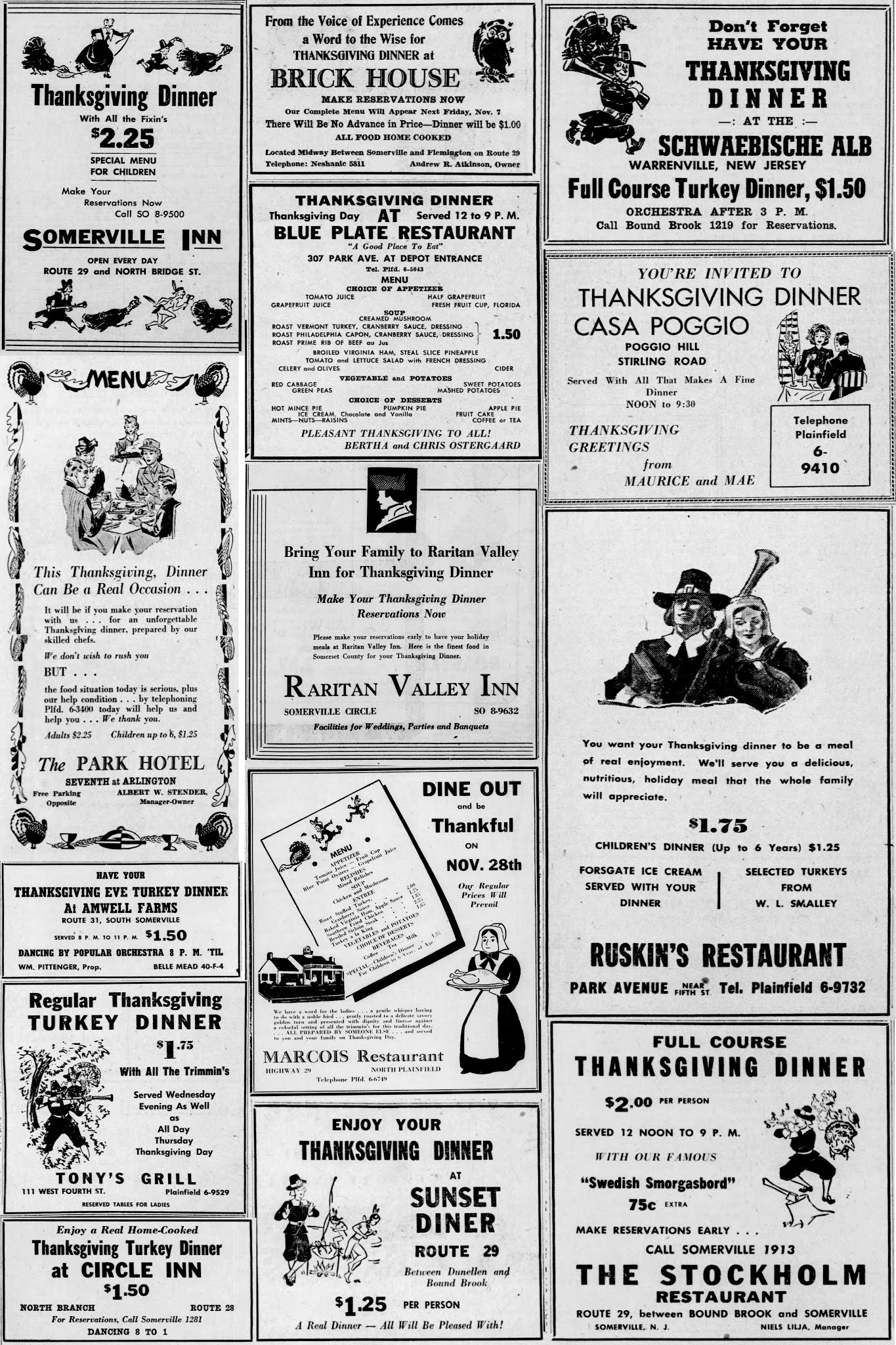
Are you preparing the feast at home this Thanksgiving? How quaint! The modern family leaves the brining and basting to the professionals - or at least you might think so after taking a look at these area newspaper ads from the 1930s, 1940s, 1950s, and beyond.

1930s newspaper advertisements

In the 1930s a full Thanksgiving dinner could be had at even the classiest establishments such as the Park Hotel for just $1.50. The best bargain didn't even entail leaving town, as the Three Towers offered a De Luxe Turkey Dinner for only a buck!

1940s newspaper advertisements


I love the graphics in the above ads from the 1940s - how can you go wrong with turkeys and pilgrims? Plainfield's Park Hotel ad from 1943 includes a family member possibly on leave from their military service - a female no less - enjoying Thanksgiving. The best places had raised their prices to $2 or more, but it was still possible to get a $1 dinner at the Brick House on Route 29 (today's Route 202).


1950s newspaper advertisements


I'll have to admit I never thought of Howard Johnson's for Thanksgiving - but in 1958, why not? The Town and Country Inn (the former Three Towers) offered a BYOT - Bring Your Own Turkey - service, but if you wanted to carve, please be sure to bring your own knives too! By the end of the decade, many restaurants had stopped advertising their prices - but the popular Somerville Inn was proud to boast of their $2.25 dinner in 1958 (kids half price).

I cheated on two of the ads above - the Amwell Farms Inn ad is from 1967 and Duke's Farm Inn (the former Town and Country) is from 1971. Still a pretty good bargain at $4.95!


13 October 2020

The Somerville Academy

On July 4th, 1801, in observance of Independence Day, some number of men from Somerset County gathered in Somerville to celebrate. Among them was Colonel Peter D. Vroom of Hillsborough and his nine-year-old son of the same name. The festivities of the day included public speeches - including one on the discovery of America given by the son of J.R. Hardenburgh, Esq. and one on the death of George Washington by young Peter.

Plan of Somerville showing the location of the Academy.
From the 1850 map of Somerset County


Colonel Vroom, who had served under Washington during the Revolution, was no doubt moved by his son's tribute to America's first president - but he was bothered by something. After the orations were complete, the men adjourned to the local hotel and the subject of education came up. Vroom and many of the others had sons between eight and twelve who were bright and would need to be educated beyond the log cabin schoolhouses of the rural county. They decided that day to establish a classical school - one where Latin and Greek, as well as the usual academic subjects, would be taught in preparation for a college career. On July 18th the group met again and adopted a constitution. Abraham Messler describes it in his book, "First Things in Old Somerset":

"[On] the eighteenth of July, at another meeting, a constitution was adopted, which provided for the erection of a building and the organization of an association aiding in its support and patronage. The preamble recites that 'whereas, an attempt made by the inhabitants of Somerville and vicinity, to raise by subscription in shares of ten dollars each, a sum sufficient to erect a suitable building for a classical school, had succeeded so far as to warrant the commencement of such building; that, therefore, it had become necessary to form a constitution for the government of the said association. The first article fixes its name as "The Proprietors of the Academy of Somerville", and defines it as an institution expressly set apart for the instruction of youth in the learned languages, the English, the arts and sciences, and public speaking.'"


At their December 1801 meeting, they fixed the price of tuition at $4 per quarter and authorized an additional $50 to attract a teacher. By March of the next year, the school building was nearly complete and the school had hired its first teacher, an Irishman by the name of Luca George.

Newspaper ads for the Somerville Academy from 1811, 1824, and 1833.

The only other "high school" in the area was the academy at Basking Ridge (known today as the Brick Academy). The school building was located on the west side of North Bridge Street (then called Jersey Street) between Main Street and High Street. Many scholars attended the school in the more than 50 years of its existence, including that nine-year-old boy - Peter Dumont Vroom - who grew up to be governor of New Jersey.

The school was discontinued in 1855 and the property sold to prominent landholder S.S. Hartwell.

23 September 2020

Five Iron Bridges of Hillsborough

Hillsborough Township, NJ might not be an island, but you wouldn't be able to tell that from the abundance of bridges required for autoists to escape the city limits. Bridges in Somerset County were mostly made of timber and stone until the first iron bridge was installed at Weston in 1872. Hillsborough's four - technically five - remaining iron road bridges were built between 1886 and 1902.


Nevius Street Bridge

On November 17, 1886, the Somerset County Freeholders accepted the Nevius Street Bridge as complete from the Wrought Iron Bridge Company of Canton, Ohio.   According to the National Register of Historic Places nomination form, Somerset County's oldest remaining iron bridge is a "two-span, 10-panel, double-intersection Pratt. pin-connected, through-truss bridge of either steel or iron approximately 300 feet long, 18 feet wide, and 23 feet high."

The Nevius Street Bridge circa 1912.
Note the 6-ton weight limit sign.

The iron bridge replaced an earlier wooden bridge spanning the Raritan River between Raritan Boro and Hillsborough that dated from 1846. Motorists who remember faring for the safety of their side-view mirrors before the bridge was designated as one lane can blame local residents who petitioned for a last-minute change to the design increasing the width from 16 to 18 feet! A width of 16 feet would have pretty much eliminated any possibility of two-direction travel in the modern era.

Nevius Street Bridge circa 1989


The Higginsville Road Bridges

Bridges two and three of our survey carry Higginsville Road across the South Branch of the Raritan River - both the main channel and a smaller channel that served as a mill race - in the Hillsborough Township village of Higginsville. The two bridges are similar in that each is of a Pratt metal through-truss design and they are each 100 feet long, 16 feet wide - but they are from different manufacturers and constructed on different dates.


Higginsville Road Bridges circa 1999

The bridge over the main channel, constructed in 1890, is a rare surviving example of a bridge by Milliken Brothers of Brooklyn, New York. Somerset County originally contended that because the river had two channels in this location, the bridge over the main channel was wholly the responsibility of Hunterdon County. It took a judge to decide that both channels of the South Branch - because they never were more than 500 feet apart - constituted one waterway and that both counties were responsible for both bridges.


In 1893 the Freeholders of both counties met to discuss what to do about the deteriorating 88-foot wooden bridge spanning the minor channel. After some resistance from the Somerset delegation, it was agreed to construct another 100-foot long, 16-foot wide Pratt through-truss bridge as a replacement. The contract was awarded to the Wrought Iron Bridge Company of Canton, Ohio - a company that had already built several other bridges in Somerset County including in North Plainfield, Somerville, Rocky Hill, and Raritan Boro. The only one of these bridges which survives today, besides the Higginsville Bridge,  is the Nevius Street Bridge described above.


Elm Street Bridge


One of the most recognizable bridges in Hillsborough is one of the six structures that constitute the Neshanic Mills Historic District - the Elm Street Bridge. Unlike Hillsborough's other iron bridges, the Elm Street Bridge is not a Pratt through-truss bridge but rather a lenticular truss bridge. 

The Elm Street Bridge circa 1980

After the devastating 1896 flood destroyed nearly every bridge on the South Branch and the main stem of the Raritan River between Neshanic and Bound Brook, Somerset County Freeholders had their hands full. The contract for the Elm Street Bridge was awarded to the Berlin Iron Bridge Company of East Berlin, Connecticut. Each of the two spans of the bridge is 140 feet long, and the roadway is seventeen and a half feet in width.

The Elm Street Bridge circa 1989


Woodfern Road Bridge

Our final bridge carries Woodfern Road over the South Branch of the Raritan River between Hillsborough and Branchburg. Like most of the others, it is a two-span Pratt through-truss bridge with an earth-filled stone pier in the middle.

Woodfern Road Bridge circa 1989

The bridge was constructed by J.W. Scott of Flemington in 1902 and is 187 feet long with a roadway width of 15.4 feet. This early 20th-century bridge was rehabilitated most recently in the 21st century and looks great today.

Woodfern Road Bridge builder's plaque

16 September 2020

The Great Train Hold-Up (1910)

On Saturday afternoon, April 30, 1910, excited passengers tumbled out of the cars of the Lehigh Valley Railroad's Buffalo express train as it made its scheduled 3:45 p.m. stop in South Plainfield. They hurried to the station agent eager to share what they had just witnessed as the train passed Flagtown - the greatest and most daring train hold-up in Hillsborough, and possibly New Jersey, history!


The South Branch Railroad - a division of the Central Railroad of New Jersey also called the Flemington Branch - runs parallel to the Lehigh Valley Railroad's mainline in the vicinity of Flagtown affording the Lehigh Valley travelers a view of the stopped locomotive and the South Branch passengers lined up outside the coaches as armed bandits, some on horses, held them at gunpoint and went through their belongings.


The daring caper had been planned long in advance, you might even say it was well-scripted. The bandits arrived at the scene early, riding through the Hillsborough woods before dismounting at a small clearing. Their leader described the plan. Disguised as a railroad flagman, he would go out onto the tracks with a red flag and stop the train between Flagtown and Neshanic. Once the train was stopped he would approach the engineer's cab with revolver drawn.


Another of the gang held the conductor at gunpoint while three bandits headed for the coaches. The panicked passengers dove under their seats and screamed for help, but to no avail. One passenger, E.J. Sanborn, was shot through the arm as he leaped at a robber in a desperate attempt to disarm him. Things seemed to be going well for the gang until they made their way to the first passenger car. 


2 May 1910 Courier News


It was here that the outlaws ran into two visitors from Virginia - F.J. Halley and R.J. Wilson - who were packing pistols of their own and returned fire. It was just then that the Buffalo express was passing on the Lehigh tracks in time to see some of the passengers from the second and third coaches of the South Branch train - who had been lined up alongside the tracks - realize they had their own firearms tucked into their belts. A general melee ensued. Mr. Wiley who had been guarding the safe in the express car jumped from the car and was met with a shower of bullets, but managed to get off a couple of good shot s dropping one of the desperados, then another.


There's more to the story - including how the bandits were eventually captured with the help of the two small children of the Flagtown station agent. But it is unlikely any of those scenes took place in Hillsborough. What those passengers on the Lehigh Valley Buffalo express actually witnessed that April day in 1910 was the filming of the train scenes for one of the first American features produced by the Pathe Freres film company - The Great Train Hold-Up.

23 May 1910 Daily Gate City

Pathe Freres actually opened a large film processing facility in Bound Brook, NJ in 1907, but it wasn't until 1910 that they entered the American market with narrative films of their own. Scenes filmed around the Flagtown train station were shown in some theaters independently of the full movie in May 1910, with the entire film - all 950 feet of it - being released later on June 25.

18 June 1910, The Film Journal

Although the film was a sensation upon release and was well-received by critics, it appears to have never been re-released and may exist now only in the hands of collectors. The first two images in this story are from the film, the third is possibly from the film. Other than those few images and the descriptions of the action from industry trade journals nothing seems to be left from The Great Train Hold-Up of Hillsborough!

11 September 2020

Anna Case Is Made, Part 2

On May 4, 1909, Giulio Gatti-Casazza and Andreas Dippel - the co-managers of the New York Metropolitan Opera - sailed for Europe on their annual talent search. Before they left, the pair announced the singers they had already signed for the new season beginning in November, including the only singer up to that time who had not trained in Europe - a twenty-one-year-old soprano from South Branch, New Jersey named Anna Case.

25 May 1909, Butte Miner

Although she had been singing professionally full-time for just over two years - and had been making a reputation as a unique talent at least since her July 4, 1908 appearance at the famous Ocean Grove Auditorium - this was the first time the national public had heard the name Anna Case.

12 May 1909 St. Louis Post-Dispatch

Aside from being the first Metropolitan Opera singer with no European training, other now-familiar elements of Anna Case's story were promulgated by the press in those first weeks and months after Herr Dippel's announcement. Much was made of the fact that her father Peter Case was the village blacksmith at South Branch and that his daughter helped him in his shop, even shoeing horses on occasion.

The blacksmith shop of Peter Case from a circa 1907 postcard.
The house Anna Case grew up in is on the right.

Before long, syndicated feature stories began to appear in the pages of newspapers across the country. Although most got the circumstances of the chance meeting between Director Dippel and the budding singer wrong - they met at her performance at Philadelphia's Bellevue-Stratford Hotel, not at a church in Plainfield - other parts of her story came to light. Readers were fascinated by the story of the early life of Anna Case - how she scrubbed floors and worked in the kitchens of her neighbors, sold soap door-to-door, drove a hansom cab for fares to and from the local train stations, and gave piano lessons for children in the evenings - a revolver tucked into her belt for protection on the country roads.

30 May 1909, St. Louis Post Dispatch

In the first few years of her career with the opera, more aspects of the beginnings of Anna Case were revealed - how she borrowed seventy-five cents a week from the South Branch grocer so that she could take singing lessons from a Somerville music teacher, how she got a job playing the organ and leading the choir at the Neshanic Reformed Church, and then a job singing in the quartet at the First Presbyterian Church in Plainfield.

5 December 1909, San Francisco Examiner

By the time she agreed to meet a photographer on the roof of one of the big newspaper buildings in New York to have her photo taken holding a blacksmith's hammer, the story of Anna Case was already well known. It's not unusual or surprising that the press - and the Metropolitan Opera - would engage in myth-building - in later years they managed to shave first one, then two years from her age in order to promote an ever-youthful prima donna. What is surprising is that in the case of Miss Case the stories were essentially true. 

22 December 1912, Buffalo Sunday Morning News

Unlike other New Jersey celebrities, past and present, whose connection to our state became more tenuous the more famous they became, Anna Case belongs to that group which includes Frankie Valli and Bruce Springsteen - singers for whom the New Jersey of their youth became an essential element of their larger-than-life stories. 

25 August 1931, Brooklyn Standard-Union

But it wasn't only Anna Case's story which remained inextricably linked to New Jersey throughout her lifetime, but also Anna Case herself. After the death of her father in the 1920s, she repurchased her childhood home in South Branch and remodeled it as a home for her mother. After her mother's passing, Anna Case kept the home as a country retreat before gifting it to the South Branch Reformed Church in 1974 at the age of 86.

22 August 1957, Courier News


05 September 2020

Burlington Zephyr Breaks Speed Record, April 17, 1934

In 1933, as cheap intercity bus routes chipped away at railroad revenues, the Chicago, Burlington, and Quincy Railroad commissioned a new kind of train to compete against the bus companies. The Zephyr was the first streamlined stainless steel diesel-electric train and ushered in a new era of high-speed railway travel.


The three-car 72-passenger train made its debut speed run on April 17, 1934, in central New Jersey, clocking in at 104 mph on a straight stretch of road between Hopewell and Skillman. Passengers commented that the ride was so smooth - even in 90 mph curves - that they couldn't tell the difference between 70 and 100.


How did they do it? A 600 horsepower diesel-electric plant, reduced weight, and fewer than half of the wheels of a similar-sized locomotive all contributed to the increased speed. The train was so light that it could be easily pulled by ten men!


The newspaper photo above appeared in the April 20, 1934 edition of the Paducah Sun Democrat and pictures the Zephyr at Weston Station on April 17, 1934, after its record-breaking run. The train toured up and down the east coast before heading out west where it proceeded to break the Denver to Chicago speed record.

The video below includes scenes from the week of the Zephyr's debut, including fascinating footage of the record-breaking run through Somerset County - officially clocked at 104mph. Unfortunately, these scenes are outtakes, the original newsreel footage apparently being lost.


26 August 2020

Three Stone Bridges of Hillsborough

According to the National Park Service, Hillsborough Township's early 19th-century stone bridges included on the National Register of Historic Places are two of just twenty such bridges still standing in Somerset County. I would propose that we might add a third, later bridge to that list. 

Cat Tail Brook Bridge - Montgomery Road

The Cat Tail Brook Bridge - spanning the stream of the same name on Montgomery Road - is Hillsborough's oldest document stone bridge. The single-span arch bridge was constructed in 1825 by B.J. Gray, supervised by Mssrs. Stryker and Cruser, and assisted by stonemasons John Rowland Jr. and Thomas Stout.

Cat Tail Brook Bridge, 2009

The thirty-foot long bridge is made of local fieldstone. The arch - with a ten-foot span - is made of quarried stone. The bridge can not be called elegant, but the simple fact of its nearly 200-year service to the community attests to the workmanship of the builders.

Cat Tail Brook Bridge cornerstone


Rock Brook Bridge - Long Hill Road

The Rock Brook Bridge is so similar in construction method and materials to other bridges in the immediate area - notably the 1822 Opposum Road Bridge in Montgomery Township - that we can comfortably ascribe a circa 1825 date to this important span.

Rock Brook Bridge, 2020

Originally possessing three arches, an 1891 torrential rainfall washed out the third span. It was quickly reconstructed as an open span, necessitating some new stonework at the center arch and the east abutment. The original stone walls have also been replaced by modern guardrails. Despite these changes, the 41-foot long, 16-foot wide bridge retains its historic integrity and serves its purpose ably to this day.


Rock Brook Bridge, 2020


Hoepfner's Brook Bridge - Township Line Road

The Hoepfner's Brook Bridge on Township Line Road which spans a small tributary of the Millstone River dates to the late 19th-century. The bridge has not been researched and little is known about the circumstances of its construction.

Hoepfner's Brook Bridge looking north

Although its single 10-foot span and fieldstone construction make it visually similar to Cat Tail Brook Bridge, the use of brick for the arch sets it apart. Like the Rock Brook Bridge, a modern guardrail has been in place for a long time.

Hoepfner's Brook Bridge looking south


19 August 2020

Millstone River Bridge and Causeway

Of all the historic bridges in and around Hillsborough, perhaps none have been more important in the commerce and communication of the township than the series of bridges spanning the Millstone River in the village of the same name.

Millstone River Bridge circa 1905

When the first bridge was constructed - probably around 1725 - the Delaware and Raritan Canal was still more than 100 years in the future; the railroads after that. The most direct route to the market town of New Brunswick, and its port, was overland by wagon road. Throughout the 18th century, the farmers of Hillsborough depended on the road and the bridge to get their produce to market.


We don't know exactly what the bridge or bridges that existed in the 1700s looked like, but there are a few things we can say for certain. The bridge would have been wooden, and, the width of the river being too great for a single span, a stone pier would have been required midstream. 


The photo above of the late 19th-century version of the Millstone River Bridge gives a good idea of the configuration of the wooden bridges. We also know those earlier crossings were not in the location of today's bridge but rather just to the north - intersecting with what today is called North River Street.


Millstone River Bridge circa 1906

In 1901 the Somerset County Freeholders commissioned a new bridge at the same location. Originally envisioned as being two spans supported with a stone pier in the middle, the design was changed to a single-span iron bridge.


Millstone River Bridge circa 1908

Although referred to as the "Millstone Causeway", the pedestrian boardwalk was the only element other than the bridge itself that was elevated. The roadway between the river and the Delaware and Raritan Canal was at ground level across the meadows.

Millstone River Bridge and the flooded meadows - looking south, 1905

Flooding of the meadows - which may have only been a nuisance in the 18th and 19th centuries - was considered much more of a serious issue in the 20th. As the area became more developed, properties, especially the commercial and industrial businesses in East Millstone, became very valuable. Constant flooding - not just in Millstone but also in Weston and around Bound Brook - made it impossible for the local fire companies to reach East Millstone during an emergency.

An illustration of the proposed New Millstone Causeway
by Oscar Smith, Jr., County Engineer

It was said that any measurable amount of rain would flood the roadway. This was not such a problem in the days of horses and carriages which could navigate a little water, but in the age of the automobile, it was a disaster. In the 1920s, busses would regularly unload their passengers at one end of the boardwalk and have them walk across to a waiting bus at the other end to continue their commute. But ultimately it was a devastating fire in East Millstone - with fire companies from Manville, Somerville, and Bound Brook unable to reach the town - which led to the consideration of a completely new elevated causeway.

Construction of the New Millstone Causeway circa 1931

The original proposal called for the repaired and strengthened 1901 bridge to remain in place and connect to a new concrete causeway across the meadow. On the East Millstone side, Somerset County officials negotiated with the Pennsylvania Railroad - owners of the canal - over what to do about the canal bridge. These initial plans failed to address the centuries-old problem of the bridge not actually leading to Millstone River Road but rather to North River Street.

14 August 1931 Courier News

A solution was found with the county's acquisition of a small private road called "The Driftway". Never a public thoroughfare, the short street leading from North and South River Street to Millstone River Road became the perfect path for a brand new bridge and causeway. Plans were drawn up in 1929 and preliminary engineering work took about six months. The Courier News gave the statistics for the new bridge and causeway in an August 1931 story heralding the completion of the span:

The bridge is of three spans and is 135 feet long, made of concrete and steel. The causeway starts from the east end of the new bridge and extends for 665 feet, ending in a 300-foot fill connecting the road with the bridge over the Delaware and Raritan Canal in East Millstone. The centers of the 25 spans in the causeway are 27 feet apart. The roadway is 24 feet wide, and approximately 10 feet above the meadow.

A sidewalk, five feet, three inches wide extends along the northerly side of the highway for pedestrians. The piers under the causeway rest on piling, approximately 8,460 lineal feet being used, the piles reaching bedrock 19 feet below the surface. The causeway carries attractive sideway of ornamental concrete and is illuminated with cluster lights at the top of ornamental concrete pillars.

The Millstone Causeway underwent extensive reconstruction in 1998 and continues today as a vital link in Somerset County's 300-year-old transportation network.